
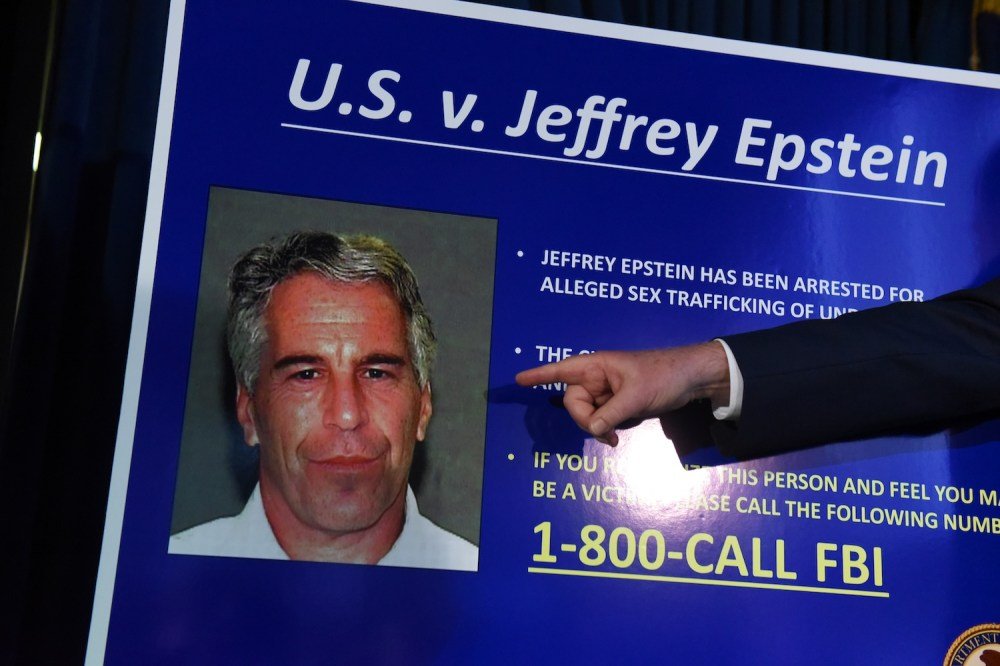
Jeffrey Epstein’s email and text correspondences—a huge batch of which the U.S. government released recently—illustrate just how deeply connected the convicted sex offender was to the international elite, in sectors spanning finance, politics, philanthropy, and academia.
Where did Epstein’s wealth come from? What sort of elite was Epstein a part of? Are elites inherently deformed in a moral or psychological sense?
Those are just a few of the questions that came up in my recent conversation with FP economics columnist Adam Tooze on the podcast we co-host, Ones and Tooze. What follows is an excerpt, edited for length and clarity. For the full conversation, look for Ones and Tooze wherever you get your podcasts. And check out Adam’s Substack newsletter.
Cameron Abadi: As far as we can tell, where exactly did Epstein’s wealth derive from?
Adam Tooze: He is really the classic American story—a kid whose dad was working class essentially, who himself didn’t complete college, and then just bluffed his way into math teaching at the Dalton School in New York City. And then when he was exposed there, he charmed his way into a job at Bear Stearns. And he was exposed at Bear Stearns as not having the degrees he claimed. And he just fronted up and said, “Yeah, well, you know, I thought if you’d actually seen my CV, you would have never given me the chance.” And they said, “Well, actually, you’re quite good at doing this, so carry on.” And he’s not finally booted out of there until these really egregious expense account manipulations are exposed where he’s basically buying presents for girlfriends.
And so he leaves there under a cloud, starts his own money management company, but he’s got serious high-level backing from the bigwigs at Bear Stearns. He falls in with some upper-class British family for a while, defrauds them a little bit, it seems. Comes back to New York, is a Hochstapler in the German sense, always playing it higher than where he’s actually at, and it works. So then he establishes some really posh offices, maybe defrauds somebody else of some property funds. And then he gets lucky because he, through his connections at Bear Stearns and in other places, begins to build associations with truly rich people, the Rockefellers, Les Wexner, and then Leon Black. And it’s in the management of their money, leveraged by way of his very serious connections to Bear Stearns and then ultimately to JP Morgan as well, that he really begins to accumulate serious amounts of money. And then he sets up a foundation, and then you’re in the foundation game because then you are a quote, quote, donor. And then you’re off to the races. So that’s how it seems to work. By the ’90s, he’s a genuinely wealthy person.
And by the 2000s he’s worth $500 million-plus. He is a fantastically wealthy guy, largely through skimming commissions. There may also have been blackmail involved. There’s huge payments from Leon Black, which are wreathed in litigation and so on. Leon Black is the Apollo guy. Les Wexner is Victoria’s Secret, Abercrombie & Fitch. So it’s private entrepreneurial money or private-equity, hedge fund-type money that he’s really dealing with. And you couldn’t get as much money as he accumulated as quickly as he did coming up from the floor at somewhere like Bear Stearns. He is accumulating by way of various types of personal money management relationships with non-institutionalized private wealth.
CA: What can we say about the composition of the elite that Epstein was a part of? What does it consist of?
AT: There’s a New York social, cultural, business scene, people like [President Donald] Trump. There was the moment of the Clinton presidency and the 1990s, which opened up, in a way, and Epstein immediately burrowed into and worked his way into the presence of [President] Bill [Clinton]. Then he seems to have gone after, I think you could quite fairly describe it as the kind of 2000s Davos set. So it’s people like Bill Gates and the starry names at Harvard and MIT of that period and Larry Summers, fresh from the Clinton Treasury. He didn’t necessarily update very quickly, so there’s a sense that by the 2010s everyone’s aging out a little bit. But nevertheless, he’s playing in that kind of group. And then I think once his reputation started building, you get the Sergey Brins, you get the Elon Musks all wanting in on the action that he’s able to provide.
And it seems as though he started building, you know, the empire of sexual exploitation—that has a history, too. It’s not like he did that all the time. Early on, there was some talk about inappropriate behavior at Dalton toward young women. But he was in his early 20s at the time. So the real sex trafficking network seems to have built up from the ’90s onward. And that then obviously changes the currency that he’s dealing in by the 2010s, because he’s able to offer—I mean, it’s quite clear, I think, that all of these phrases, “pizza” and so on, are code words for the trading of young women of different ages, shapes, sizes, ethnicities. The exchanges with [British politician] Peter Mandelson are very revealing about the way in which people would essentially kind of phone in their preferences. So I think that changes the sorts of people that he’s engaging with, right?
The real cognitive dissonance is that, given that he has a conviction record and he’s not unknown, why anyone would ever agree to continue to put a sign of decency and respectability in this shop window, so to speak. Obviously, with sexual slavery and prostitution and all of that—it’s New York, for heaven’s sake, it’s all around. But like, why would you, as a high-status person, still engage in polite chat with somebody like this? Even just for self-protection, did these people really imagine that at some point this wouldn’t come out? This wouldn’t become a liability for them? It’s very puzzling.
And it was clearly unashamed, in fact, unabashed. The people who were close to him, I think, precisely appreciated how overt he was about his perversion. You know, it doesn’t seem like there was a great deal of secrecy. They were trading suggestions about [Vladimir] Nabokov’s Lolita, for heaven’s sake. It’s quite extraordinary. So there was some level at which the inhibition clearly dropped. And maybe people didn’t understand the full extent and the violence of what seems to have been going on. Or maybe that’s making excuses.
CA: What function does vice play in elite groups? On the one hand, the flagrant indulgence of vice can be a signal of power. Or is it that communal indulgences of vice are precisely what elite belonging can consist of—the bonding that can happen precisely by being transgressive together?
AT: I mean, in this case, it’s somewhere between the frat house and 18th-century libertinism. The libertine maybe is the kind of character who emerged in 19th-century France, the second empire or Third Republic, who openly embraced prostitution and the use of prostitution as a lifestyle. There’s something like that that’s going on here, I think. And on the one end, there’s the frat house thing—what happens in the frat house stays in the frat house, hazing, you know, all of the kind of abuse that happens there.
Apparently, there’s at least one photo where Epstein has some text by the Marquis de Sade lying out somewhere, right? And there isn’t much in any of the emails or texts that I’ve read that explicitly refers to that kind of inspiration.
CA: This is the namesake of sadism and sadomasochism.
AT: Yes, a man who explicitly rejects the logic of conventional morality, especially as it is embodied by the church. And instead is one of the progenitors of the sexual dungeon fantasy. And in some ways, they all appear to be living out that fantasy. And all of it is set off against Harvard and MIT. And so this sort of triangle of the frat house, de Sade, and porn is set against the polite norms of a kind of ’90s, 2000s, Clinton-era liberalism. That tension, I think, is what is at work.
CA: What portrait does this paint of elites in general in our world? Are elites themselves out of control inherently?
AT: I mean, that for me there was always the haunting set of questions around the Nazi elite that I studied so intensively for a while. And it has always seemed incredibly plausible to me—and you know the figure of Albert Speer or Reinhard Heydrich. These kinds of guys who have undoubted charisma, capacity, energy, dynamism, and where there’s also just clearly like a screw loose. And I’m, broadly speaking, quite sympathetic to that kind of reading—that the acquisition of power, wealth, influence in our societies almost always does go hand in hand with some sort of déformation professionnelle. It’s a question that’s preoccupied me just all my life. And this is a shocking demonstration.
It can take different forms, right? It can take the form of a kind of Nietzschean Superman version. I can do whatever I like, you know, the Trump kind of, you know, I could shoot somebody on Fifth Avenue and no one would touch me, that kind of logic. But I mean, when you look at Epstein’s circle of influence, you get rather more the impression that an awful lot of people make it to the top without ever having taken care of other things they wanted, desired, maybe even needed. I mean, reading his correspondence with Summers, the horrifying thing is that Epstein is actually quite a good friend to him. And to emphasize, there’s nothing I’ve seen that suggests Summers was interested in the more exotic sexual services that Epstein offered, or indeed any. But he was obviously kind of a friend, a mate.
And there’s this extraordinary text where Epstein says something like, “Well, yeah, this is a totally messy love affair, and I think you’re going to get your heart broken, but frankly, Larry, you’re much better off doing this than you are going to another IMF [International Monetary Fund] meeting where you’ll give a speech which you could give in your sleep to people that you basically have contempt for. So onward, my friend, onward!” So he becomes this weird kind of demonic, like really satanic kind of caretaker—totally disinhibited on his own account and catering to a bunch of folks that have needs and interests that they can’t really deal with in any kind of reasonable way.



