
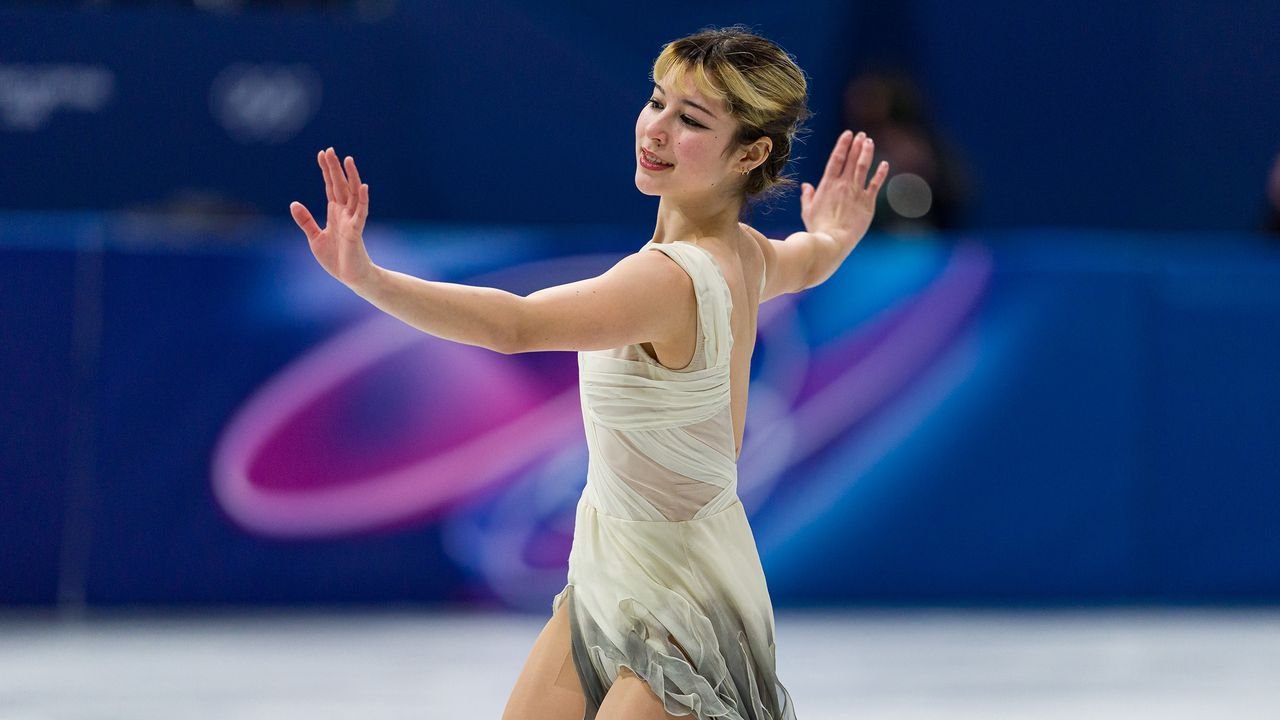
And that was, in some sense, the way it turned out: two Russians came away with gold and silver, while Sakamoto took the bronze. But in Beijing the Russian team imploded on live television. During the Olympics, it was reported that the favorite to win, a wisp of a girl named Kamila Valieva, had tested positive for a banned heart medication; she was allowed to continue to compete, while the investigation was ongoing, but fell apart during her long program and afterward, on television, was berated by her coach. The silver-medal winner, Alexandra Trusova, who landed five quads during the free skate, was heard shouting, “I hate this sport.” The gold-medal winner, Anna Shcherbakova, sat alone, clutching a stuffed animal.
The Russians were excluded from international competition soon after, on account of the invasion of Ukraine, and in their absence Liu took bronze at the world championship that spring. Then she retired at sixteen. The grim joke among figure-skating fans was that Tutberidze’s skaters came with an expiration date: seventeen. Maybe they weren’t the only ones.
Figure skating was the only sport to include women at the first official Winter Olympics, in 1924, and it was the last to drop the designation of “ladies”: the event was called women’s figure skating for the first time in 2022. The term “ladies” reflected the sport’s traditional origins as an artistic pursuit for upper-class women instead of a merely athletic contest, but there could have been another justification: many of the sport’s most successful competitors were not fully grown women. The sport has long been dominated by teen-agers, but particularly in the past thirty years, as compulsory figures that demonstrated edgework were abandoned in competition and jumps have become more difficult. Tara Lipinski, who won Olympic gold for the U.S., in 1998, was fifteen years old, and Sarah Hughes, who won the team’s most recent gold, in 2002, was sixteen.
There were the usual obvious explanations, based on physics: small, light, narrow bodies that have not undergone puberty can spin faster and fly higher than bodies with, say, hips. That’s not to say older skaters can’t land big jumps; the only American woman at the Milan Olympics who currently performs a triple axel is Amber Glenn, who is twenty-six. But the kind of total commitment and discipline required to master many of those skills is also easier to demand of a child. “You should get ready for war before war started,” Rafael Arutyunyan, who coached Nathan Chen, the men’s gold medallist in Beijing, and taught Ilia Malinin the quad axel, told Defector, in 2022. “My problem is I am coaching women, not [junior] ladies skaters, because until they get to the point to come to me, they become women and then it’s too late. The system should be created when a child comes to you from 4 or 5 years old and you give them the shortest way to get more than anybody else.”
Liu had begun skating when she was five. Her father, Arthur, had committed her life—and a great deal of money—to turning her into a champion. Her career did not have the structural stability of the Russian system—Arthur had a habit of cycling through coaches—but she was told what to eat, what to wear, what music to use, how to angle her fingers. Naturally creative and sociable, she chafed against that kind of rigidity. During COVID, she was glad when the rinks closed.
After retiring, she hung out with her friends. She hiked to the Mt. Everest base camp and went to U.C.L.A. But on a ski trip, enjoying the sense of exhilaration, she found that she missed skating. So about two years after retiring, she called her old coach and told him that she wanted to come back. He tried, and failed, to talk her out of it. This time, though, she made it clear that it would be on her terms. She would be involved in every aspect: her clothes, her choreography, her music, her training. Only after she’d assembled her team did she inform her father.



