
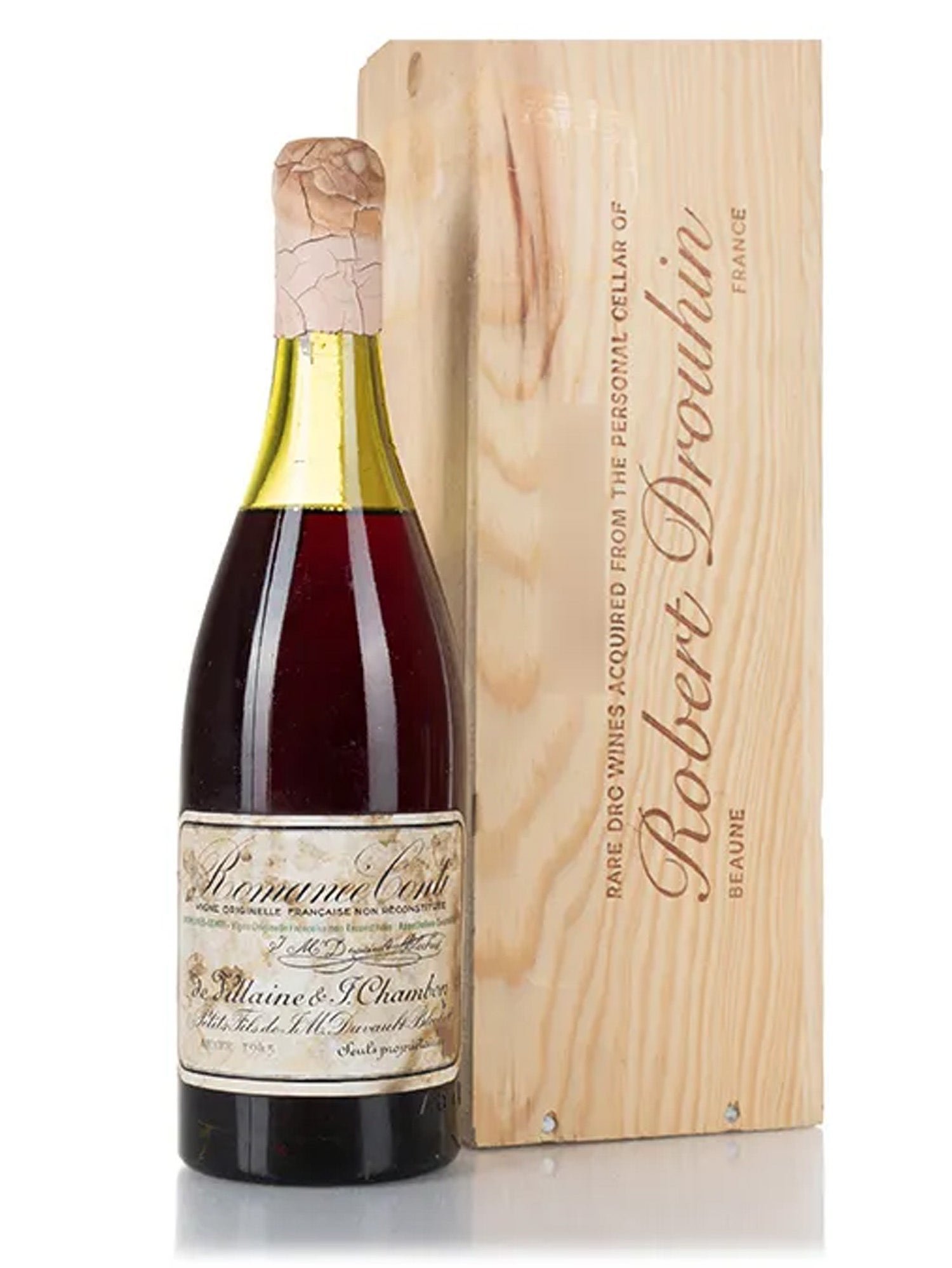
Last week, at Acker’s annual La Paulée Auction, a world record was smashed. A single 750mL bottle of 1945 Domaine de la Romanée-Conti sold for $812,500—nearly doubling the previous record. Across the auction, over $25 million in wine was sold that day.
To the vast majority of wine drinkers, that number is shocking. Who would—or even could—spend nearly $1 million dollars on an 80-year-old bottle of wine?
But there are better questions to ask. If wines can command such celestial prices, why are there so many headlines about sales being down across the industry? And what does this particular bottle have to say about what’s going on?
// Create the element
var script_69d9f53996e3a = document.createElement(“script”);
script_69d9f53996e3a.innerHTML = `
window.googletag = window.googletag || {cmd: []};
googletag.cmd.push(function() {
var adType = “leaderboard”;
var mapping;
var lbmapping = googletag.sizeMapping()
.addSize([1024, 0], [[970, 250], [970, 90], [1, 1], [728, 90]])
.addSize([728, 0], [[728, 90], [1, 1]])
.addSize([320, 0], [[1, 1], [300, 50], [300, 100], [320, 50], [320, 100]])
.addSize([0, 0], [[1, 1], [320, 50]])
.build();; // Size mapping for leaderboard ads
var medrecmapping = googletag.sizeMapping()
.addSize([1024, 0], [[300, 600],[300, 250]])
.addSize([728, 0], [300, 250])
.addSize([320, 0], [[1, 1],[300, 250]])
.addSize([0, 0], [[1, 1], [300, 250]])
.build(); // Size mapping for med rectengle ads
if(‘/39808611/article_page/article_leaderboard_1’ == ‘/39808611/article_page/article_leaderboard_1’
|| ‘/39808611/article_page/article_leaderboard_1’ == ‘/39808611/article_page/article_leaderboard_2’
|| ‘/39808611/article_page/article_leaderboard_1’ == ‘/39808611/article_page/article_leaderboard_3’) {
mapping = googletag.sizeMapping()
.addSize([1920, 0], [[728, 90]]) // >= 1920px
.addSize([1440, 0], [[728, 90]]) // 1440px-1919px
.addSize([730, 0], [[300, 250]]) // 730px-1439px
.addSize([0, 0], [[320, 100], [320, 50], [300, 100], [300, 50], [300, 250]]) // Up to 729px
.build();
} else {
mapping = adType == ‘leaderboard’ ? lbmapping : medrecmapping;
}
googletag.defineSlot(‘/39808611/article_page/article_leaderboard_1’, [],
‘div-gpt-ad-69d9f53996e3a’).addService(googletag.pubads()).defineSizeMapping(mapping);
googletag.pubads().enableSingleRequest();
googletag.pubads().collapseEmptyDivs();
googletag.display(‘div-gpt-ad-69d9f53996e3a’);
});
`;
// Append the script to the body
document.body.appendChild(script_69d9f53996e3a);
The Prized Bottle
Every year, Burgundyheads and other wine lovers gather for Acker’s annual La Paulée Auction. The two-day festival is always busy but this year was buzzing. The auction house reports it broke 460 wine sales records across its 3,700 lots, which included gems like ‘85 Dujac, ‘71 La Tâche, and ‘43 Drouhin Domanee Conti. “It was certainly surprising,” says John Kapon, Acker’s chairman.
The 1945 Romanée-Conti—now the world’s most expensive bottle ever sold at auction—is an incredibly special bottle for a couple of reasons.
It’s from the last vintage produced before the Domaine ripped out its oldest vines, ones that had seen two World Wars, survived phylloxera, and weathered a century of life in Burgundy.
It also came from the personal cellar of Robert Drouhin, adoptive son of Maurice Drouhin, a member of the famed Burgundy wine family and prominent player in the French Resistance. In 1944, Maurice escaped the Gestapo through the family cellars and found shelter among the Catholic nuns in the Hospices de Beaune.
This bottle of DRC was born a year later in the midst of war recovery efforts, in a vintage that produced very little, but very beautiful fruit. “Only 600 bottles were produced that year versus approximately 6,000 in a typical year,” says Kapon.
The vintage is so marked with survival and sentimentality that bottles from 1945 routinely rack up extreme prices at auctions. The previous record for the world’s most expensive bottle was set in 2018, when Sotheby’s auctioned off the exact same bottle, also from Robert’s cellar, for $558,000.
The provenance helped to push up the price of this recent sale even higher than the previous record. “The fact that this bottle came directly from the collection of a well-respected figure in the wine world added a level of confidence that clearly influenced both bidding and the final result,” says Tynan Pierce, wine director at Yes Society, Maggie Harrison’s wine club for serious collectors.
But the prices of these kinds of coveted bottles seems to be rising across the board.
The Luxury Halo
Other auctions and outlets for buying premium wine are seeing similarly strong sales.
Earlier in March, the Hospices de Nuits-St.-Georges auction rang in $1.76 million in wine sales, a dramatic 91.7% increase over last year. Hospices de Beaune’s sale saw increases of 4.6% in average hammer price per barrel. Cult Wines (a luxe wine investment platform) showed monthly trading volumes increased around 6.4%.
Last June, the cellar of billionaire William I. Koch—which included a Methuselah of DRC—sold for $28.8 million, nearly double the pre-sale estimate.
The strength of the upper tier isn’t limited to wine. In January, a bottle of 1982 Old Rip Van Winkle sold for $162,500, which is the highest price ever paid for a bottle of American whiskey.
“The fine and rare wine market is not lagging at all,” says Kapon.
The thing is, rich people will always exist, and the number of them is growing exponentially.
Kate Dingwall
Meanwhile, the overall industry is in a five-year sales slump. Lows are low and expected to remain as such. In the 2026 edition of the Silicon Valley Bank report, Wine Division Founder Rob McMillan cautioned, “We are not at the bottom yet.”
Add in the uncertainty of tariffs, which has bumped up wine prices in the United States, and it doesn’t exactly feel like the climate for big wine sales.
The thing is, rich people will always exist, and the number of them is growing exponentially. There are now more billionaires than ever before and upper-income households are also growing substantially. While the rest of the population may worry about the rising cost of gas and groceries—not to mention their Tuesday night bottle of wine—this growing cohort will always have money to spend on the finer things.
“When it comes to the rarest and scarcest bottles, money is no object,” says Kapon. “While consumption may be down among younger generations, it’s as strong as ever among mature and experienced collectors who have the means to drink the best.”
// Create the element
var script_69d9f53999335 = document.createElement(“script”);
script_69d9f53999335.innerHTML = `
window.googletag = window.googletag || {cmd: []};
googletag.cmd.push(function() {
var adType = “leaderboard”;
var mapping;
var lbmapping = googletag.sizeMapping()
.addSize([1024, 0], [[970, 250], [970, 90], [1, 1], [728, 90]])
.addSize([728, 0], [[728, 90], [1, 1]])
.addSize([320, 0], [[1, 1], [300, 50], [300, 100], [320, 50], [320, 100]])
.addSize([0, 0], [[1, 1], [320, 50]])
.build();; // Size mapping for leaderboard ads
var medrecmapping = googletag.sizeMapping()
.addSize([1024, 0], [[300, 600],[300, 250]])
.addSize([728, 0], [300, 250])
.addSize([320, 0], [[1, 1],[300, 250]])
.addSize([0, 0], [[1, 1], [300, 250]])
.build(); // Size mapping for med rectengle ads
if(‘/39808611/article_page/article_leaderboard_2’ == ‘/39808611/article_page/article_leaderboard_1’
|| ‘/39808611/article_page/article_leaderboard_2’ == ‘/39808611/article_page/article_leaderboard_2’
|| ‘/39808611/article_page/article_leaderboard_2’ == ‘/39808611/article_page/article_leaderboard_3’) {
mapping = googletag.sizeMapping()
.addSize([1920, 0], [[728, 90]]) // >= 1920px
.addSize([1440, 0], [[728, 90]]) // 1440px-1919px
.addSize([730, 0], [[300, 250]]) // 730px-1439px
.addSize([0, 0], [[320, 100], [320, 50], [300, 100], [300, 50], [300, 250]]) // Up to 729px
.build();
} else {
mapping = adType == ‘leaderboard’ ? lbmapping : medrecmapping;
}
googletag.defineSlot(‘/39808611/article_page/article_leaderboard_2’, [],
‘div-gpt-ad-69d9f53999335’).addService(googletag.pubads()).defineSizeMapping(mapping);
googletag.pubads().enableSingleRequest();
googletag.pubads().collapseEmptyDivs();
googletag.display(‘div-gpt-ad-69d9f53999335’);
});
`;
// Append the script to the body
document.body.appendChild(script_69d9f53999335);
It’s worth noting that wines at this level aren’t just wine—something to open over dinner with friends. They’re collectibles, items of rarity and pedigree and elusiveness, like an Hermès Birkin or a Rolex watch.
For many collectors, these bottles are investments. “Some of these wines are treated more as assets, bought with the intention of being resold over time,” says Pierce. In the last six years, there’s been a wave of online fine wine investment platforms (like WineFi, VinDome, and VinoVest) launching, looking to capitalize on the strength of the collecting market.
“The very top wines serve as a status symbol and alternate investment so they seem to be pretty securely entrenched in the very special event and collectable categories,” says Dave Parker, CEO of Benchmark Wine Group, a leading wine reseller.
He’s seen strong demand across three- and four-figure wines, with a healthy balance between velocity and depth of buying.
“Wines in the $100 to $1,000 range are moving quickly, driven by a broad base of buyers—from collectors adding depth to their cellars to clients purchasing for near-term enjoyment,” says Parker. At the $1,000-plus level, he finds the pace is more measured, but demand remains steady and confident.
What the Wealthy Are Drinking
So what are buyers of four-, five-, and six-figure bottles seeking? Burgundy, specifically DRC, is the auction darling.
“There doesn’t seem to be a ceiling for Burgundy prices from the very top producers,” says Parker. “Retail and auction prices for those top bottles can be well into the four figures and, in some cases, five or six figures.”
Red Burgundy is “overheated,” he notes, and white Burgundy is growing, “especially as fears of pre-mature oxidation fade,” he continues. Allocations are near impossible to snag, even if you run a Michelin-starred beverage program, so demand is ravenous.
Why Burgundy? There’s the scarcity issue. Geographical confines and temperamental weather means quantity is finite, and often limited. (Have you tried getting an allocation of Dujac or PYCM?!) It’s an authentic scarcity, too, unlike the controlled scarcity of a high-end Napa project with a hard-to-get-on mailing list.
Burgundy is also Burgundy—a place of storied terroir and intangible magic. “When people have explored the wine world thoroughly, they seem to gravitate to Burgundy and never look back,” says Parker.
Possibly related, possibly not, but other upper tier wine regions are not performing as well. “Some regions and producers that were once considered blue chip have softened over time,” says Pierce.
Champagne sales are down for the third year in a row, while Bordeaux continues to struggle with value. Cult California producers are reckoning with wallet fatigue from consumers and collectors. Even still, holy grail bottles from the above regions do sell well at auction. Last year’s sale of Jacqueline de Rothschild Piatigorsky saw bottles of 1899 Haut-Brion reach record prices. The auction hit $11 million in wine sales—four times the estimate.
Pierce flags that a lot of the strengths of the upper tier lie in where these hyper-expensive wines are being sold. It’s location specific—these high prices are accrued by auction houses, restaurants, and distributors with a cultivated (read: ultra-wealthy) clientele. “This level of demand is not universal,” says Pierce. “Many retailers and restaurants are not seeing the same velocity, largely due to differences in clientele and reach.”
And, it’s worth mentioning that the auction market is, in part, a self-fulfilling prophecy. Just as billionaire wealth has skyrocketed over the past five years, so, too, has the high-end wine auction market.
“There is also a reinforcing dynamic at play,” he continues. “Strong auction results tend to build confidence, shaping expectations for future sales of similar wines. In that sense, the very top of the market can become somewhat self-sustaining.”
More Luxury Wine Coverage
- The latest ultra-luxury building amenity? Private sommeliers.
- Superyacht wine cellars have reached peak lavishness.
- Nine extravagant hotel wine cellars worth traveling to see.
- 11 of the world’s most lavish wine trips, from a Rhône private cottage to celebrity chef lunch.
- From modernist lines to natural materials: six cellar design trends to watch in 2025.

In the Shop
Flex Your Collection
Transform your home into a wine lover’s paradise with a custom wine cellar. From design to functionality, Wine Enthusiast can create the perfect storage solution.
The post An Industry in Crisis? Luxury Wine Can’t Relate appeared first on Wine Enthusiast.



