
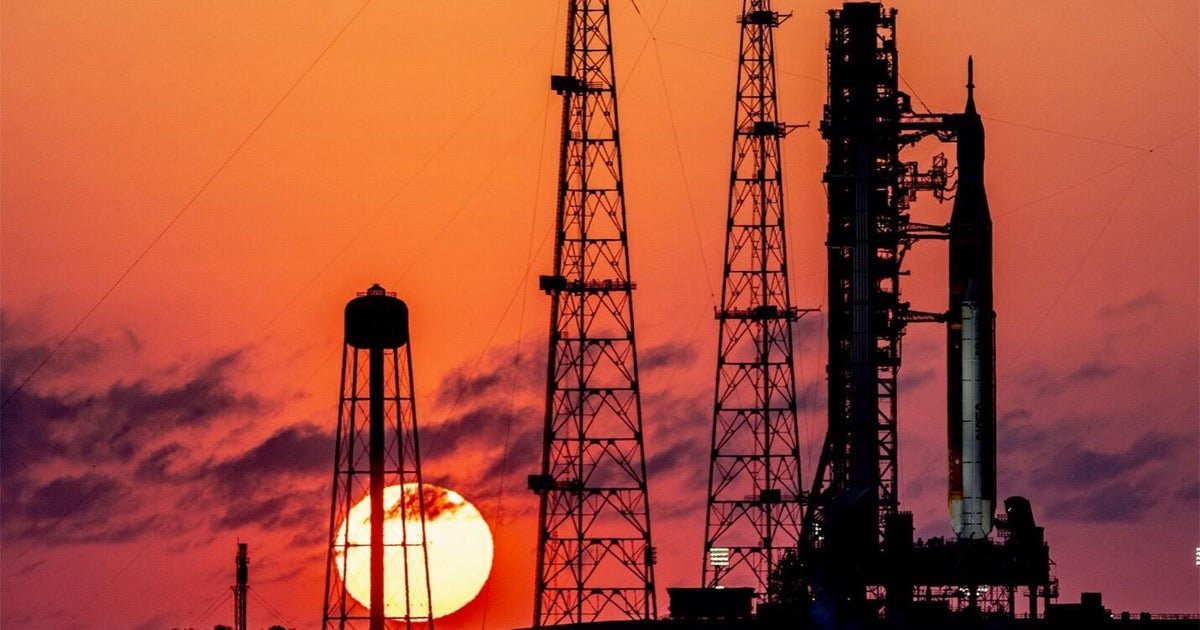
Coast Guard to close some waterways around launch site
The United States Coast Guard will close certain waterways around the Artemis launch site on Wednesday, the agency said, blocking or limiting mariners’ access to areas around Cape Canaveral, Florida.
In the hours leading up to launch, Coast Guard crews establish a “security zone,” “safety zone” and “regulated navigation area,” which cannot be transited without formal approval.
People are also advised to steer clear of waters outside of those designated areas for a window of time around the rocket’s planned liftoff because “hazardous conditions may be present in event of a space vehicle malfunction,” the Coast Guard said. Hazards could include falling debris or vehicle components that could damage vessels below.
A map illustrating the Coast Guard’s restrictions is posted here.
Fueling progressing according to plan, NASA says
Fueling the rocket is progressing as planned. NASA says the launch team transitioned to the fast fill of liquid hydrogen into the rocket’s massive tanks, a step that brings them closer to full capacity, after the slow fill of liquid hydrogen and liquid oxygen.
Weather forecast looking good for launch
So far, forecasters are predicting an 80% chance of favorable weather conditions at launch time, with some risk of clouds, wind and showers. Tonight’s 2-hour window shows light winds, mostly clear skies and temperatures in the mid 70s.
There are very specific weather criteria that must be met for the launch to proceed:
- Temperatures must be above 41.4 degrees Fahrenheit and cannot rise above 94.5 degrees for longer than 30 minutes.
- Winds cannot exceed 33 mph at 132.5 feet and cannot exceed 45 mph at 457.5 feet.
- There cannot be liftoff for at least 30 minutes after lightning strikes within a 10 mile radius.
- Thunderstorm clouds (cumulonimbus) must be more than 3 miles away, clouds over 4,500 feet thick must be more than 5 miles away, cumulus clouds must be more than 10 miles away, and there cannot be any smoke plumes nearby.
- There cannot be any precipitation falling.
Launch team approves fueling up the rocket
In the first major decision point of the day, NASA says the launch team has polled “go” to begin tanking the Space Launch System (SLS) rocket. At 8:29 a.m. EDT, they will begin filling the vehicle with about 756,000 gallons of cryogenic liquid propellant.
The core stage will be filled with:
- 537,000 gallons of liquid hydrogen (LH2) chilled down to -423° Fahrenheit
- 196,000 gallons of liquid oxygen (LOX) chilled down to -297° Fahrenheit
The upper stage, or Interim Cryogenic Propulsion Stage (ICPS), will be filled with:
- 17,000 gallons of chilled liquid hydrogen (LH2)
- 5,000 gallons of chilled liquid oxygen (LOX)
CBS News
NASA leader calls Artemis II an “extremely challenging” mission
Artemis II is “a test flight,” NASA Administrator Jared Isaacman noted in an interview with CBS News the day before launch. “This is the opening act in a series of missions that will send astronauts to and from the moon with great frequency as we return to stay.”
NASA intends to follow it up with additional flights next year, at least one lunar landing in 2028 and longer-term construction of a moon base.
“This first mission, this is extremely challenging,” Isaacman said.
“These astronauts are going to go farther from Earth than any humans have ever been before, potentially faster than any humans have ever been before.”
Watch the full interview here.
Astronauts bring wealth of experience to moon mission
The four crew members chosen for the Artemis II mission stand out even in a NASA astronaut corps full of super achievers. They’ve spent the past three years training for the days ahead.
NASA 
Mission commander Reid Wiseman, 50, holds a degree in computer and systems engineering and a master’s in systems engineering. He became a naval aviator in 1999 and joined NASA’s astronaut corps in 2009. Wiseman first flew in space in 2014, logging 165 days in orbit aboard the International Space Station and completing two spacewalks.
Artemis II pilot Victor Glover, 49, is a U.S. Navy captain with an engineering degree and three master’s degrees in military aviation, systems engineering and management. He has flown more than 400 carrier flights and 24 combat missions, and piloted a SpaceX Crew Dragon flight to the International Space Station in 2020-21, logging 168 days in orbit and completing four spacewalks.
Mission specialist Christina Koch, 47, worked as an electrical engineer at NASA’s Goddard Space Flight Center, conducted research in Antarctica and helped develop scientific instruments for space probes. An astronaut since 2013, she logged 328 days in space aboard the International Space Station in 2019-20 — the longest single spaceflight by a woman — and has conducted six spacewalks.
Mission specialist Jeremy Hansen, 50, is the only spaceflight rookie on the team. He is from Canada and will be the first Canadian astronaut ever to travel beyond near-Earth orbit. He learned to fly as a teen, earned a degree in space science at Royal Military College, and became a fighter pilot before joining the Canadian Space Agency in 2009.
Read more here.
Where is Artemis II going?
Artemis II is a flight to the moon — but the astronauts will not land on the moon or go into orbit around it. Instead, they will loop behind it and get an unprecedented view of the far side of the moon.
In the process, they’re expected to set a record for the farthest distance humans have ever traveled from Earth: 252,000 miles.
The crew will spend their first 24 hours after launch in an elliptical orbit around the Earth. Then, if all goes according to plan, a crucial engine firing called the “trans-lunar injection,” or TLI, will boost the ship’s velocity by about 900 mph, just enough to push it out of Earth orbit to begin the four-day coast to the moon.
The spacecraft will be on a “free return” trajectory, using lunar gravity to bend the ship’s path back toward Earth, where it will return for splashdown in the Pacific Ocean on April 10.
Graphic by Jonathan WALTER and Paz PIZARRO / AFP via Getty Images 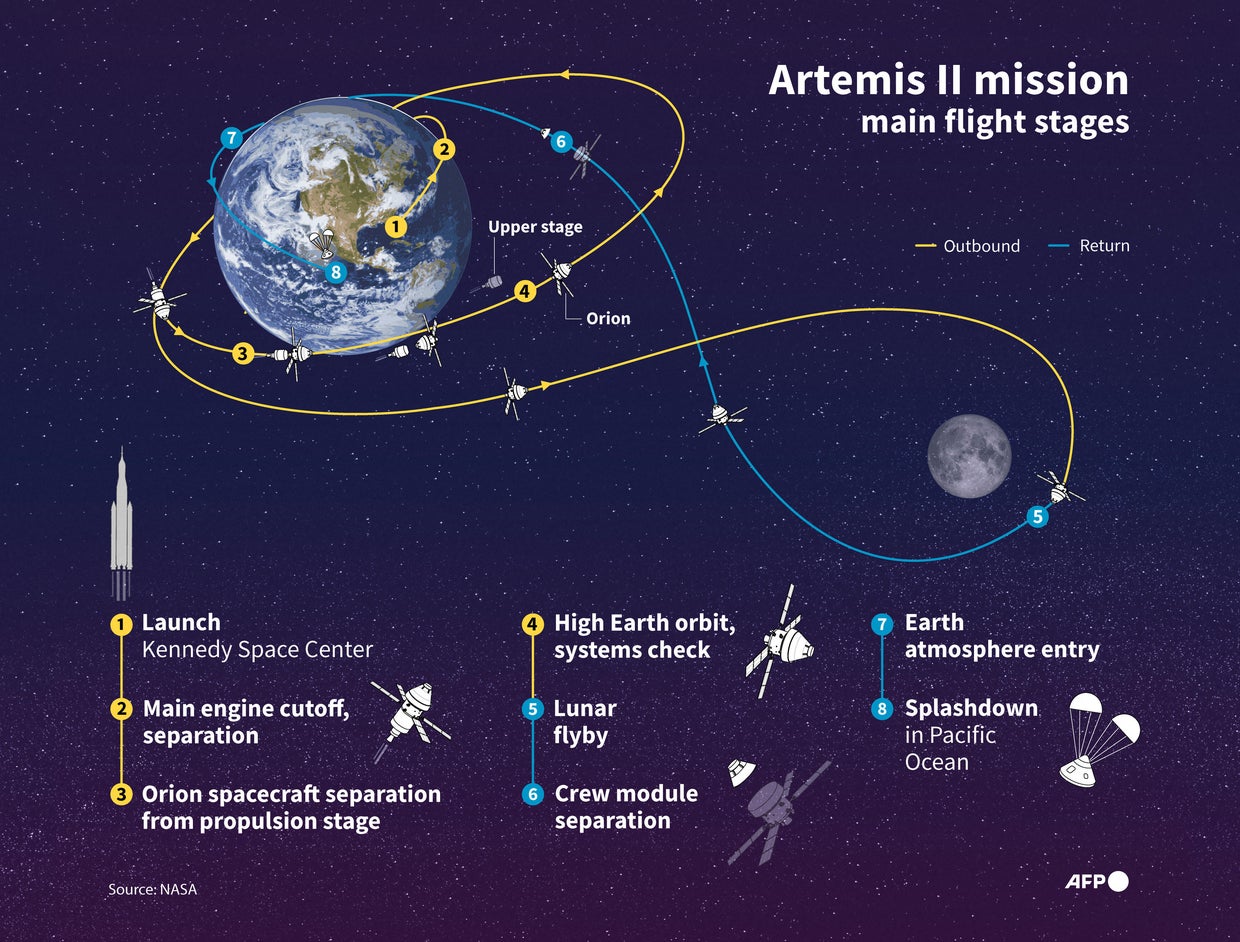
Countdown underway after multiple delays to fix issues
Artemis II originally planned to take off in early February, but the flight was delayed repeatedly.
The first setback came in the form of hydrogen fuel leaks during a dress-rehearsal countdown. Then problems arose with the upper stage propellant pressurization system.
NASA says both issues have been resolved, finally clearing the way for launch.
More than 48 hours before liftoff, the official countdown clocks began ticking at 4:44 p.m. EDT Monday afternoon.
How to watch NASA’s Artemis II moon launch
CBS News 24/7 will have live streaming coverage starting at 4 p.m. EDT for the countdown to the launch. Watch live in the video player on this page or download the free CBS News app.
- What: NASA launches the Artemis II mission to fly astronauts around the moon.
- Date: Wednesday, April 1, 2026.
- Time: Launch window opens at 6:24 p.m. EDT.
- Location: Kennedy Space Center, Florida.
- On TV: A CBS News Special Report anchored by Tony Dokoupil airs on CBS television stations starting at 6 p.m. EDT. Find your local station here.
- Online stream: Watch live on CBS News in the video player above and on your mobile or streaming device.
Coverage plans subject to change.



