
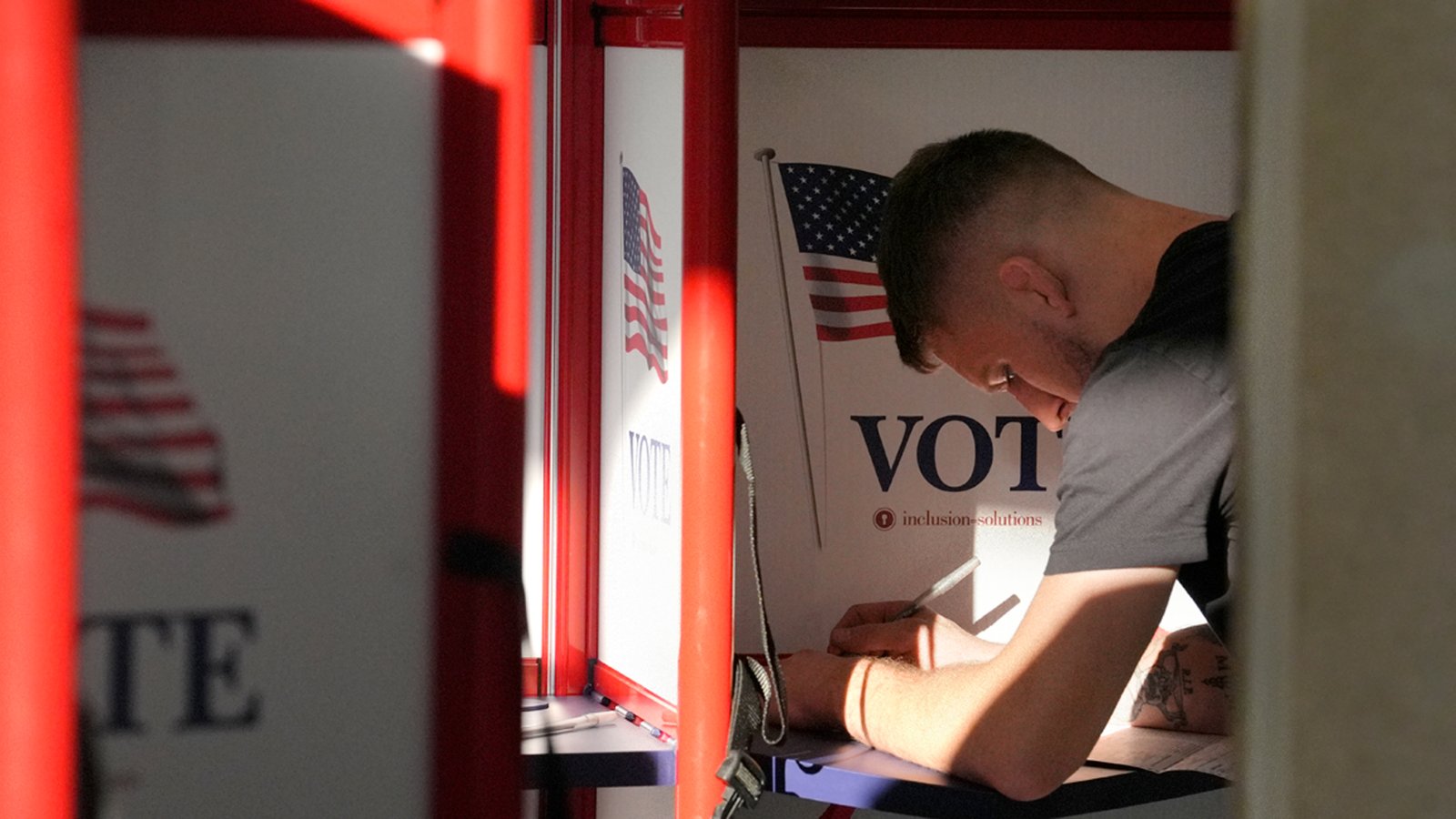
 WASHINGTON — Voting by mail would be sharply curtailed, students could not use their campus IDs to register to vote and the Department of Homeland Security, the immigration-enforcement arm of the U.S. government, would be allowed to seize state voter rolls under legislation before Congress.
The legislation would institute sweeping changes to U.S. elections, including a requirement that every voter provide proof of American citizenship.
“It doesn’t silence voters. It empowers voters,” Rep. Jeff Van Drew (R-2nd), who voted for the bill, said from the House floor on Wednesday. “It only ensures that Americans are voting in American elections. For God’s sake, why would anybody be opposed to that?” New Jersey’s two other Republicans in Congress – Chris Smith (R-4th) and Tom Kean Jr. (R-7th) – also voted for the bill, while the Democrats who represent the state in the capital city voted against it.
Federal law bans people who are not U.S. citizens from voting and instances of non-citizens voting are extraordinarily rare.
By a 218-213 vote, the Republican-majority House passed the bill Wednesday, dispatching it to the Senate, where it stands almost no chance of passage because of a key Senate rule. 
If it does pass, and President Donald Trump signs it into law, the measure would take effect immediately, leaving state election officials to determine how to implement the law in a matter of months.
Republicans have passed similar bills in recent years, including in 2025, when the House passed a comparable but less restrictive version. Those measures have languished in the Senate.
Though this bill will likely meet the same fate, online influencers and politically right-leaning allies of the Trump administration, including billionaire Elon Musk and rapper Nicki Minaj, have mounted an Internet campaign to pressure the Senate.
“Please call your senator and ask for voter ID to be passed,” Musk wrote online Thursday.
Musk, whose companies have extensive government contracts, spent hundreds of millions of dollars in 2024 to elect Republicans to Congress, including Rep. Tom Kean Jr. (R-7th).
The House vote came after Trump’s recent calls to nationalize the nation’s election system and threats from a former presidential aide to deploy ICE to polling places in the November midterm elections, which independent experts expect to favor Democrats over Republicans.

For years, Trump has railed against “rigged” elections he maintains, without evidence, are slanted against Republicans.
Former Trump staffer Steve Bannon said last week on a podcast of his that the administration could send Immigration and Customs Enforcement agents to polling places in the fall. “You’re damn right we’re going to have ICE surround the polls come November,” said Bannon, who served four months in prison after Congress in 2022 held him in contempt for refusing to testify to a special congressional committee about the Jan. 6, 2021, attack on the Capitol.
Asked last week if she could guarantee ICE would not be sent to polling sites, White House Press Secretary Karoline Leavitt did not rule it out.
“I can’t guarantee an ICE agent won’t be around a polling location in November—I mean, that’s frankly a very silly hypothetical question,” Leavitt said.
If Democrats win enough seats in November to flip control of the House, they would serve as a significant check on the Trump administration, in particular its legislative agenda and domestic policies.
At its core, the House-passed bill would require Americans to show a passport or birth certificate to register to vote. Roughly 21 million people in the U.S. do not have easy access to these documents, according to researchers at the Brennan Center, a legal and policy group based in New York City.
The bill would also require states to submit their voter rolls to the Department of Homeland Security.
Some arch-conservatives of the Senate, in particular Utah Republican Mike Lee and Florida Republican Rick Scott, have pushed to do away with the filibuster — the Senate rule that requires 60 votes to pass most legislation — in its current form and replace it with a filibuster that requires dissenting members to physically speak on the floor to stall debate.
Senate Majority Leader John Thune, the Republican from South Dakota who leads the chamber, appeared to dismiss the concept this week, saying the strategy could consume valuable floor time.
Still, he appeared open to the bill the House passed. “You ought to be able to prove that you’re a citizen of this country in order to be able to vote. How we get to that vote remains to be seen,” Thune told reporters.
During debate, some Republicans, like Mary Miller of Illinois, again claimed without proof that there is widespread fraud in U.S. elections.
“The Democratic Party knows that cheating is their only path to victory,” said Miller. “Their goal is to replace the votes of American citizens with those of illegal aliens.”
The bill could complicate voting for millions of married women whose names do not match the surnames on their birth certificates. “Republicans know this and want to use that misinformation to block them from voting,” said Norma Torres, a Democrat from southern California.



