By lunchtime Monday, the Persia House of Kebabs was packed, everyone sipping steaming tea, eating dates and sesame cookies, talking about the war.
Who will step up to lead Iran?
How long will the bombing last?
When can we go back?
Most of the regulars at the restaurant had been born in Iran but left after the 1979 revolution that saw the overthrow of the country’s shah and the collapse of the Western-backed regime.
Many have never returned.
But now Iran’s supreme leader and other top government officials have been killed in coordinated U.S.-Israeli strikes that began over the weekend.
At the small Tampa eatery on Fletcher Avenue, Iranians from across Tampa Bay gathered to talk through the news from the homeland they still love. Some shared hope for a new chapter for their country. Others worried about more people being killed.
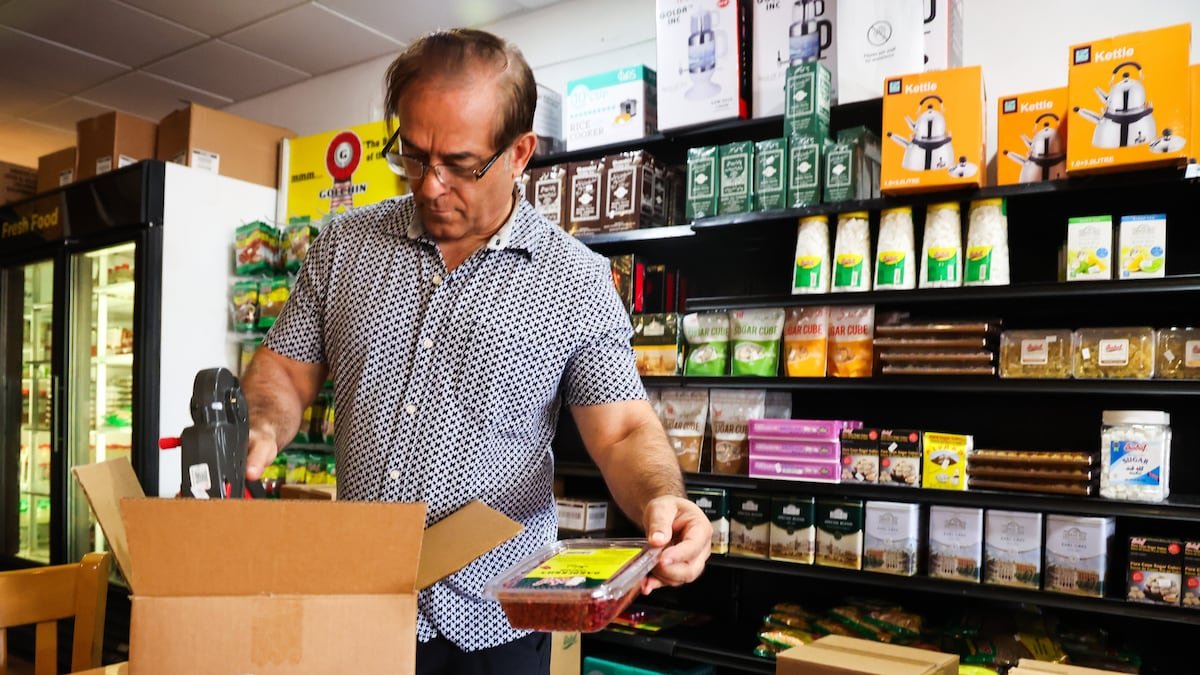
Persian music played on the television. Silver bowls cradled sugar cubes. The fridge was filled with feta and yogurt soda.

“I can plan a trip now, as soon as things are stable,” said Isabella Hauzerduff, 60, slicing stuffed grape leaves. “I’m worried about what’s going to happen, of course. But now the people have a chance to choose who they want as a leader. They can make Iran great again.”
Hauzerduff grew up in Sweden, lived in Hawaii, Los Angeles, Miami. She never told anyone she was Iranian. “People think we’re all terrorists.”
Three days earlier, when Iran’s leader was killed, “That was the best day of my life!” said Hauzerduff, a retired mortgage broker. She bought $400 worth of Persian cookies from the shop to share. “Now, before I die, I’ll see freedom for my country.”
Mitva Kamali Azad, a real estate agent sitting at another table, had invited five women to the kebab shop to celebrate. They each had been glued to the news, scrolling through videos recorded 7,000 miles away. “We all hate this regime. They made us all refugees. A regime that can kill — massacre — its own people …” Azad said. “Now, at least Iran has a chance.”
Her friend, an emergency room doctor, frowned and shook her head. “I think it’s an atrocity, this whole thing,” said the woman, who would only give her first name, Janet.
Yes, she was glad the ayatollah was dead. “I’ve had fantasies of killing him myself,” the 64-year-old told her friends. “But this war, they’re killing innocent people, bombing schools and hospitals. (President Donald) Trump is not fighting to bring democracy to Iran. He wants Iran’s oil and resources. He’s just doing Israel’s dirty work. Iran is going to turn into rubble and be cut into pieces.”
“What revolution has been victimless?” countered Azad. So many people already have died, she said. What’s a few more? And so what if Trump wants oil? Or if Israel partitions off parts of Iran? “I don’t care about any of that if we’re free,” Azad said.
“You don’t care?” Janet shot back. “This government is so brutal. When the people rise up, they’ll all be killed. I don’t see a way out right now.”
The restaurant is on Fletcher Avenue, near USF, and has been at the same location for 43 years. It serves as a hub for the Persian diaspora, with customers coming from Sarasota, Lakeland and Orlando.
Many people at the shop on Monday were hoping that the shah’s son, Prince Reza Pahlavi, would come back to lead Iran. He has been living in exile in New York, speaking out against the Islamic Republic.
“Iran was a monarchy,” Hauzerduff said. “I’d like to see a monarchy again. The shah’s son is just waiting for the green light from Trump.”
Again, the doctor disagreed. The crown prince is not trustworthy, she said. “Just like his father and grandfather.”
“Any hope is better than the status quo,” Azad said.
“Is Gaza still hopeful?” asked Janet. “There’s nothing left there. That’s what’s going to happen to Iran. The shah is not secular. We need a secular government.”
Democracy, she said, is just a dream. “All of the intelligent people who are capable of leading the country are in jail.”
“We have plenty of smart people,” Azad said. “We will rise to the occasion.”
At a table by the window, two men were sharing videos on their phones, watching Iranians dancing in the streets. One predicted the war would be over in a couple of months. Another gave it two weeks.
While his customers debated, mostly in Farsi, the shop manager unpacked boxes. The restaurant doubles as a market, shelves lined with pistachio halva, chickpeas and fava beans. Later this month, Iranians celebrate Persian New Year — the start of spring. So the manager, Kavoos Khosh, 63, was stocking up on baklava and honey almond brittle.
He said he was glad Iran’s leader was gone. But like the doctor, he worries about the war, cities being destroyed, friends and family getting killed. He hopes the bombing stops soon.
“Iran should be free, a democratic society,” said Khosh, who has managed the shop for 22 years. “The whole order of civilization came from there. But it’s hard to say what the politicians will do.”
Tens of thousands of Iranians left their country after the revolution. According to the U.S. Census, more than 3,800 people in Tampa Bay have Iranian ancestry. When this chaos is over, Khosh said, they’ll start going home. Sanctions will be lifted. U.S. companies will invest in Iran, and money will start coming in.
Right now, he said, people in Iran can’t get enough food. They have to wait six hours to buy gas. They’re afraid to venture into the streets.
“From all this chaos, things have to improve,” Khosh said. “We can’t wait any longer.”
By 4 p.m., the restaurant was mostly empty. The manager sat down with a plate of kebabs.
The sole server finally got a break. He had been listening to the conversations all afternoon but hadn’t said a word about the war he hates.
“This is wrong,” said Seyed Tabib, 72, who has lived in the United States for 47 years. “It was wrong to just start bombing. It’s against international law.”
No matter how many Iranian leaders get killed, he said, “They’re just going to keep replacing them and keep the regime. I feel bad about killing anybody. Anybody. I want everything to be peaceful.”
He hopes — but doesn’t believe — life there will improve.
Times data editor Langston Taylor contributed to this story.