
Imagine if the next data dashboard you reviewed did not stop at 12th grade, but followed students into their first year after graduation.
What would those data reveal about your district’s commitment to postsecondary advising? While superintendents cannot control the choices of college admissions officers or local employers, they can control the quality of postsecondary advising available to their students.
Across the nation, school districts are doubling down on their commitment to ensuring their students graduate college and career-ready. However, in our experience, where many districts fall short is in implementation or “what this needs to look like.” While many district leaders are experienced with visioning and goal setting, they are less clear about knowing what the adults need to be able to do to support a comprehensive advising approach that sets students up for success after high school.
High Quality Postsecondary Advising Framework as a Key Element of College and Career Success Goals
As researchers and leaders in the postsecondary readiness and transition field, we routinely partner with school districts who aspire to thoughtfully and effectively implement strong systems that support postsecondary advising. However, beyond calling for better advising, many district leaders struggle to articulate what kind of advising needs to be carried out to meet their postsecondary goals and expectations.
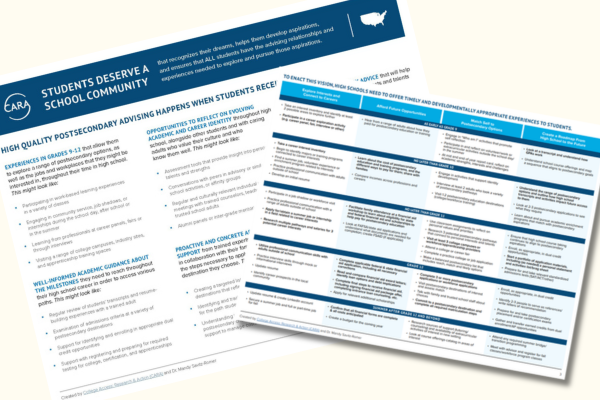
Over the past year, drawing on postsecondary readiness resources and our previous work and experience – including CARA’s Organizing for Access and Dr. Mandy Savitz-Romer’s book Ready, Willing and Able – and with funding from the Gates Foundation Pathways and Washington State Initiative teams – we have developed a framework for improving the quality of postsecondary advising. It aims to unite the field around a shared understanding of all the experiences and relationships that young people deserve to be supported in their college and career development throughout high school.
We drew on various tools, efforts, and experts to create this framework. Here are a few unique aspects that set this framework apart and we hope will facilitate its use to directly shape the work of high schools.
- This framework is student centered. Rather than focusing on what adults should do, it centers young people and the experiences we believe they deserve.
- It spans grades 9-12. Research shows the importance of exposure and experience as soon as students arrive in high school; currently, too many students do not begin learning or thinking about this process until 12th grade.
- It explicitly includes balanced attention to college AND career. Reflecting the evolving understanding in the field of the ways these are intertwined, we set out to provide a balanced set of experiences that set students up for college AND career exploration.
- This framework spotlights the importance of aligning the timing of experiences and tasks with a developmental focus.
- Finally, we include a “Summer and Beyond” section to illustrate the critical tasks that occur once school doors close.
How can superintendents use this framework?

Superintendents can and should identify high level goals across the work of all of the adults in school buildings. Rather than it being solely for teachers or counselors, it is meant to lay out a clear roadmap for shared work.
Additionally, by concretely outlining “what” constitutes high quality advising, we anticipate district leaders can bring their expertise to the “how” and move much more quickly to action.
This framework may also be used to identify areas that need increased attention. For example, one district that has begun to use this framework shared that it helped identify the need for more attention in the tenth grade. Another saw the need to increase its students’ exposure to campuses and workplaces, and began implementing more trips. Importantly, we hope that articulating the set of experiences that comprise advising will encourage superintendents to consider supporting the full set of staffing, resources, and working conditions necessary to implement it at high quality.
To enact all that the framework includes, districts will also need to leverage their partnerships with a range of other community-based organizations, as well as find ways to train and incorporate a wider set of school staff and utilize classroom spaces in new ways. It is meant to be considered alongside the District Framework for Enabling Postsecondary Success, which articulates the conditions that are necessary for adults to be able to engage in this work.
Read more on that framework, released last year, here, and visit the accompanying website to read more about how districts and schools are incorporating its principles.
“The Next, Best Step” Schools of Thought series equips district leaders with research-backed strategies and real-world success stories to help them better prepare students for life after graduation. Each post combines cutting-edge data on postsecondary outcomes with practical implementation strategies from leaders who are transforming how schools approach college and career readiness. From FAFSA completion tactics to data-driven advising approaches, this series aims to ensure every student graduates with both a diploma and a plan for social and economic prosperity.



