
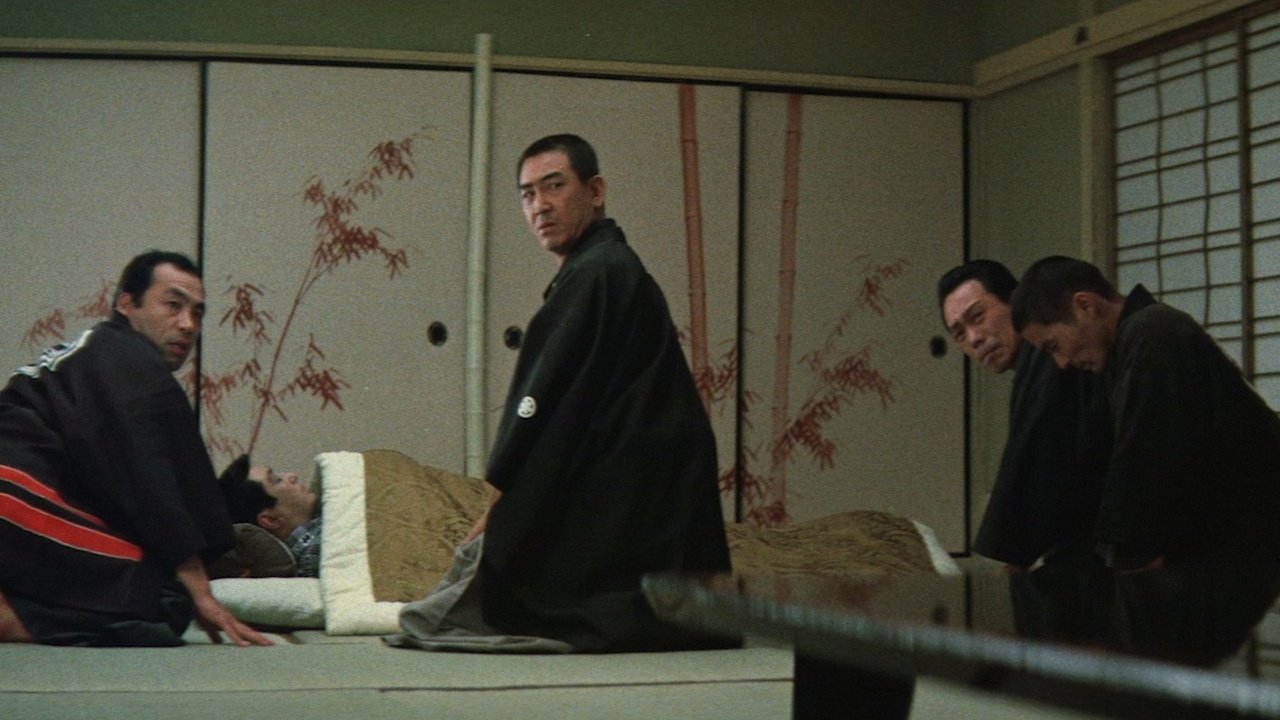
The end of World War II marks a decisive moment in Japanese history, leading many to rethink their relationship with the nation and its values. For director Kosaku Yamashita, it was a moment that made him question authority, namely the Emperor, whom he would later compare to a yakuza boss “casually sending people to their deaths”. His critical stance towards national ideals and authorities would naturally influence works such as “The Valiant Red Peony” and, perhaps most importantly, “Big Time Gambling Boss”, regarded by many critics as one of the finest ninkyo eiga (“chivalry” gangster films). Yamashita explores how greed and the hunger for power infect friendships and relationships, highlighted through a character-driven approach that focuses on the individual rather than the hierarchical structure of the yakuza.
Buy This Title
by clicking on the image below
After the head of the mighty Tenryu clan is no longer able to lead, a new leader must be chosen. Shinjiro Nakai (Koji Tsuruta), who has been a loyal lieutenant over the years, appears to be the obvious choice, but he rejects the offer as he still sees himself as an outsider. However, his suggestion — his “brother” Tetsuo Matsuda (Tomisaburo Wakayama) — is also denied in favour of Kohei Ishido (Hiroshi Nawa), the former boss’s son-in-law. Nakai accepts the decision of his peers, but Matsuda is anything but satisfied, believing that his “brother”, who is more popular among the men, should have been chosen.
As the process of installing Ishido as the new boss is set in motion, Matsuda angers the rest of the clan by accusing them of lacking honour. After he survives an assassination attempt, tensions escalate into open conflict between him and Ishido, with Nakai trying his best to mediate. He suspects a traitor within the clan, but his search for the truth may come too late, as another tragedy makes an all-out war inevitable.
Judging merely from its premise, “Big Time Gambling Boss” could be one of many yakuza films from the 1960s. Thematically, Yamashita’s feature touches upon familiar topics, such as the problematic bond between politics and the underworld, which leads to violence, corruption and destruction while also blurring the line between gangster, politician and company owner. The film also shares some of the aesthetics of the genre, presenting claustrophobic, tense meetings among gangsters while also depicting the brutality that erupts as a consequence.
However, Yamashita places a stronger emphasis on character development and relationships, adding a layer of complexity that is often neglected or ignored in other genre entries, which tend to prioritise the socio-political impact of the yakuza over the internal struggles of characters who must choose between their two families.
Nakai, Ishido and Matsuda may function as “mere” thugs on the surface, but Yamashita manages to give them depth and gravitas. Whereas in Kinji Fukasaku’s yakuza features they would be “just” gangsters, in “Big Time Gambling Boss” we also encounter them as friends, husbands, fathers and mentors. While scenes such as their devotion to their now seriously ill boss might appear somewhat exaggerated, moments like Nakai and Matsuda struggling to maintain their oath of brotherhood amid a tumultuous transition within their clan highlight their bond beyond the yakuza hierarchy.
Likewise, their loving marriages are frequently depicted, with actresses Junko Fuji (as Hiroe, Matsuda’s wife) and Hiroko Sakuramachi (as Tsuyako, Nakai’s wife) delivering memorable performances that underline their characters’ devotion as well as their dignity. The audience understands what is at stake for these characters and how choosing between their two families becomes a moral dilemma that determines whether they retain their humanity or fully transform into gangsters devoid of remorse.
Considering these narrative and thematic aspects, “Big Time Gambling Boss” is much closer to a stage drama or tragedy. Cinematographer Nagaki Yamagishi emphasises the intimate, tense and often fragile harmony of the characters’ private family lives, as well as the dissonance within their other “family” — the clan to which they have sworn their loyalty. The opening minutes, which depict a business negotiation between the Tenryu clan and another yakuza family, set the tone by highlighting the illusion of the gangster hierarchy, which is, after all, an institution built on blind loyalty and obedience — one that also “casually sends people to their deaths”.
With “Big Time Gambling Boss”, Kosaku Yamashita transforms familiar genre conventions into a quiet but devastating tragedy. Beneath its surface of rituals, negotiations and shifting alliances lies a world in which the idea of family becomes increasingly hollow — reduced to a mechanism of control rather than a source of belonging. By the time the film reaches its conclusion, what once appeared as a code of honour reveals itself as little more than a carefully maintained illusion, one that ultimately consumes both the individual and the system that sustains it.



