
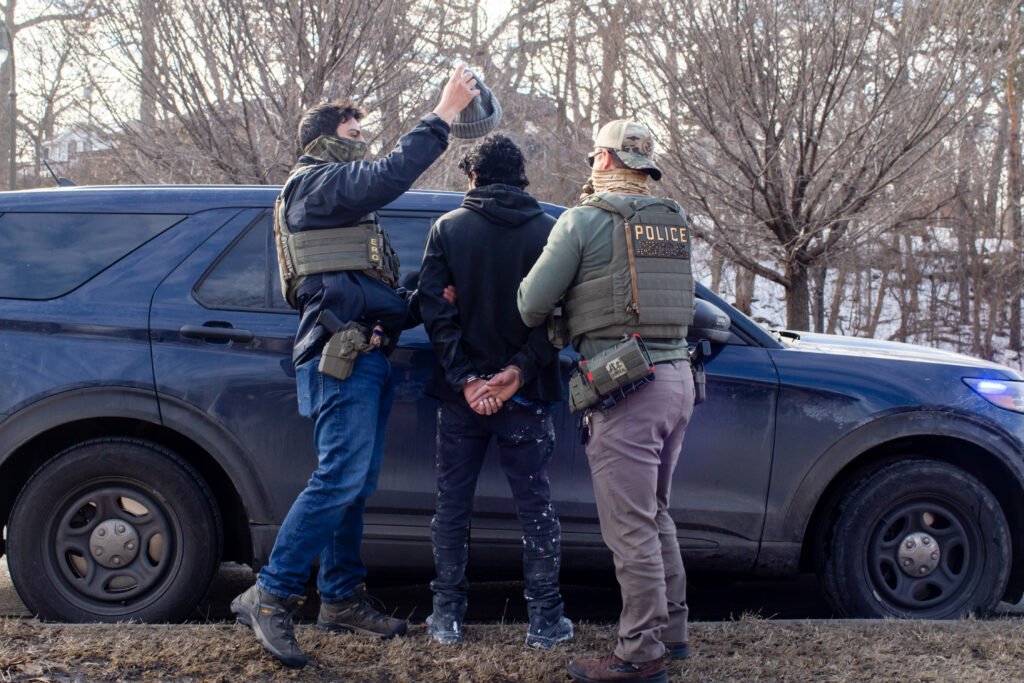
President Donald Trump’s border czar announced on Thursday an imminent end to Operation Metro Surge, claiming success from the unprecedented federal incursion that brought thousands of immigration officers to Minnesota, ignited massive resistance and resulted in two killings of American citizens.
“The Twin Cities, and Minnesota in general, are and will continue to be much safer for the communities here because of what we have accomplished under President Trump’s leadership,” Border Czar Tom Homan said during a morning news conference.
He said a “small footprint of personnel” will remain for “a period of time” to wind down the operation. Within the next week, agents sent here from other states will be sent home or deployed elsewhere, he said. Homan, who reportedly was investigated for receiving $50,000 in cash from an undercover FBI agent in 2024 in an alleged bribery scheme, said the personnel here for fraud investigations will remain.
The announcement comes a little over two weeks after Homan arrived in the state, taking over control of an operation that had, by any measure, spun out of control.
Since the beginning of the year, immigration agents have shot three people, killing two; racially profiled people, asking them to produce proof of legal residency; detained legal immigrants and shipped them across state lines, including young children; caused numerous car crashes; deployed chemical irritants on public school property; smashed the car windows of observers and arrested them before releasing them without charges; charged journalists and activists while stymieing investigations of federal agents, leading to an exodus of prosecutors from the U.S. Attorney’s Office, among other high-profile incidents.
The surge was deeply unpopular in Minnesota and across the country. Nearly two-thirds of people in Minnesota disapprove of how ICE is handling its job, according to a recent poll by NBC News Decision Desk, KARE 11 and Minnesota Star Tribune.
“President Trump didn’t send me here because the operations were being run and conducted perfectly,” Homan acknowledged.
Homan took over control from Border Commander Gregory Bovino, who spent many days out in the field with his “troops,” as he referred to them, asking Somali Uber drivers for their passports and throwing gas at protesters.
Just three weeks ago, Bovino would not say when the operation would end, and said that it would be “ongoing until there are no more of those criminal illegal aliens roaming the streets.”
Homan’s arrival – and Bovino’s termination – brought a swift reversal. Homan announced the beginning of a drawdown last week, pulling 700 immigration agents from Minnesota. Gov. Tim Walz said earlier this week, after speaking with Trump’s Chief of Staff Susie Wiles, that he believed a full end to the surge was days away.
“They knew they needed to get out here but, in very Trumpian fashion, they needed to save face,” Walz said at a Thursday news conference.
Walz said the state must now begin efforts to recover from the massive disruption the operation brought to schools and businesses.
U.S. Rep. Ilhan Omar said ending the operation is not enough.
“We need justice and accountability. That starts with independent investigations into the murders of Renee Good and Alex Pretti, economic restitution for businesses impacted, abolishing ICE, and the impeachment of Kristi Noem,” Omar posted to social media.
Other Democratic leaders welcomed the news of the draw down but expressed skepticism that the Trump administration would follow through.
“Any announcement of a drawdown or end to Operation Metro Surge must be followed by real action. Last week, we were told ICE would be reducing its presence in Minnesota. Yet yesterday, we witnessed a reckless high-speed chase in a densely populated, heavily visited part of our city,” St. Paul Mayor Kaohly Her said in a statement.
A group of Minnesotans who traveled to Washington, D.C. said on Thursday that Congress must still deny a funding increase to Homeland Security; an ongoing stalemate over the issue appears likely to lead to a partial government shutdown on Friday.
“We need real investigations, real oversight, real consequences when lives are lost,” Rochester Imam Salah Mohamed said, standing in front of the U.S. Capitol.
The Trump administration began sending federal agents to the state late last year, and their ranks swelled to 3,000 in what the Department of Homeland Security called its largest operation ever.
The operation catalyzed fierce resistance from residents across the Twin Cities metro, who created sophisticated anonymous networks to monitor and document ICE activities and deliver food and other necessities to immigrants too afraid to leave their homes.
Opposition to the operation, that by most accounts looked and felt like a military siege, grew even larger following the killing of a Minneapolis ICE observer, Renee Good, in her car on Jan. 7. Just over two weeks later, Border Patrol agents killed a second person, Alex Pretti, an ICU nurse at the Minneapolis VA Medical Center.
Walz along with other Democratic leaders have for weeks called on the Trump administration to end the operation, saying it has only endangered residents rather than increasing public safety.
Minnesota Attorney General Keith Ellison along with the cities of Minneapolis and St. Paul sued the Trump administration in hopes of forcing an end to the surge, pointing to widespread accounts of racial discrimination, violence against bystanders and protesters and enforcement actions at schools, churches and hospitals.
Homan touted the many arrests federal agents made of undocumented immigrants with criminal records, including murderers, sex offenders and other violent criminals.
Yet of the roughly 4,000 arrests made since the beginning of Operation Metro Surge last December, Homan could not say how many were targeted arrests of people deemed a safety threat.
Homeland Security has not released the names of the people it arrested. Instead, the agency has released curated lists of people they call the “worst of the worst” who they claim to have taken off the streets. But many of those people were actually in state prisons already and were simply transferred to federal custody, following standard practice that started long before the operation.
Homan said they’ve earned significant collaboration with local law enforcement and seen a reduction in “agitator behavior” interrupting immigration operations, two key conditions he made at a news conference last week for a full draw down.
“We have obtained an unprecedented level of coordination from law enforcement officials that is focused on promoting public safety across the entire state,” Homan said.
He boasted that local sheriffs offices will notify ICE when people of interest are released from jails, which has been common practice for county sheriffs for years. Homan reiterated he will not ask sheriffs to detain people beyond their scheduled release, which violates Minnesota law according to an opinion issued by Ellison last year.
Homan thanked Minneapolis Police Chief Brian O’Hara, Hennepin County Sheriff Dawanna Witt and other law enforcement leaders “for their responsiveness and efforts to maintain law and order in the streets.”
He also thanked Walz for his “messages focusing on peace” and Minneapolis Mayor Jacob Frey for directing police to take down community barricades in the street.
Walz said he didn’t give up anything as part of a deal to end the operation.
“Nothing has changed. The final agreement was that Minnesota would continue to do what we do,” Walz said.
Madison McVan contributed reporting.
This story was originally produced by Minnesota Reformer, which is part of States Newsroom, a nonprofit news network which includes New Jersey Monitor, and is supported by grants and a coalition of donors as a 501c(3) public charity.



