
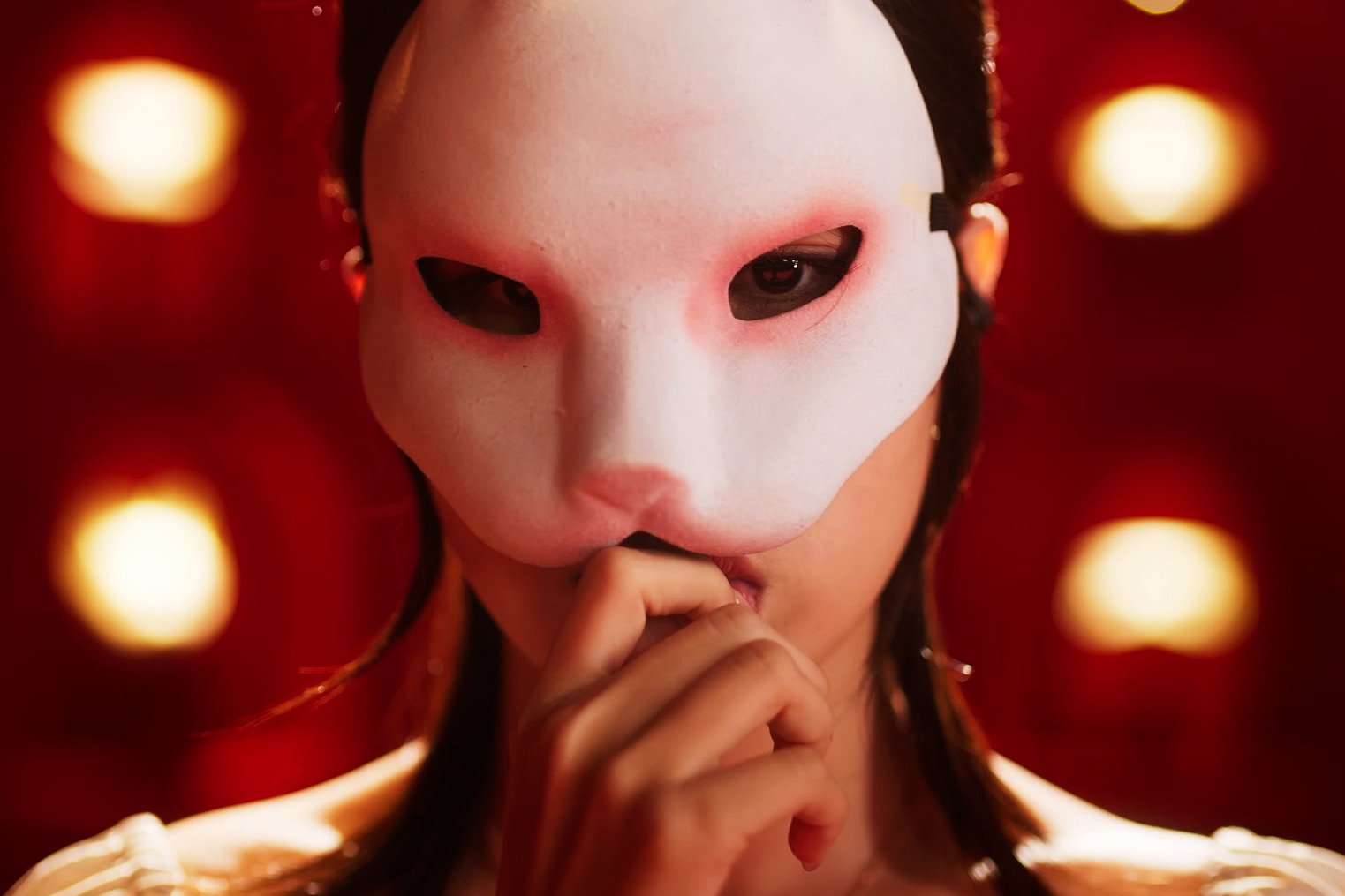
“Bunny!!” has already proven a massive success in Vietnam, grossing over $16 million and becoming the country’s number one movie of the year, as well as one of the top five highest-grossing titles of all time. Tran Thanh continues to dominate the local industry, now holding five spots among Vietnam’s top ten highest-grossing productions. In a market where 100 billion VND is considered a hit, he remains the only filmmaker whose works have all surpassed 300 billion VND at the domestic box office.
As is usually the case in Vietnamese mainstream cinema, the story begins in a comedic fashion before gradually shifting into something completely different. Initially, one of the protagonists, Linh, is shown having her husband, Phong, record her on a live video while they are on a boat on a river. Shortly afterwards, the two are depicted having sex in the woods, in a scene that is rather rare for Vietnam, although not graphic. At the same time, and in a somewhat surrealistic approach, her “adopted” sister Lan is watching the live feed on her phone and commenting, before her attention soon turns to her husband, Son, whom she initially appears to adore. Soon, however, her true attitude is revealed, as she exhibits a genuinely toxic behavior, constantly acting with paranoid jealousy and essentially bullying the poor man.
Later on, it is revealed that Linh is the host of a popular TV show where people in masks and with encrypted voices share their relationship problems, while she attempts to solve them live on air. Things begin to change when Bunny, a mysterious young woman, appears on the show, hinting at a toxic relationship with her current boyfriend, but soon also revealing that she is hiding a number of secrets, some of which connect her with the two sisters. As more revelations come to light, the relationships among all the couples become increasingly strained, while pressure mounts from all sides.
Allow me to start with the negative aspects. There is simply too much dialogue, to the point that it feels constant, with virtually no moment of silence. Additionally, some of the characters speak in an excessively loud manner, which frequently results in an overall experience that becomes rather irritating. Secondly, the way the twists are presented, along with the characterization, is not particularly convincing. Tran Thanh builds several characters as toxic, only to later exonerate them and then reverse this again, in ways that lack logic, ultimately resulting in a narrative that is difficult to believe. Lastly, the various transitions throughout the movie, including the constant back and forth, further intensify these issues.
Despite these flaws, however, there are several redeeming qualities. For starters, the surrealism through which the live show is introduced and developed enhances the overall atmosphere of mystery and disorientation, particularly since it becomes evident early on that something negative is bound to occur. Furthermore, the individual storylines, even if not entirely cohesive as a whole, remain engaging when viewed separately, with the depiction of toxicity from both genders adding a rather appealing sense of realism.
Moreover, the overall excessiveness, which is mirrored in the maximalist set design, the lush and vivid color palette, and the polished cinematography by Phunam, is handled effectively for entertainment purposes. As a result, the movie is quite easy to watch and visually pleasing. This aspect is further enhanced by the particularly attractive cast. LyLy, as Hai Linh, is especially captivating on screen, while the same can easily be said for Van Mai Huong as Lan. Additionally, both main male protagonists, Tran Quoc Anh as Son and Vinh Dam as Phong, contribute to this overall appeal. The combination ultimately results in a production that can be described as eye candy.
The two women also deliver strong performances in their respective roles, even if the writing occasionally undermines their characters, while Tran Thanh, as Kim, offers a scene-stealing performance, particularly during the finale.
Speaking of the finale, even if it is not entirely coherent, it remains quite impressive to watch, providing a rewarding release in entertainment terms and ultimately standing out as the most memorable sequence of the movie.
“Bunny!!” has its issues in terms of narrative and characterization, but if one avoids focusing too much on logic, there are enough elements here to maintain interest and provide entertainment for the majority of its duration.



