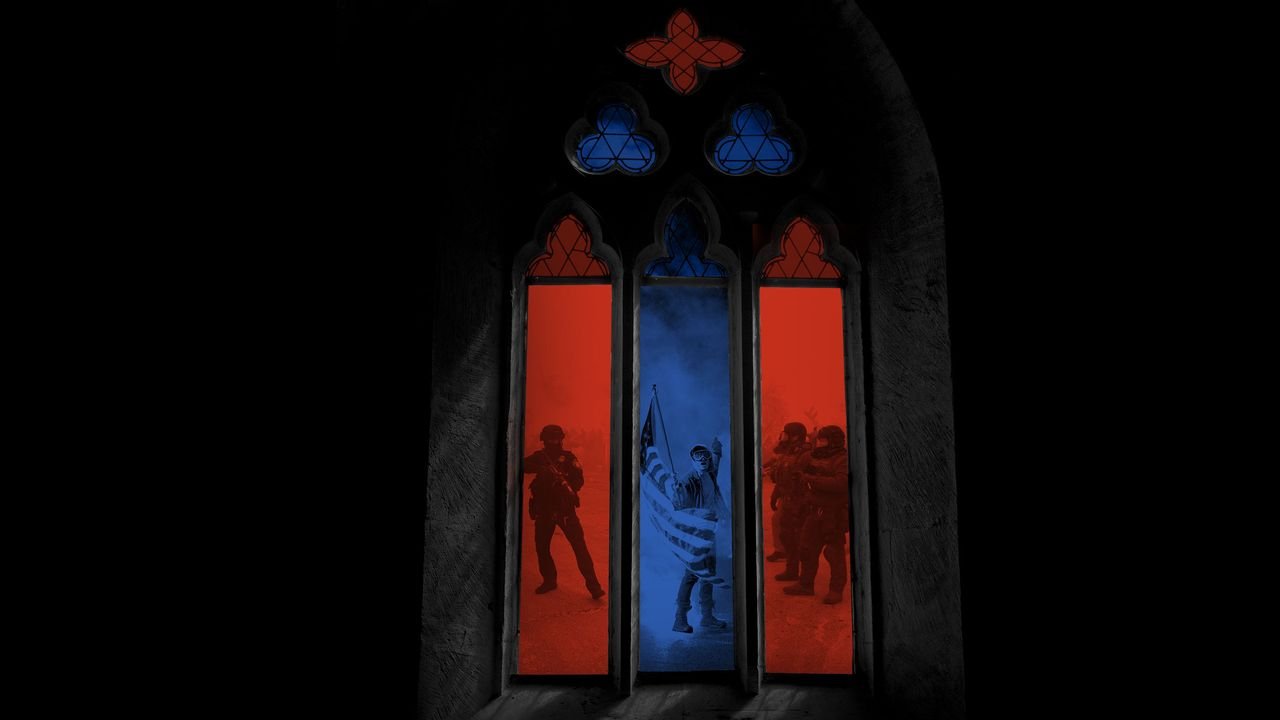
It’s clear to me that progressive causes would be better served with the church in a leadership role, but it’s also clear that this is a nostalgic vision, out of touch with both the reality of churchgoing today and the torpor of our screen-bound lives. When so much dissent happens online or at big marches under vague political banners—when even some religious services take place within the blurry rectangles of Zoom—how does a church, synagogue, mosque, or temple make itself heard?
University Lutheran Chapel still holds services today, in the sort of odd, asymmetrical building that you sometimes find in college towns filled with architects and ideas. (The best way to describe it would be neo-California Spanish but mid-century modern, too.) In 1969, the church hired a young pastor named Gus Schultz, who had worked in the civil-rights movement in Alabama. In 1971, Schultz and U.L.C. made their first declaration of sanctuary for conscientious objectors from the Vietnam War. The logic of that declaration—that the church would provide shelter for those whose lives were at risk—was applied to the 1982 Sanctuary Movement, and Schultz is widely credited as one of the principal visionaries who spread the idea to faith organizations nationwide. U.L.C. still identifies itself as part of a network of sanctuary faith organizations, and commits itself to a broad range of social-justice issues, but it does so now at a time when young people are either not going to church or, in some instances, are seeking out more traditional and ritualistic forms of spirituality. Congregations like U.L.C. are aging, and, although there are still faith organizations around the country that engage in activist work, the church does not have the same prominence in campaigns of civil disobedience. At the same time, many progressive church leaders, facing dwindling congregations and general public apathy, have become more careful about appearing partisan in any way, which has allowed right-wing Christian nationalism to define the conversation about religion and politics.
Last September, U.L.C. brought in a new pastor, named Kwame Pitts, whom the church’s leaders believed could continue the sanctuary tradition. “One thing the search committee told me very early on was that they were planning to put themselves and their bodies on the line in this push against injustice regarding immigration,” Pitts told me. They asked her, “Are you with us?” She said she was.
Pitts believes in a church that follows in the footsteps of the civil-rights movement and thinks that the turn away from politics might be part of the reason so many young people in subsequent generations have decided to stay home on Sundays. But she also said that there has been a “fracture” along familiar political lines that has led to an uneasy stasis among clergy. Faith communities are not like universities or some workplaces, where it is easier to come together in something close to political conformity. And, because so many churches have fewer and fewer members, it’s hard for any church to turn itself into the vanguard of one cause or another. Perhaps a place of worship in a liberal haven such as Berkeley can do so, but this is harder to pull off in more politically purple parts of the country. Pitts told me that, when she attended seminary, she was taught to talk about what was happening in the country and to push her congregation to stand with the oppressed and to love their neighbor as they love their creator, which she sees as Christ’s two most important teachings. “When we got out into the real world,” she said, “we realized very quickly that there are a lot of churches who are not interested, and just want to be comforted and protect what they have to make sure their church didn’t die out.”
Pitts is of the opinion that dwindling attendance and the rise of Christian nationalism have effectively silenced much of the clergy who might otherwise have expressed political or humanitarian thoughts about ICE. She does not think that we are returning to a time when there were “over forty kids in Sunday School” per church, as she put it; nor does she see converting people into churchgoers as a central part of her mission. “Literally, my job is to ask, ‘Do you need some food? Do you want lunch? Do you need a place to vent?’ ” She said that this approach encourages the type of interfaith community-building that informed the original Sanctuary Movement.