
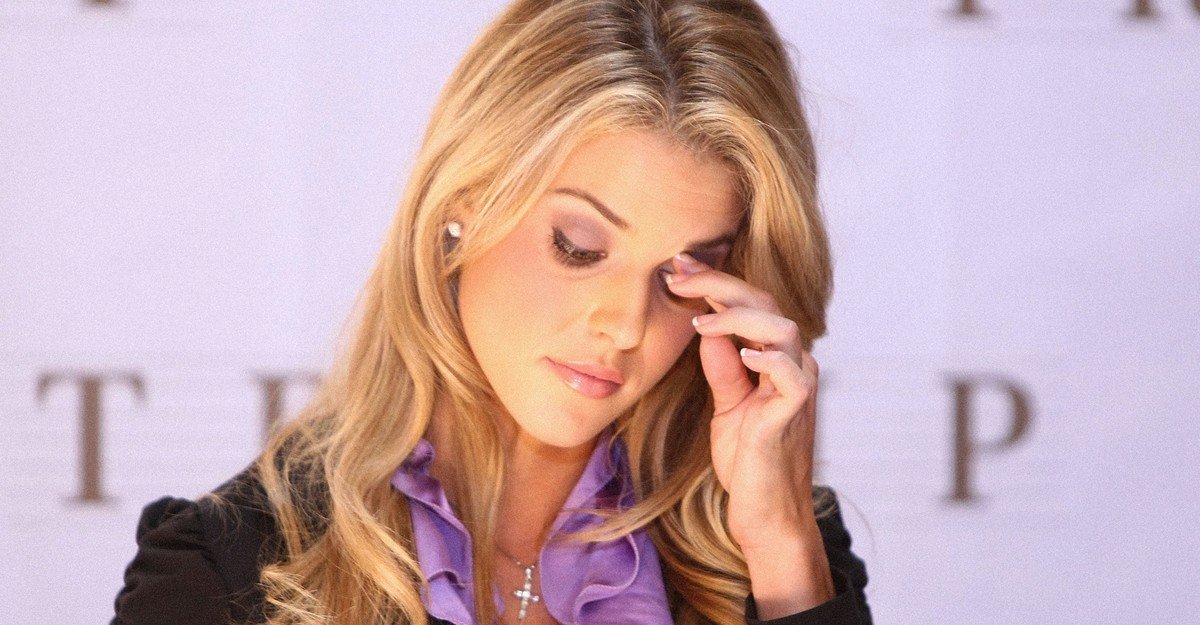
“It is not a biblical mandate that I have to worship Israel,” Carrie Prejean Boller told me today. The former Miss California USA turned social-media influencer was dismissed from President Trump’s Religious Liberty Commission yesterday after drawing charges of anti-Semitism. But, she wanted to make clear, she regrets nothing—and has no intention of disappearing without a fight.
On Tuesday, the Religious Liberty Commission held its fifth hearing, in Washington, D.C., to discuss anti-Jewish prejudice. Meetings of blue-ribbon panels are typically sleepy, stage-managed affairs designed to serve the purposes of whatever administration put them together. But Boller had other ideas. She repeatedly interrogated the participants about their opinions on anti-Zionism, which she distinguished from anti-Semitism, and complained that other panelists had called Candace Owens and Tucker Carlson, the wildly popular podcasters, anti-Semitic.
Video of Boller’s interjections went viral, sparking furious recriminations on the right. “I’m with her,” declared former Representative Marjorie Taylor Greene. Boller took to social media in her own defense and began resharing others’ support for her conduct, including Owens’s claim that the two women were being assailed for refusing to “support the mass slaughter and rape of innocent children for occult Baal worshipers.” Boller’s performance raised her profile—her previously marginal X account increased its following 20-fold. “Be a good Goyim and give me a follow,” she posted Tuesday afternoon, inaccurately using the plural form of the colloquial Hebrew word for “non-Jew.” Yesterday, Texas Lieutenant Governor Dan Patrick, the chair of the Religious Liberty Commission, announced that Boller had been removed, saying in a statement that “no member of the Commission has the right to hijack a hearing for their own personal and political agenda on any issue.”
When I interviewed Boller by phone about her experience, she told me that the first attempt to oust her from the commission came back in August, when she received a phone call from a staffer at the Office of Presidential Personnel asking her to step down. Boller attributed this effort to her social-media posts about the devastation in Gaza. She alleged that Patrick and Paula White, a confidante of Trump’s whom Boller described as an “absolute evangelical demon,” had been “colluding with the White House.” (The commission did not immediately respond to a request for comment.)
Boller cited her faith when explaining her position, as she had at the hearing. “It’s anti-Christian to accuse me of anti-Semitism by being a Christian,” she said. She reiterated that Zionism is not compatible with her Catholicism, the faith to which she converted in April. The Vatican has long recognized the state of Palestine and called for a two-state solution, positions at odds with those of the current Israeli government, but it has also backed Israel’s right to exist. Indeed, as long as the subject was Israel, Boller was eager to engage. But when the conversation turned to other things that she had said at the commission hearing that pertained to anti-Semitism, not merely anti-Zionism, she suddenly became much more evasive.
“I would really appreciate it if you would stop calling Candace Owens an anti-Semite,” she told one of the witnesses at the hearing, Seth Dillon, the CEO of the conservative satire site The Babylon Bee. “I don’t know why you keep bringing her up and Tucker,” she added. “Because they’re the two most famous anti-Semites,” retorted Dillon. “Everyone’s an anti-Semite!” Boller replied. “Do you think that anything Candace has said is anti-Semitic?” Dillon later asked. “No, I don’t,” Boller responded. “I listen to her daily, and I haven’t heard one thing out of her mouth that I would say is anti-Semitic.”
As it happens, Owens has said many deranged things about Jews, plenty of which have nothing to do with Israel. So I was surprised to hear her so vigorously defended at a hearing ostensibly devoted to combatting anti-Jewish bigotry. I raised the subject with Boller, who regularly reposts content from Owens on social media, and I quoted several recent claims that the podcaster had made.
On February 2, for instance, Owens praised the decision of General Ulysses S. Grant to expel all Jews from his military district in 1862, during the Civil War. The move was soon reversed by President Abraham Lincoln, and Grant later disavowed it—but Owens did not. “Jewish supremacists,” she said, “had everything to do with the Civil War in America. They excel at creating the false dialectic, the North versus the South, the left versus the right. Ulysses S. Grant notoriously expelled Jews from his military district: Tennessee, Mississippi, Kentucky. You think he just—he was just, like, what? Another white supremacist? Everyone’s just a white supremacist,” she said. “Well, they would have called him a white supremacist” or said that “he was anti-Semitic.”
I read this monologue to Boller and asked her if she thought it was anti-Semitic to defend expelling American Jews. “I’m not going to get involved in any of that,” she said. “I watched her show, and I have never heard anything out of her mouth that is anti-Semitic. So I’m not gonna make a statement on something that I haven’t heard the full context of.” I offered to play Boller the audio of this remark in its full context. She declined to listen. So I moved on to another of Owens’s greatest hits: blaming American Jews for the African slave trade. This canard has been repeatedly debunked by historians and repeatedly invoked by Owens. “Jewish people were the ones that were trading us,” she said in December. “Jewish people were in control of the slave trade. They’ve buried a lot of it, but it’s there and you can find it.”
Was this anti-Semitic? “From what I’ve heard from my ears, from her mouth, I have not heard anything that is anti-Semitic,” Boller repeated. Okay, but if someone such as Owens did say such things, it would be anti-Semitic, right? “I’m not playing the ‘What if?’ game,” she said, her previous moral clarity abruptly turning into cagey ambiguity.
I had hoped to ask Boller for her opinion about other claims made by Owens—that “Talmudic Jews” think “that we’re animals, that they have a right to own us, that they have a right to make us worship them,” and that Israel was complicit in the 9/11 attacks and the assassination of President John F. Kennedy—but she refused to engage and eventually ended the call. Rather than reckon with anti-Semitic statements from those she had defended at a hearing intended to confront anti-Semitism, she repeatedly attempted to reroute our conversation back to the safer ground of criticizing Israel. She either did not realize that she was using anti-Zionism as a pretext to launder vulgar anti-Semitism and its purveyors into the public square, or she did not care.
Although Boller may not be willing to answer such questions from a reporter, she is also not backing away from her views. Before our conversation concluded, she told me that she planned to show up at the Religious Liberty Commission’s next meeting because, she argued, only President Trump himself has the authority to fire her. “I remain on this commission until I hear from the president,” she said. “I want the president to admit: Is he ‘America First’ or ‘Israel First’?”



