
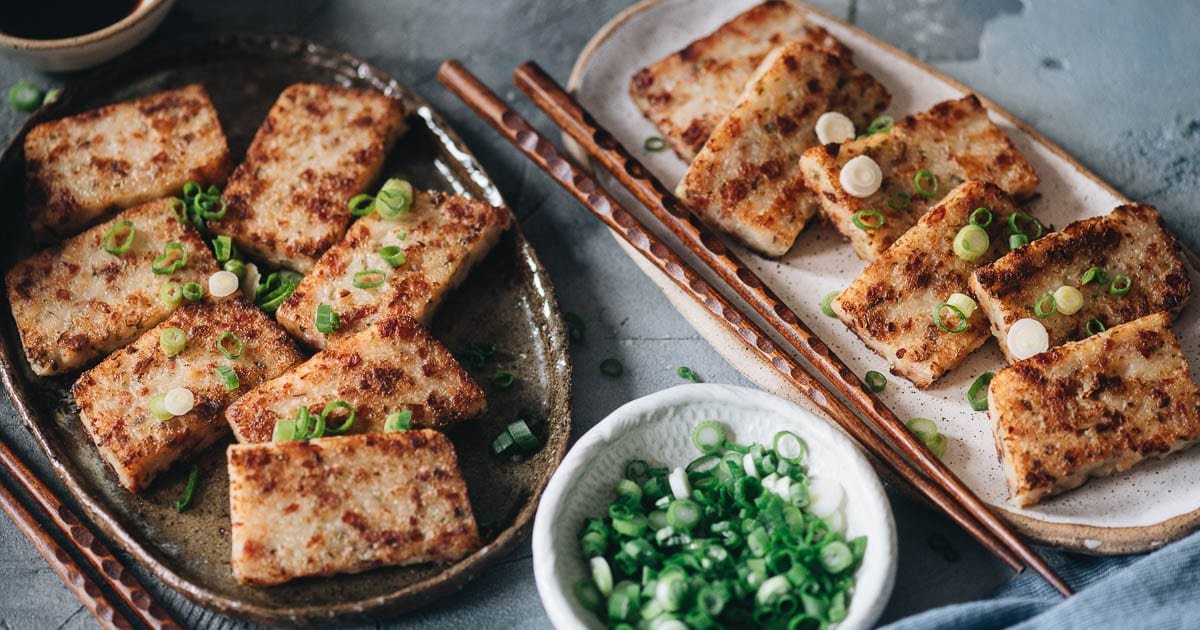
Lo bak go (萝卜糕) is a traditional Cantonese dim sum made from rice flour and daikon radish, steamed until set and then pan fried until golden and crispy. It is a must have during Chinese New Year celebrations and Lunar New Year feasts, symbolizing good fortune for the year ahead.
I grew up eating turnip cake at dim sum restaurants, but I was never impressed until I tried the homemade version loaded with delicious filling. For my recipe, I grate the daikon, cook it with a savory filling of Chinese sausage and dried shrimp, steam the batter for about an hour, then rest it overnight and pan fry slices until crispy. So good!
I know this recipe takes time and effort, but the results are worth it when my family gathers around the table during the holidays. My husband loves the crispy edges and my friends always ask to take some home, so I make extra for them since it stores so well. I hope you give this recipe a try at home and make it a tradition in your kitchen too.

Ingredients
I grouped the ingredients by dried goods that need soaking, the main vegetable, the filling, and the seasonings for the batter.

Dried Goods
Dried shiitake mushrooms: These add deep umami flavor to the filling. I soak them in warm water until soft and dice the caps into small pieces.

Dried shrimp: These tiny sun dried shrimp bring an intense savory taste. I mince them after soaking so they distribute evenly throughout the cake.

Main Ingredient
Daikon radish: This is the star of the dish, grated coarsely and cooked until soft. You will need about 2 lbs before peeling, which yields around 1 lb 4 oz grated. Do not use turnip in this recipe, or else the finished dish could be off.

Filling
Chinese sausage: I use 3 sausages, slice it in half, cut each half into thin strips, and then chop everything into small pieces.
Note: I left the pieces a little larger in my version, but you can mince further if you prefer the dim sum restaurant style.

Batter and Seasonings
Rice flour: I use 1 1/4 cups to create a batter that sets into a tender cake. The ratio of flour to liquid is the trickiest part of this recipe.
Sugar, salt, white pepper: These simple seasonings balance the savory filling.
Different filling variations
Every family has their own preferred filling for turnip cake. Here are some of the most popular options:
Dried scallop: It is also called conpoy (干贝). You can use it to replace the dried shrimp, or add about 2 tablespoons dried scallop and reduce the Chinese sausage into 2 links. Soak in warm water thoroughly then use your hands to break them into thin threads before using.
Cured pork belly (腊肉): It adds a savory taste and amazing texture. You can use a 1/4 cup small diced dried ham to replace 1 to 2 links of Chinese sausage.
Scallions: You can thinly slice 1 to 2 scallion and add to the turnip cake. You don’t need to cook them before adding. Scallion adds freshness, a subtle sweetness, and bright color.
How to Make
Soak the mushrooms: Rinse the shiitake mushrooms with tap water and rub them to remove any dirt. Place in a bowl and add warm water to cover. Soak for 15 minutes, or until soft. Drain thoroughly and dice the caps into 1/4 inch pieces.

Soak the shrimp: Rinse the dried shrimp with tap water and rub to remove any dirt. Place in a separate bowl and add warm water to cover. Soak for 15 minutes, or until soft. Drain thoroughly and mince.

Cook the sausage: Add the Chinese sausage to a large nonstick skillet and heat over medium. Turn to medium low once it starts to sizzle and cook until lightly browned and some fat has rendered, about 5 minutes. Transfer to a bowl and reserve the rendered fat in the pan.
If you use minced Chinese sausage, stir and cook for 1 minute or so, until they are just lightly seared.

Cook the mushrooms and shrimp: Add the mushrooms and shrimp to the pan. Cook until lightly charred, then transfer to the same bowl with the sausage.

Braise the daikon: Add the daikon radish and 1 cup of water into the same skillet. Cook over medium high heat until simmering. Cover and simmer over medium low heat until the daikon is soft and translucent, 8 to 10 minutes.

Strain the daikon: Strain the cooked daikon over a colander, pressing out as much liquid as you can into a measuring cup.

Create the batter: Measure out 1 cup of liquid and pour it into a large bowl. Add rice flour, sugar, salt, and white pepper. Stir well until a very runny batter forms.

Add the daikon: Add back the daikon and mix again.

Thicken the batter: Transfer the mixture to a clean nonstick skillet. Cook over medium low heat, stirring constantly, until the mixture has thickened enough to form a clump when stirred, about 1 to 2 minutes.

Add the filling: Stir in the cooked filling.

Assemble: Grease a glass container or baking dish that fits your steamer with oil. Transfer the mixture into the container.

Steam: Set up your steamer with plenty of water and bring to a boil. Place the container on a steaming rack and steam over medium high heat for 50 to 60 minutes.

Rest and fry: Let the turnip cake cool completely, then refrigerate overnight until fully set. Turn the cake out of the container and cut into 1/4 inch thick slices using a sawing motion for clean edges. Pan fry in a thin layer of oil over medium heat until golden on both sides.

Serve: Enjoy with soy sauce and sliced green onions. Check my Serving Suggestions section for more details on how I like to serve.

Expert Tips
Get the daikon to flour ratio right: If you use too much flour, the cake turns tough. Too little and it will not hold together. I like to use the ratio of 2 pounds daikon with 1 1/4 cups rice flour. I press the cooked daikon well and measure exactly 1 cup of liquid to mix with the flour for a tender result.
Cook the batter before steaming: The batter looks runny at first, but cooking it briefly in the pan thickens it just enough to holds its shape. This technique is the only way I have found to add more moisture while still getting a cake that sets properly.
Cut with a sawing motion: This recipe creates such a tender cake that cutting straight down crushes it. I use a back and forth sawing motion for smooth, clean edges that brown evenly when pan frying. The cake becomes much easier to slice if you let it set in the fridge overnight.
Rest the cake overnight: You can eat the rice cake the same day once it cools off. But the turnip cake will have a stickier texture and it’s hard to get a clean cut. The cake also has a softer texture during pan frying, so you need to handle them carefully. Overnight in the fridge gives the best texture.
Customize the filling: Every family has different preferences. Dry scallop and Chinese preserved pork belly are popular additions. I add them by reducing the amount of dried shrimp and Chinese sausage.
Serving Suggestions
I serve turnip cake straight from the pan while the edges are still crispy. Add a drizzle of soy sauce if you want more saltiness. My favorite way is to serve it with chili garlic sauce. Other times I set out my homemade chili oil as well to let everyone add their own heat.
When I make this for Chinese New Year gatherings, I steam the full batch ahead of time and keep it in the fridge. Then I slice and pan fry portions as guests arrive so everyone gets hot, crispy slices throughout the meal. Turnip cake pairs well with other dim sum favorites like char siu bao, Chinese egg rolls, and steamed custard buns. For a full holiday spread, check out my Chinese New Year recipes roundup for more ideas.

Frequently ask questions
Why is my turnip cake tough?
The most common reason is using too much rice flour. I measure my ingredients carefully and make sure to press out the daikon liquid before measuring. The ratio I use creates a tender, moist cake.
How do I know when the turnip cake is done steaming?
I insert a knife into the center of the cake. It should come out clean with no wet batter sticking to it. The steaming time is about 50 to 60 minutes depending on the thickness.
How do I store and reheat turnip cake?
I store the steamed cake in an airtight container in the fridge for 2 to 3 days, or freeze for up to 1 month. Before using it, thaw frozen cake overnight in the fridge before pan frying. I always pan fry to reheat to create the best texture.
Chinese Cooking Made Easy
Are you new to this website? This free email series is a great place to start. I’ll walk you through a few of my most popular recipes and show you how and why they work. You’ll quickly start to cook better Chinese food in your own kitchen.
I make this turnip cake with grated daikon, Chinese sausage, and dried shrimp, then steam and pan fry it until crispy on the outside. The key is getting the daikon to flour ratio just right so the cake is tender and moist, not tough. It is a classic dim sum appetizer dish I make every Chinese New Year, and it tastes so much better than the restaurant version.
Prevent your screen from going dark
Soak dried ingredients: Rinse the shiitake mushrooms and dried shrimp separately with tap water and gently rub them to remove any dirt. Place each ingredient into a different bowl. Add warm water to cover. Soak for 15 minutes, or until the ingredients turn soft. Drain thoroughly. Dice mushroom cap into 1/4” pieces and mince the shrimp.
Cook the filling: Add the Chinese sausage into a large nonstick skillet and heat it over medium heat. Cook from a cold pan and turn to medium-low heat once the sausage starts to sizzle. Cook until the sausage is lightly browned and some oil is rendered off, 5 minutes or so. Transfer the sausage to a bowl and reserve the rendered fat. Add the shiitake mushrooms and dried shrimp. Cook and stir until lightly charred. Transfer to the same bowl with the sausage.
Cook the daikon: Add the daikon radish and 1 cup of water into the same skillet. Cook over medium-high heat until simmering. Cover, simmer over medium-low heat until the daikon is soft and translucent, 8 to 10 minutes.
Create the batter: Strain the cooked radish over a colander, pressing out as much liquid as you can into a big bowl or measuring cup. Measure out 1 cup of liquid, pour into a large bowl. Add rice flour, sugar, salt and white pepper. Stir to mix well until forming a very runny batter. Add back the radish and mix again.
Cook the batter: Transfer the radish mixture to a large, clean nonstick skillet. Cook over medium-low heat and stir constantly, until the mixture has slightly thickened. When you stir the mixture, the radish should be able to form a clump without looking too runny. This will only take 1 or 2 minutes. Stir in the cooked filling.
Assemble: Prepare 1 to 2 glass tupperware or baking dishes that can fit into your steamer. You can use two 4.5” x 4.5” (11cm x 11 cm) tupperware dishes to cook two batches. If you have a large wok or steamer, you might be able to fit a 5” x 9” (13cm x 23cm) loaf pan or 7”x7” (20cm x 20cm) baking pan (*Footnote 3). You’ll only need to cook one batch in this case. If you’ll be cooking in two batches, cover the uncooked batter with plastic wrap to prevent it from drying out. Grease the glass tupperware with oil. Transfer the mixture into the tupperware.
Steam: Set up your steamer by adding plenty of water and bringing it to a boil (*Footnote 4). Add the steaming rack with the turnip cake container. Steam over medium-high heat for 50 to 60 minutes until the turnip cake is cooked through. Test the doneness by inserting a knife into the cake and it should come out clean.
Rest: Remove the steamed turnip cake and set it aside to cool. Once the container is no longer hot, transfer it to the fridge. Let the turnip cake set until it has cooled completely. (*Footnote 5)
Release: Use a knife to loosen the edges from the container, then turn the container upside down. The turnip cake should come out in one piece.
Serve: Cut the turnip cake into 1/4” (1 cm) thick pieces. Heat a skillet coated with a thin layer of oil, cook both sides over medium or medium low heat until heated through and the surface turns golden. Garnish with sliced green onion if using. Serve with soy sauce and chili garlic sauce, if desired.
Store: Transfer the steamed turnip cakes (without pan-frying) into an airtight container and store them in the fridge for 2 to 3 days, or in the freezer for up to 1 month. To reheat, thaw the frozen turnip cakes first, and pan fry them before serving.
Ingredient Substitution Guide
- I used a radish that was just under 2-lb (900 g). After peeling and grating, I had 1 lb 4 oz of grated radish to use in the cooking. You will lose quite some daikon by peeling and grating, so it’s better to purchase extra.
- I like to keep the sausage pieces slightly larger for a chewy texture. To slice the sausage, divide it into 3 pieces lengthwise, then divide each piece into 3 strips lengthwise. Then slice across into a small dice that’s just slightly larger than minced. If you prefer the dim sum restaurant style, mince the sausages and cook them less.
- A 8” round pan works too and it will fit into a steamer easier than a square container. The cuts you get from it will be less perfect looking but it won’t affect the taste.
- It’s very important to add plenty of water to your steamer, because it takes a long time to cook and the water might boil completely off if you don’t add enough.
- You can slice the turnip cake when it’s still warm, but the texture will be a little sticky and you won’t get a clean cut.
Serving: 1serving, Calories: 170kcal, Carbohydrates: 25.5g, Protein: 7g, Fat: 5g, Saturated Fat: 1.6g, Cholesterol: 19mg, Sodium: 559mg, Potassium: 282mg, Fiber: 2.9g, Sugar: 3.4g, Calcium: 14mg, Iron: 1mg

Did you make this recipe?
I’d love to hear how it turned out for you! Please take a moment to leave a 5-star rating ⭐️ and share your thoughts in the comments further down the page. It really helps others discover the recipe too.
Lilja Walter is a part of the Omnivore’s Cookbook team and worked closely with Maggie to develop and test this recipe.



