The war in Gaza, which in its latest phase began with Hamas killing Israelis on October 7, 2023 and was followed by a brutal retaliation from the IDF that killed tens of thousands of Palestinians and destroyed much of the Gaza Strip, has already become the subject of numerous documentaries. In “Collapse”, Anat Even returns to what was once her home, traversing for over two years the remnants of the kibbutz of Nir Oz and its surroundings, which have now been partially repurposed for tourist itineraries and military training exercises, ultimately crafting a cinematic essay on war and its aftermath.
Shortly after the events of October 7, Even returns to the burned remains of Nir Oz, once a quiet community that now stands as a symbol of loss and devastation. With her camera, she walks through abandoned homes and destroyed streets, confronting the traces of violence that still linger in the landscape. From there, she spends the next two years traveling along the fence that has separated Israel from the Gaza Strip since the mid-1990s.
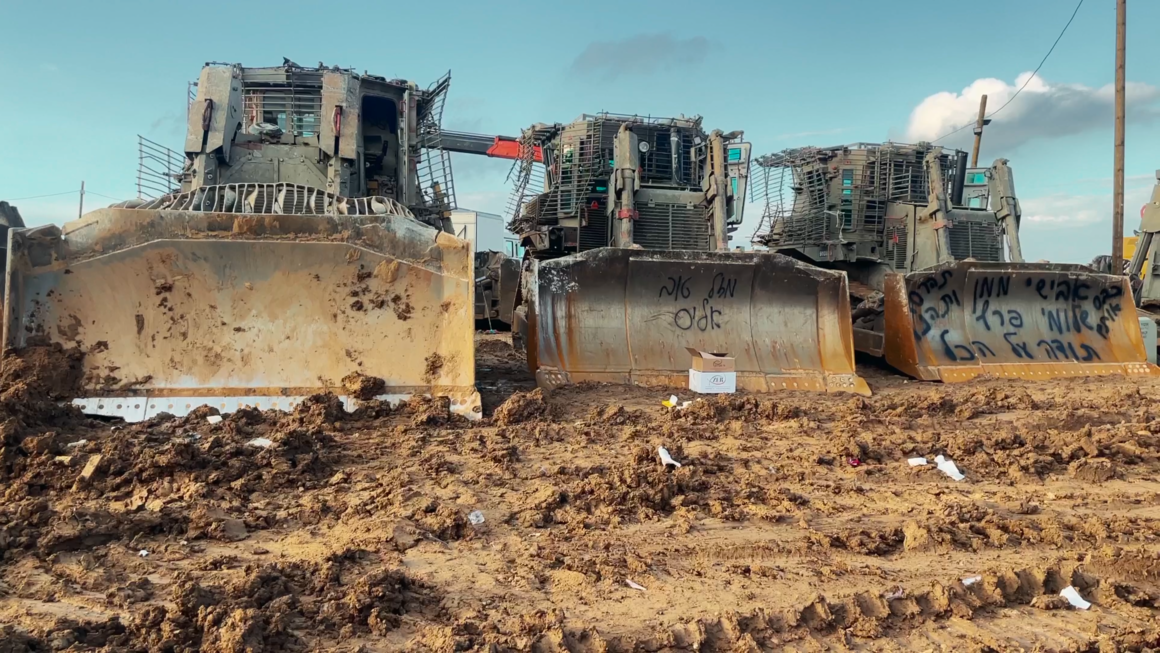
Throughout this journey, Even documents the uneasy coexistence of everyday life and military preparation. Tanks stand near agricultural fields where farmers continue to plough the land, while the distant sounds and flashes of bombardment in Gaza remain constantly present beyond the fence. Through voiceover reflections, recorded correspondence and conversations with others, the filmmaker attempts to understand not only the war itself but also the psychological and ethical tensions shaping the perspectives of those living around it.
Among the voices included in the documentary are Ariel Cypel, a Paris-based friend who eventually ends their correspondence due to political disagreements, Avichai, who criticizes Israel’s military strategy, and Palestinian doctor Ezzideen Shehab, who writes from Gaza City describing the dire conditions faced by civilians.
Even follows an observational approach, functioning both as director and cinematographer, while the work also unfolds like a road trip across the area, in an effort to present the issues from multiple angles. The result proves striking, both through the individual segments and through the accumulation of images. Particularly memorable are moments such as the mailboxes with the word “murdered” written on top of them, or the gathering of the Oz Chaim group of settlers and their intense slogans, including “Occupy, Expel, Settle” and “We must settle and Judaize Gaza”.
In general, Even attempts to approach the conflict from various perspectives, highlighting both those who support the war and those who oppose it, a relatively rare approach during such a polarized period that also provides insight into the Israeli side of the debate. At the same time, the filmmaker portrays a society grappling with anger, fear and ideological division. Equally disturbing is the sense of normalization surrounding the conflict. Tourists look out toward Gaza from observation points while smoke rises in the distance, and farmers harvest crops while artillery echoes beyond the border.
Oron Adar’s editing adopts a reflective rhythm, weaving together field footage, voiceover commentary and excerpts from letters and emails. Rather than building toward dramatic climaxes, the structure gradually accumulates fragments of testimony and observation. Sound design also plays a crucial role, as distant bombings and the constant hum of military activity form an unsettling background that reinforces the tension between visible and invisible violence.
Although “Collapse” offers little in the way of resolution, it succeeds as a chronicle of both current and past devastation and the consequences of war across all levels of society. In that regard, Anat Even’s work ultimately stands as a vital contribution to the cinematic documentation of an ongoing conflict.