
 WASHINGTON — Congress averted a long-term government shutdown but punted on a potential overhaul of immigration enforcement programs as the Trump administration increases its aggressive, and sometimes violent, mass deportation effort.
In a 217-214 vote Tuesday, the House of Representatives passed legislation to fund federal programs and agencies, days after a partial government shutdown had begun. The roughly $1.2 trillion package keeps significant quarters of the U.S. government, including the Pentagon, public health and labor agencies, running through September, when the current budget period will expire.
Congress passed a two-week extension of funding for the Department of Homeland Security, buying time for members to write and debate legislation to fund the department, a target of loathing for Democrats outraged over recent lethal shootings in Minnesota by immigration agents.
“Why do these people get to go around murdering people and beating the crap out of folks and literally terrorizing communities without any accountability?” LaMonica McIver, the House member for New Jersey’s 10th Congressional District, anchored by Newark, said in an interview off the chamber floor.

McIver and every New Jersey Democratic member voted against the bill except Rep. Josh Gottheimer (D-5th), who voted with the state’s three Republicans, Reps. Jeff Van Drew (R-2nd), Chris Smith (R-4th) and Tom Kean Jr. (R-7th).
Gottheimer said he voted for the bill because it holds money for a slew of topics, including transportation funding, firefighters, flood mitigation and mental health services.
As Congress debates the future of immigration policy in the U.S. in the coming weeks, Gottheimer said in a statement he would “be at the table advocating for the reforms” in a bill of his to establish standards for immigration officers, such a clear identification, dashboard cameras in vehicles and the protection of sensitive locations, like houses of worship, schools and hospitals.
Late last week, the Senate passed the bill, 71-29. New Jersey’s senators, Cory Booker and Andy Kim, both Democrats, voted against the legislation.
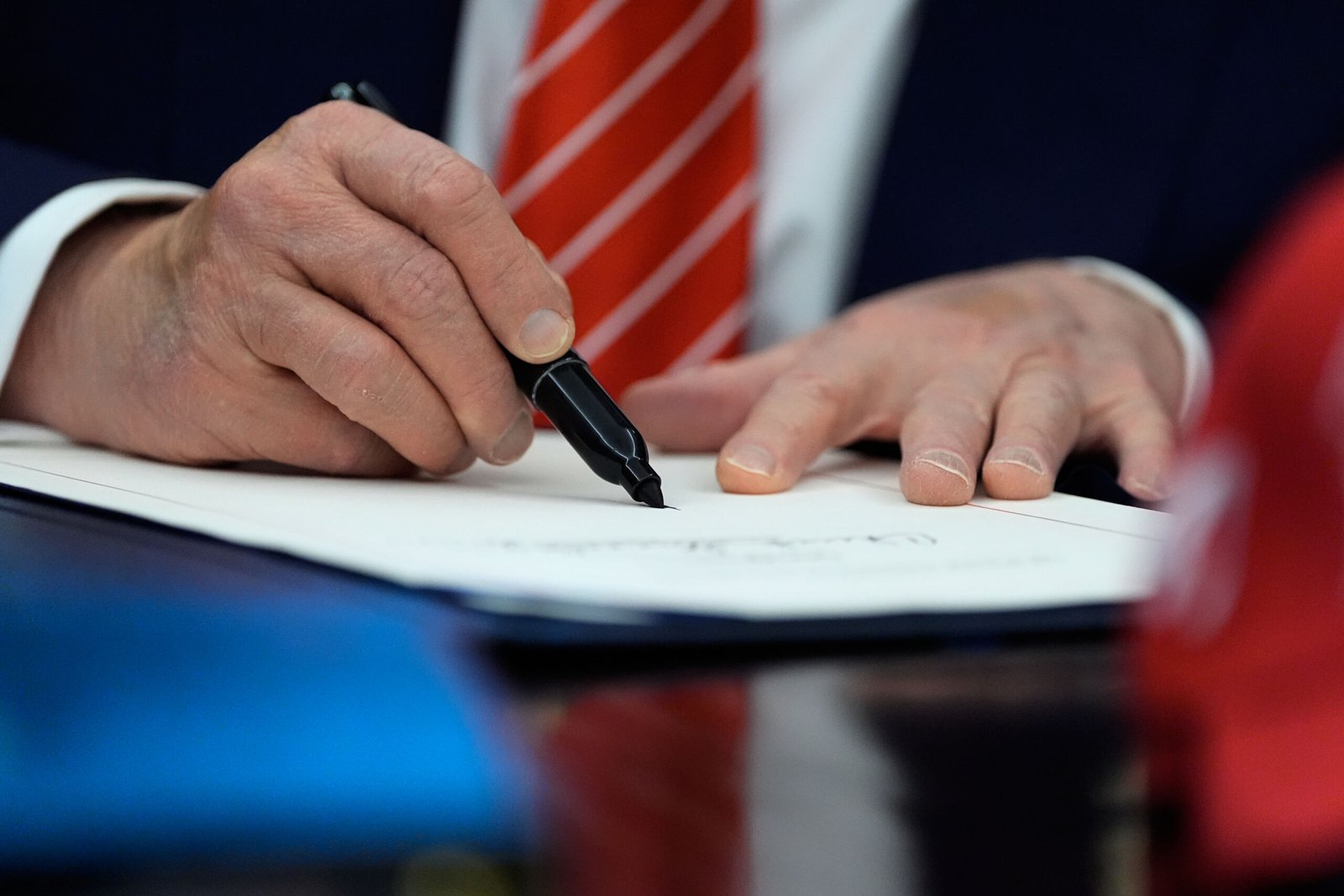
President Donald Trump, who in 2023 said undocumented immigrants were “poisoning the blood of our country,” signed the bill into law Tuesday afternoon.
The package funds large pockets of the U.S. government, from the U.S. military and the Department of Education, to foreign-aid spending and cancer-researching scientists at the National Institutes of Health.
But the steady talk and debate on Capitol Hill in the next two weeks will center on the future of the Department of Homeland Security, an octopus-like agency that includes the U.S. Coast Guard, the Transportation Security Administration, the Federal Emergency Management Agency and the U.S. Secret Service, stood up in the aftermath of the Sept. 11, 2001, terror attacks.
Democrats have called for two units within — Immigration and Customs Enforcement and Customs and Border Protection, which have dispatched for months thousands of agents nationwide in a dragnet-style immigration crackdown — to be significantly overhauled.
“This is a time we have to play hard ball,” Rep. Bonnie Watson Coleman (D-12th) said in an interview Monday night. After voting no Tuesday, Watson Coleman said DHS should be dismantled and “an immigration system that respects the rights and safety of every member of our community” replace it.
“We need dramatic change” at DHS, House Minority Leader Hakeem Jeffries, a Democrat of New York, told reporters after the vote. Instituting a policy to require immigration agents to remove their masks is a must-have, Jeffries said. “That is a hard, red line.”
In a television interview after the vote, Speaker Mike Johnson, a Louisiana Republican who sets the legislative agenda on the House floor, noted that DHS does more than immigration work.
“Republicans got the job done. Our majority worked together, and we got the bills over the line,” Johnson said after passage. Taking the agency apart is not wise, he said. “It is TSA. It’s the agents who keep us safe at the airports and keep air travel moving. It’s the Coast Guard. It’s Secret Service. It’s FEMA,” he said. “We’re in the middle of winter storms that people are still digging out from. This is not time to jeopardize that funding.”
The latest attempt to fund DHS failed after it could not muster 60 votes in the Senate, the requirement for most bills to overcome the filibuster, a legislative snag that Democrats have used during this presidency to extract concessions, such as immigration policy reform, from the Republican-majority Congress.
Street arrests by ICE agents grew by 11 times during the first nine months of the second Trump administration, researchers Graeme Blair and David Hausman of the Deportation Data Project, an independent organization that tracks immigration statistics and trends, said last week.
“Street arrests at this order of magnitude are a new phenomenon,” the two wrote in an analysis published last week.
At the same time, ICE approximately tripled the number of detention beds used in the interior of the country, in places like Delaney Hall in Newark. “It did so not only by spending more money on detention, but also because of a decline in arrivals at the border,” the pair wrote.
The legislation contains hundreds of dollars’ worth of funding for New Jersey, including money for hyper-local projects known as “earmarks.” It contains funding for the World Trade Center Health Program. And it holds $700 million for the Gateway Program, the bridge-and-tunnel project vital to New Jersey’s transportation future though under threat from the White House.
Before the bill cleared the House, the speaker huddled with hard-right members, including a group of holdouts, in the back-center of the chamber, cajoling and listening to their demands. While that group of Republicans, largely members of the House Freedom Caucus, an often reflexively anti-government cluster.
Once Republicans flipped the holdouts on the procedural vote, passage of the full bill was highly likely.
There might be a compromise over requiring ICE and CBP to wear body cameras, members indicated.
“Couldn’t agree more,” said Tom Cole, a cigar-chomping Oklahoman who chairs the House Appropriations Committee.
The top Democrat on the committee, Rosa DeLauro of Connecticut, said further delay in funding the government would place important work and services, like Head Start and federally qualified health centers. “The list goes on and on and on.”
Members should focus on molding the budget and policies of DHS in the next weeks, she said, calling DHS under the Trump administration a “season of terror” and noting how immigration raids have struck fear in the hearts of U.S. citizens, too.
“People are so frightened to death that they are carrying their passports with them,” DeLauro said.



