
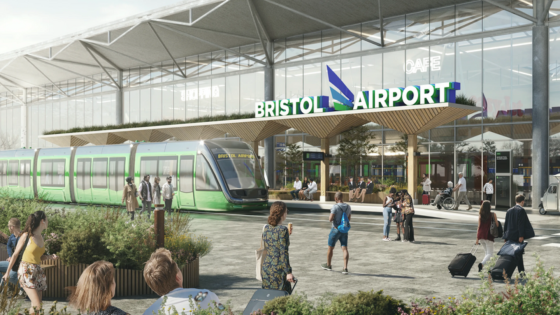
The West of England Combined Authority (Weca) has announced it will focus on developing a mass transit system to take passengers from Bristol city centre to the airport hoping to start construction in the next four to five years.
What form this mass transit will take is yet to be decided by the authority has suggested both a light railway or electric tram system as suitable options. A further proposal details “vehicles that look and operate similar to trams, for instance with longer vehicles, multiple entry/exit points, low floors, smooth ride quality, and running on segregated roadways”.
Mayor of the West of England Helen Godwin unveiled the early proposals as part of Weca’s Transport Vision.
This “confirms a shared determination from the region’s political leaders to deliver the work needed to be able to start building mass transit within four or five years”.
The focal point of the vision is the “first potential concepts of mass transit for the West, picturing Redcliffe Way and Bristol Airport”.
Weca’s report details the need for a new mass transit system connecting the city of Bristol with Bristol Airport as it is the country’s only regional airport without a fixed mass transit link.
“We are the largest city-region in the country without a committed or operational mass transit system, and Bristol Airport is the largest airport in the UK without a fixed mass transit link,” the report states.
“The National Infrastructure Commission identified the region as one of the four places in the UK most in need of mass transit investment.”
The combined authority currently has funding to invest in the mass transit system and said it is working to develop a 15-year plan a system for all of its economic growth zones. Within that, Weca’s ambition is for the link between the city centre and airport to start delivery within four to five years but “achieving this will require our region to make a unified and compelling case to government for further investment”.
A visualisation of the Weca’s potential mass transit system
As well as the mass transit system, Weca has outlined a number of other immediate priorities.
Delivering the long-awaited Portishead line and new stations at Charfield, North Filton and Henbury are high up its wish list.
A year ago a deal was struck between Weca and the government to fund the reopening of the abandoned Portishead Branch Line. The project was previously due to be funded under the Restoring Your Railway fund, but this initiative was cancelled in summer 2024 after the current government came into power.
Beyond the mass transit system and planned rail routes, Weca outlined other areas of interest where the future of the region’s public transport system is concerned.
These are:
- The West Innovation Arc (WIA) where Weca is looking at increasing rail frequency between the WIA and Bristol Temple Quarter, as well as orbital routes
- The Bristol and Bath Growth Zone (A4 corridor)
- The North Somerset Growth Gateway, including the airport
- Improved public transport connections to the Somer Valley Growth Zone
- Linking key locations across Bristol city centre, including enabling seamless onward journeys from Bristol Temple Mead
Former Bristol mayor Marvin Rees continually promoted the idea ofbuilding an underground rail system in the city during his tenure, which endced in 2024.
Previous costings of the project had put it somewhere between £4bn and £18bn to fully construct. Rees defended a £7bn price tag for the proposed scheme after a leaked report by WSP claimed the scheme could cost up to £18bn.
A leaked Weca report recommended the scheme go forward but West of England metro mayor Dan Norris said the city would not get an underground.
It wasn’t the first time Norris had raised his scepticism for the project. In June 2023, a £15M study exploring the construction of a part-underground transit system in Bristol was confirmed despite Norris saying it was “unlikely” to go ahead.
West of England ‘needs a transport system that people can trust’
Mayor of the West of England Helen Godwin said: “Nobody wants to sit stuck in traffic or hang around for a bus that never turns up.
“Our record transport investment secured from government must make a real difference that people across the West can see and feel.
“We can start to give people their time back: to be home sooner, get out into nature more, or visit the many attractions that make our part of the world so special.
“We need a transport system that people can trust, wherever they live. Together, we can and must deliver the integrated transport system that people need and deserve.
“As we lay the foundations with existing transport projects, and step things up a gear for better buses, more trains, and mass transit plans, we will seek our fair share of further funding to really get the West moving.”
Bath & North East Somerset Council deputy mayor and leader Kevin Guy said: “Bath & North East Somerset Council is committed to a transport network that supports our growing communities, strengthens our local economy, and helps people move around easily and sustainably.
“This regional vision aligns with the work we’re already delivering – from improving travel choices to creating better-connected places – and will help us secure the investment needed to keep our area moving. We look forward to working closely with our partners to ensure residents and businesses feel the benefits of this long term plan.”
Bristol City Council leader Tony Dyer said: “We have already seen how beneficial targeted investment in our city’s transport system can be, from our new fleet of eco-friendly buses to new train stations that better connect our communities.
“Yet, we continue to be held back by a transport network that struggles to maintain pace with the growing demands of our city.
“That is why this newly set out vision is so important. Bristol continues to punch above its weight culturally and economically, yet we are still crying out for real, sustained investment into our transport system.
“Through this plan, we can take the first steps to delivering the modern, reliable, and future proofed transport network, which includes a mass transit system, that our residents deserve and continue to unlock the full potential of our city centre and the wider region.”
North Somerset Council cabinet member for highways and transport Hugh Malyan said: “Getting around shouldn’t be a daily struggle.
“Investment in better buses, safer walking and cycling routes, improved rail links and well-maintained roads across the region will make every day journeys easier for people in North Somerset.
“By working with our neighbours across the West, we want to deliver practical, joined-up transport improvements that support local jobs and businesses and make a real difference in our towns, villages and rural communities.”
South Gloucestershire Council leader Maggie Tyrrell said: “We welcome the Mayor’s new Transport Vision and the shared ambition to build a transport network people can trust.
“With significant growth across South Gloucestershire, we need transport improvements that help communities and businesses thrive, connecting people to key services and workplaces.
“That means reliable public transport, safe and accessible walking, wheeling and cycling.
“We will also be planning now for the next big changes in rail and mass transit. This vision is an important step towards giving people genuine choice in how we travel.”
Like what you’ve read? To receive New Civil Engineer’s daily and weekly newsletters click here.
Source: www.newcivilengineer.com



