
One day, at the turn of the millennium or thereabouts, I went to lunch at the Red Flame Diner, in midtown, with Roger Angell, the magazine’s redoubtable fiction maven, baseball bard, palindromist, and office elder. For me, meals like this were memorable. We both liked the grilled-cheese sandwiches—the Red Flame nails the crispy-to-melty ratio—and Roger was ever ready with sage advice. The New Yorker was his inheritance. His mother, Katharine White, had been the fiction editor, the magazine’s first; eventually, Roger filled the same chair, ministering to many of the same writers. As he put it to both his friends and his therapist, “For years, I sat in my mother’s office, doing my mother’s job.” The therapist, for his part, called this “the greatest piece of active sublimation in my experience.”
Over those grilled-cheese sandwiches, I complained to Roger that, although I could readily persuade an eminent foreign correspondent to head off to some troubled corner of the earth, it was, well, quite a different thing to—
He cut me off. “Let me guess,” he said. “It’s surprisingly hard to get the longer reported pieces that are funny along the way.”
Well, yes. How did he know?
“I know because I heard the same thing from Tina and Gottlieb and Shawn and Ross,” he said, naming my predecessors, running back to the Jazz Age.
I didn’t really grow up on The New Yorker. Esquire, Rolling Stone, and the Village Voice carried the countercultural news. But later, catching up, I read a long string of comic reported pieces in The New Yorker that knocked me sideways: Calvin Trillin on the crime reporter Edna Buchanan; Mark Singer on an Oklahoma banking crisis; Ian Frazier’s Profile of Poncé Cruse Evans, who wrote the “Hints from Heloise” advice column; Susan Orlean on the Shaggs, a sublimely bad cult band.
Roger, who died in 2022, when he was a hundred and one, would, year after year, echo what he said to me at lunch that day: Treasure the funny stuff. Because life, in case you haven’t noticed yet, will wear you down.
And so, by way of capping off a centenary year of Takes and a technological revision of our online archive that has made cruising through a century of writing a cinch, I want to point to an exemplary deep cut—what the critics so condescendingly call a “minor classic.”
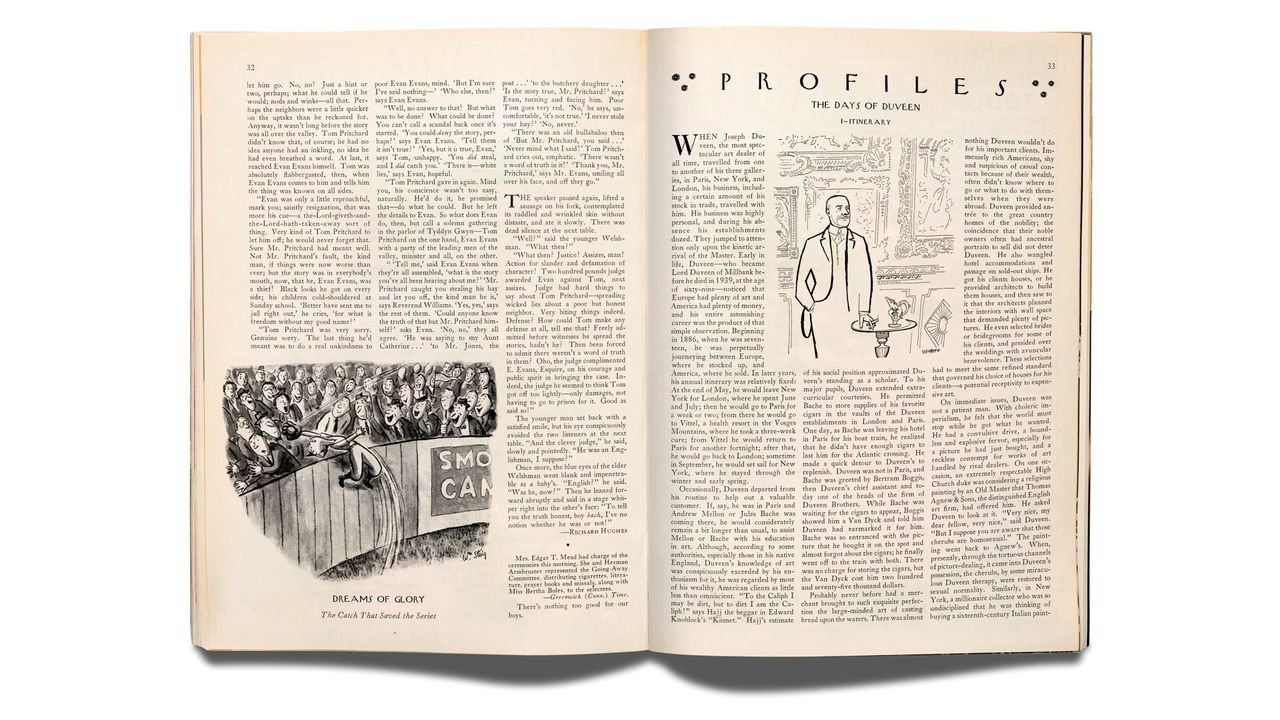
Between the early twenties and early sixties, S. N. Behrman, the son of Lithuanian Jewish immigrants, was known for his screenplays and Broadway plays. Dated stuff now, for the most part (unless you happen to treasure Greta Garbo in “Queen Christina” and “Two-Faced Woman”). What lasts, what makes me preposterously happy every time I read it, is “The Days of Duveen,” his wry Profile of the British-born art dealer Joseph Duveen, which was published in 1951, in six installments. The Gilded Age had bred a generation of new American wealth—Rockefeller, Frick, Hearst, Kress, Huntington, Mellon, Morgan. All they lacked was taste, and they dearly wanted to buy some. Duveen rushed toward that market requirement with an insight that would transform culture and its transoceanic acquisition: “Europe has a great deal of art, and America has a great deal of money.”
He combined brash self-confidence and an ability to sell himself as the arbiter of just what an American millionaire must have on his walls: “Each picture he had to sell, each tapestry, each piece of sculpture was the greatest since the last one and until the next one,” Behrman writes. “How could these men dawdle, thwart their itch to own these magnificent works, because of a mere matter of price? They could replace the money many times over, but they were acquiring the irreplaceable when they bought, simply by paying Duveen’s price for it, a Duveen.”



