
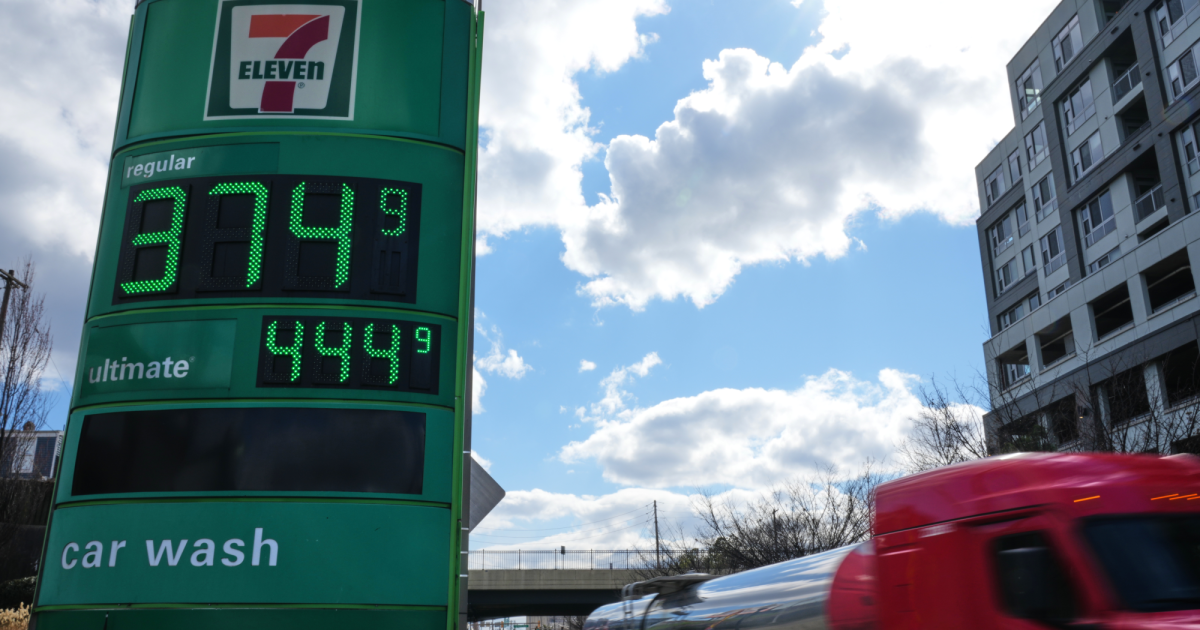
A gas station in Baltimore., March 17, 2026.Stephanie Scarbrough/AP
This story was originally published by the Guardian and is reproduced here as part of the Climate Desk collaboration.
With big oil companies poised to reap billions of dollars in profits from the war in Iran, Democratic lawmakers and progressive groups are calling for a windfall tax on major fossil fuel companies.
The US-Israeli strikes on Iran have triggered the largest ever disruption to fuel supply, according to the International Energy Agency, sending crude costs surging over $100 per barrel in recent days. Those high prices have hit US pocketbooks, with average domestic gas prices topping $3.70 a gallon, and Americans spending more than an additional $2 billion to fill their tanks in the past fortnight according to one estimate.
“Surges in energy prices exacerbate inequality in our societies.”
As ordinary people struggle, corporations are seeing windfall gains. Since the war began last month, share prices for US oil giants ExxonMobil and Chevron have climbed by more than 5 percent and 7 percnt respectively, while their market values have soared.
With oil prices continuing to rise, the Sen. Sheldon Whitehouse (D-R.I.) and Rep. Ro Khanna (D-Calif.) have proposed taxing big oil’s windfall profits from the Iran war-fueled crisis. “Trump’s war of choice in Iran is not just a moral mistake but an economic blunder that is skyrocketing gas prices for working Americans,” said Khanna in a statement.
The Guardian has contacted the American Petroleum Institute, the top US oil lobby group, for comment.
Hours before the bill’s release, dozens of consumer and environmental advocacy organizations sent a formal letter to Congress backing such a proposal. “Revenue from a windfall profits tax should be returned directly to struggling American households to help offset rising costs,” says the letter, which was signed by the Make Polluters Pay campaign, the Sierra Club, Public Citizen, and more than 70 other state and national groups.
The time to impose the tax is now, supporters say. If oil prices remain at their current level, gas prices will continue to rise while US fossil fuel firms could collect an additional $60 billion this year, analyses from consultancy firm Rystad Energy and investment bank Jeffries show.
“Energy producers and commodity trading firms benefit from volatility in energy prices,” Isabella Weber, an economics professor at the University of Massachusetts Amherst, told the Guardian last week. Windfall taxes, she said, can “raise money to cushion the more vulnerable sections of society from cost-of-living pressures.”
Though the United States has not imposed a windfall tax on oil companies since the 1980s, the sector has profited from various fuel crises since. After Russia invaded Ukraine in 2022, oil companies recorded historic profits—profits that one 2025 study co-authored by Weber found were 13 percent higher than total investment in the US’s green energy transition that year.
“The only reason Congress won’t pass it is because too many politicians are bought and paid for by big oil.”
Donald Trump has insisted that such excess profits benefit ordinary Americans.
“The United States is the largest Oil Producer in the World, by far, so when oil prices go up, we make a lot of money,” Trump posted on Truth Social last week.
The post only holds true if by “we” Trump meant to refer to wealthy people, according to another 2025 analysis co-authored by Weber. Oil firms’ profits flow to those who own shares in them, either directly or via retirement funds, pensions, or other investments. Those people tend to be well-off, the study found.
During the 2022 fuel crisis triggered by Russia’s war on Ukraine, 50 percent of the profits of US oil and gas firms went to the wealthiest 1 percent of individuals, while the bottom 50 percent only obtained 1 percent of profits. “Since stock ownership is so heavily skewed towards the richest people in our societies, record profits for energy firms means record income for them,” said Weber. “The evidence clearly shows that surges in energy prices exacerbate inequality in our societies.”
A windfall tax could help “contain inequality and raise money to cushion the more vulnerable sections of society from cost-of-living pressures,” said Weber.
In their Tuesday letter to congressional leaders, supporters cited a University of Massachusetts Amherst study indicating that if a similar tax had been enacted during the 2022 price shock, roughly $1,715 could have been returned to each American household. “Other countries have already demonstrated that this approach works,” the letter says, noting that after the 2022 fuel shock the United Kingdom imposed a windfall tax on oil and gas companies, raising $3.3 billion in its first year and $4.5 billion the next.
Khanna and Whitehouse previously proposed a windfall profits tax during the 2022 energy crisis. At the time, one poll showed some 80 percent of Americans supported the move.
“A windfall profits tax is overwhelmingly popular,” said Jamie Henn, director of the anti-oil and gas nonprofit Fossil Free Media, which helped organize support for the current and earlier proposals. “The only reason Congress won’t pass it is because too many politicians are bought and paid for by Big Oil.”
Ultimately, the US should quickly move toward a managed transition away from “volatile fossil fuels,” said Collin Rees, US policy manager at the climate research and advocacy nonprofit Oil Change International, which signed the Tuesday letter supporting a windfall tax.
“That could deliver huge potential benefits there in terms of decreased conflict, in terms of ending the deadly wars for oil that the US keeps waging,” he said. “In the meantime, we need to stop the oil billionaires from profiteering.”



