
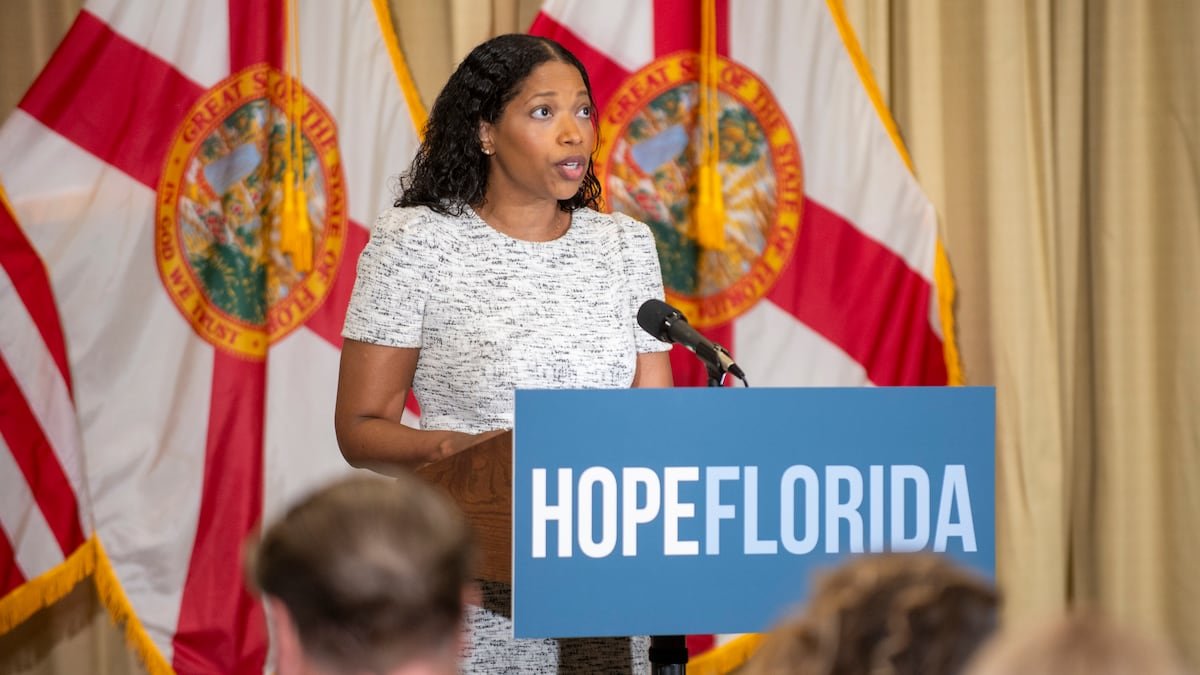
A top official in Gov. Ron DeSantis’ administration said Monday that she would not have approved diverting $10 million from a state legal settlement to the Hope Florida Foundation — and that all of it was ultimately treated as Medicaid money.
Asked whether she would have approved the 2024 settlement, Agency for Health Care Administration Secretary Shevaun Harris told a Senate committee that she wouldn’t have, but not because it was wrong.
“Obviously, looking at how it has been perceived, looking at how many people’s names have been dragged through the mud, the fallout from it? No, I would not,” Harris said.
“Only because there’s been that fallout?” asked Sen. Tina Polsky, a Boca Raton Democrat. “Or because it’s the wrong thing to do, because this money is owed to Florida taxpayers?”
“Again, every indication, from what I have seen, the conversations that I’ve had, is that no one did anything wrong,” Harris responded.
DeSantis initially said that the $10 million, from a total $67 million legal settlement with the Medicaid contractor Centene, was a “cherry on top” of what the company owed taxpayers over claims of overbilling the state for medications.
Under federal guidance, that would mean that Florida taxpayers would owe the federal government a share of $57 million, not $67 million. But Harris said Monday that the agency paid back the federal government based on the full $67 million, the first such admission by the state. Harris repeatedly ignored questions from the Times/Herald about it after her first confirmation hearing earlier this month. Medicaid is a mostly federally funded health program for the needy.
“In an abundance of caution, we returned the federal share on that money so that we would avoid any future liability with (the Centers for Medicare and Medicaid Services) or potential litigation,” Harris said.
Money from Medicaid-related legal settlements belongs to state and federal taxpayers, and diverting it to charities or political committees could amount to theft of federal funds or other crimes, four former federal prosecutors told the Times/Herald last year.
Prosecutors in Leon County convened a grand jury last year to investigate the transactions. It has yet to announce a decision.
Harris said she did not know what the $10 million was ultimately spent on and doesn’t plan on asking for it back.
“If you’re asking, ‘Does the agency intend on trying to recoup those dollars?’ The answer is no,” Harris said.
Harris is the first state official to publicly admit that they would not have approved the 2024 agreement, in which Harris’ predecessor directed Medicaid contractor Centene to donate $10 million to the Hope Florida Foundation, a state-created charity.
The diversion was part of an effort by the DeSantis administration to finance a campaign against two ballot initiatives that year — to legalize recreational marijuana and overturn the state’s six-week abortion ban.
The Hope Florida Foundation quickly gave away all $10 million to two groups that donated nearly all of it to a political committee controlled by DeSantis’ then-chief of staff, current Attorney General James Uthmeier. That committee was focused on fighting the pot initiative.
The committee gave $10.5 million to the Republican Party of Florida between October and December, campaign finance records show. Rep. Alex Andrade, a Pensacola Republican whose committee investigated the transfers last year, has said the party should return most of the money.
Harris, whose confirmation was held up because of the controversy last year, oversaw the Hope Florida Foundation as secretary of the Department of Children and Families in 2024.
In addition to the $10 million, Harris oversaw the department’s diversion of millions of other taxpayer dollars to pay for political consultants and ads to defeat the two amendments, the Times/Herald reported last year.
The money included the department diverting $1.1 million from its child protection program and $4 million from the state opioid trust fund.
The ads blanketed airwaves in the weeks leading up to the election and targeted likelier voters. But Harris said Monday that the department was already planning on running ads against opioids and other drugs that fall.
In the end, the department ran ads only against marijuana because the state “had a responsibility to clear up misinformation,” Harris said.
“It was an opportune time for us to release the ones on marijuana,” she said.
She said the department intended to run ads against opioids after the election, but never did. She left the department to lead the Agency for Health Care Administration last February.
Polsky argued that Harris didn’t deserve to be confirmed as secretary.
“They were caught stealing this money, using it for political purposes, and someone has to pay the price,” Polsky said. “And maybe it’s people above Secretary Harris. But so far, nobody has, and I just can’t, in good conscience, vote to continue someone running our agencies who was a large part of this theft.”
She noted that lawmakers last year outlawed the state from using money to campaign against amendments.
Polsky was the only member of the committee to vote against Harris.
“Certainly there’s smell around the way the money was used and diverted,” said Sen. Darryl Rouson, a St. Petersburg Democrat. “But until such time as there’s a state attorney’s decision, I would be loath to use the words ‘stealing’ and ‘theft.’ I’m voting for this confirmation based on personal and professional interaction.”
The committee on Monday also approved reappointing the Hope Florida Foundation’s attorney, Jeff Aaron, to the Public Employees Relations Commission, which handles state employee and labor disputes. Aaron is a DeSantis ally whose law firm, Polsky said, has received more than 25 contracts from the administration worth more than $2 million.
Polsky asked Aaron how the foundation came to accept the $10 million. The foundation’s leader at the time testified in a House committee last year that he learned of the donation from Aaron.
“I very much would like to talk about that,” Aaron said. “But I have to assume that I am not at liberty to discuss anything around that subject matter, so I respectfully cannot answer that question.”
Times/Herald Tallahassee correspondent Romy Ellenbogen contributed to this report.



