
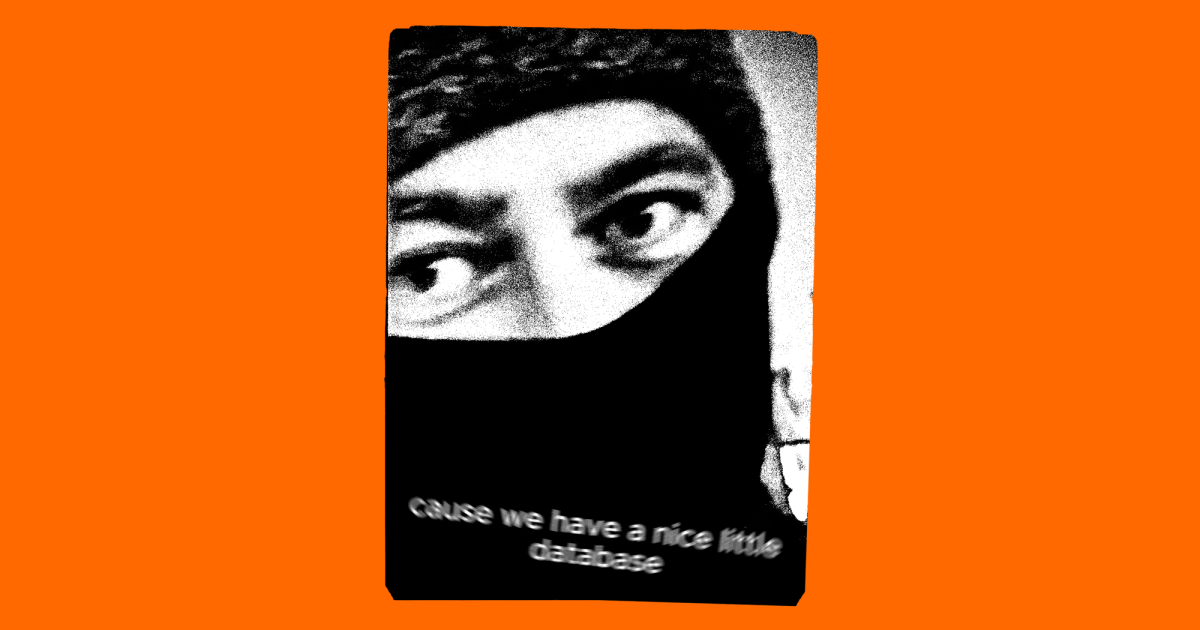
Mother Jones illustration; @kenklippenstein/X
The Trump administration is scrambling to cover its tracks amid legislative pressure and a First Amendment lawsuit over its alleged “domestic terrorist” database, new legal filings and emails reviewed by Mother Jones reveal.
A federal class action lawsuit filed last month against the Department of Homeland Security (DHS) alleges that Immigration and Customs Enforcement (ICE) agents unlawfully targeted and intimidated Maine residents who were observing immigration operations. The complaint details incidents in which federal agents collected biometric data and license plate information from two legal observers—Colleen Fagan and Elinor Hilton—and warned the women that they were being added to a domestic terrorist database.
“’Cause we have a nice little database,” the ICE agent replied when asked why he’s taking an observer’s information down, “and now you’re considered a domestic terrorist.”
“Why are you taking my information down?” Fagan asks an ICE agent in one viral video. The 31-year-old social worker had been observing and documenting ICE agents as they descended on her hometown of Portland—part of a statewide immigration enforcement surge dubbed “Operation Catch of the Day” by the Trump administration.
“’Cause we have a nice little database,” the ICE agent replies, “and now you’re considered a domestic terrorist.”
Fagan laughs as the agent walks away. “For videotaping you?” she shouts after him. “Are you crazy?”
That exchange, captured on video by Fagan and posted to X on January 23, has since been viewed more than 7 million times. The ICE agent’s remark has sparked concerns among activists that the government is building a watchlist of its critics—especially as DHS expands its use of mass surveillance technology and Trump administration officials publicly condemn peaceful protesters and legal observers as “terrorists.”
DHS has repeatedly claimed that such a database does not exist. Appearing before the court on Monday, an attorney for DHS said a review of federal records did not turn up any data on Fagan or Hilton—and the government doesn’t know what happened to the photos that were taken of them.
Records show that DHS emailed this policy to its ICE Boston Field Office on March 10, mere hours before submitting the email to the court .
“Defendants acknowledge that officers on the ground suggested otherwise, however, those statements were contrary to DHS policy,” government attorneys wrote in a March 10 brief. “Indeed, agents throughout Maine have recently been reminded of this First Amendment policy and requested to adhere to the guidance within.”
But records show that DHS emailed this policy to its ICE Boston Field Office on March 10, mere hours before submitting the email to the court as proof of the government’s documented commitment to protecting First Amendment activity.
“This email is entirely self-serving and for purposes of this litigation alone,” the plaintiffs’ lawyers argued in a reply. “It is not probative of any observed ‘policy,’ especially in light of record evidence showing that DHS agents in Maine and across the country have engaged in an undeniable pattern of threatening and harassing lawful observers.”
In fact, the policy in question is a 2019 memo that appears to have been rescinded—until defense lawyers needed to marshal it as proof that ICE agents are prohibited from “profil[ing], target[ing], or discriminat[ing] against any individual for exercising his or her First Amendment rights.”
At the time of the government’s March 10 filing, the 2019 memo was listed as “Archived” on the DHS website, and a page at the top of the document stated it “contain[ed] outdated information that may not reflect current policy.” That page was not included in the government’s submission to the court. The Wayback Machine, an internet archiving tool, shows that the policy was moved from active to archived status sometime between March 6, 2025, and April 2, 2025.
While DHS claims that the threats made by ICE agents in Maine “were not approved or condoned by DHS,” there is no evidence that the agents—who remain unknown to the public—have faced disciplinary action.
Last week, on the morning of March 12, I asked DHS if it has a current, active “policy for personnel regarding First Amendment protected activities.” The press team replied quickly, asking if I could be more specific. I explained that I was curious about whether DHS could point me to its current policy that “governs agencies’ storage/collection/usage of information related to how individuals exercise their First Amendment rights.” At the time of these emails, the 2019 memo was still listed as archived on the DHS website.
A day later, the DHS spokesperson got back to me with a link to the 2019 memo. “Archive” had been removed from the URL, which now redirected to DHS’s active publications library. The first page of the document no longer had a disclaimer about possible outdated material. The DHS website showed the page had been updated that same day, March 13. DHS did not respond to follow-up questions about why the policy had been unarchived.
While DHS claims that the threats made by ICE agents in Maine “were not approved or condoned by DHS,” there is no evidence that the agents—who remain unknown to the public—have faced disciplinary action. An ICE special agent said in a sworn declaration that he was still determining whether to discipline the agents who had violated DHS policy, despite those events having occurred more than six weeks prior.
Other developments in recent months have fueled fears that the government is targeting people for exercising their First Amendment rights. In September, Trump issued an executive order designating “antifa” a domestic terrorist organization, despite the fact that antifa is not a single, cohesive group. In an accompanying national security memorandum, the White House claimed that “anti-Americanism, anti-capitalism, and anti-Christianity” and “hostility towards those who hold traditional American views on family, religion, and morality” are ideological threads found in many violent antifa terrorists. Civil liberties experts fear the directive could be use to squash legitimate dissent in the name of counterterrorism.
The Privacy Act of 1974 “absolutely forbids” the government from maintaining a mass database of US citizens’ biometric data, says a Biden-era ICE official, while “the First Amendment forbids this domestic terrorism bullshit.”
Meanwhile, ICE agents have been using Mobile Fortify, an AI-powered facial recognition app, to scan the faces of citizens and immigrants alike. It remains unclear how that biometric data is being used, though the government is retaining it for 15 years. And in January, CNN reviewed an internal memo directing ICE agents in Minneapolis to “capture all images, license plates, identifications, and general information on hotels, agitators, protestors, etc., so we can capture it all in one consolidated form.”
Scott Shuchart, who served as assistant director for regulatory affairs and policy at ICE during the Biden administration, said that the Privacy Act of 1974 “absolutely forbids” the government from maintaining a mass database of US citizens’ biometric data, while “the First Amendment forbids this domestic terrorism bullshit.”
“But it’s not just some technical thing,” Shuchart added. “It is just a complete affront to centuries of American values that hold it is not the place for the federal government to be keeping a panopticon database of everybody. Congress, as fucking ineffective as it is, hasn’t said much as clearly as it has said that.”



