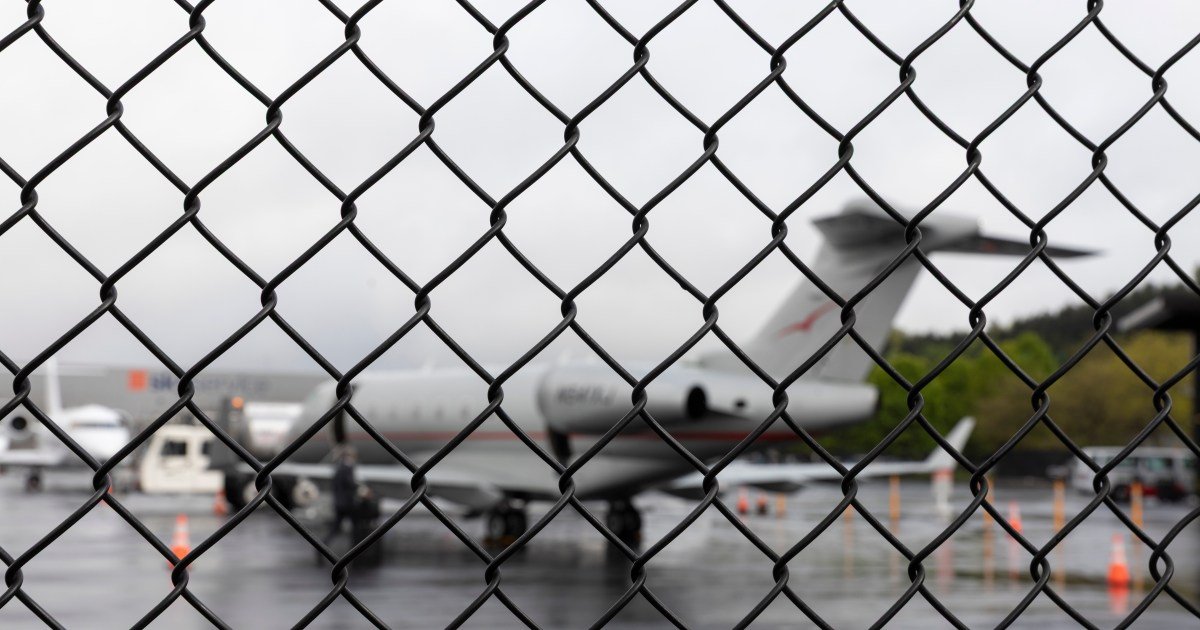
An airplane prepares for takeoff at King County International Airport in Seattle, Washington, on April 29, 2025.Paul Christian Gordon/ZUMA Press Wire
The Department of Homeland Security (DHS) and the US Secret Service want to build a tool for tracking US travelers’ flights and other personal information according to previously unreported documents reviewed by Mother Jones.
These agencies have asked for feedback from the private sector on whether this tool can be made, or if something like it already exists. Their request was posted on the government’s database for contractors. In it, the Secret Service, an arm of DHS, outlines the specifics they envision: a program that would provide real-time or near-real time access to a range of personal travel data, including passenger names, origins and destinations, flight numbers, ticket numbers, and forms of payment. The data would be gleaned from third-party ticketing sites, such as Orbitz or Expedia, and must cover major US and international airlines.
“It’s not hard to imagine that DHS would want access to these travel records to be able to track all sorts of people.”
The proposed tool appears to be an attempt to rebuild a surveillance pipeline that was recently shuttered amid public backlash. Last year, The Lever and 404 Media revealed that the Airlines Reporting Corporation (ARC)—a data broker owned by the major US airlines—had discreetly sold flight data to Immigration and Customs Enforcement and Customs and Border Protection, which are both also arms of DHS. ARC ceased its so-called Travel Intelligence Program in November, citing pressure from lawmakers. DHS’s new Request for Information (RFI) seems to reference the now-defunct ARC program, saying the requested platform would “replace an existing commercial database used by the United States Secret Service for law enforcement travel data queries.” DHS did not immediately respond to a request for comment, including a question about whether the agency is exploring a replacement for ARC.
“Travel records reveal an enormous amount of information about people’s private lives—where someone travels, how often they travel, and who they travel with—and expose deeply personal information, including medical care, family relationships, political activity, or religious practice,” said Tom Bowman, policy counsel with the Center for Democracy and Technology’s Security & Surveillance Project. “It’s not hard to imagine that DHS would want access to these travel records to be able to track all sorts of people, whether it’s people who they’re targeting for immigration related proceedings, or whether it’s targeting people who have been involved in public dissent against federal immigration enforcement.”
RFIs are an information-gathering tool; they do not mean that the proposed program exists or that the government is seeking bids on a specific contract. Still, they offer a meaningful window into the government’s surveillance wishlist—and could encourage the private market to step up and meet that demand.
“DHS is essentially inviting the creation of more surveillance-as-a-service business models to come into existence,” Bowman said.
The government’s request for increased access to flight data arrives amid an extraordinary expansion of DHS spying capabilities, fueled by the commercial data broker industry and the rise of biometric surveillance tools. ICE has come under fire for its “dystopian” use of the facial recognition app Mobile Fortify, which agents have used to scan the faces of anti-ICE protesters and gather “contactless” fingerprints. Last month, Wired reported that DHS is moving to create a search engine that would allow the government to consolidate biometric data across agencies.
In January, DHS posted an RFI requesting feedback on the use of “commercial Big Data and Ad Tech” in ICE investigations. DHS has also already purchased at least two programs that provide access to Americans’ cellphone location data, scraped from social media and sold by commercial brokers. The DHS inspector general previously found in a 2023 report that ICE’s use of real-time cellular location data had violated privacy laws, causing the agency to walk back the practice. On March 4, over 70 Congressional Democrats, led by Sen. Ron Wyden (D-Ore.) and Rep. Adriano Espaillat (D-NY), called for a new investigation into the latest cellphone data buy-up by DHS.
This rapid expansion of DHS’s domestic surveillance dragnet is a result of President Trump’s priorities for his second term, including the mandate that immigration authorities deport 1 million people per year. The government claims its use of these tools abides by federal privacy laws and is necessary for enforcing the law. But critics say that warrantless mass surveillance violates constitutional protections against unreasonable government searches.
“Purchasing all of this information from a commercial intermediary like a data broker really undermines and weakens the Fourth Amendment protections in practice,” said Bowman. “Frankly, the rule should be simple: If the government would need a warrant to compel the data, it should not be able to buy it instead. But that’s exactly what the government is seeking to do.”