
On March 17, 2006, when “V for Vendetta” premiered in the United States, the country was waging war in the Middle East. Meanwhile, conservative majorities at home held both the House and Senate under a Republican president. In the wake of 9/11, anti-immigrant sentiments were on the rise, LGBTQ+ minorities were being persecuted, and new technological advancements threatened to wreak havoc on the world.
Twenty years later, a lot has changed, but America is back in an eerily similar position, which isn’t lost on “V for Vendetta” director James McTeigue. “The politics never go away; they just change form,” he told IndieWire in the lead-up to the film’s 20th anniversary. “All the same things go on. There’s always this emergency that needs to be dealt with, a fear of otherness, a fear of things you can’t control. With that, you get complicity or apathy. It’s cyclical.”

While McTeigue’s film adaptation of “V for Vendetta” was created as a response to the George W. Bush administration and labeled as “Un-American” upon its release, the graphic novel about a masked vigilante seeking to undermine a fascist regime in the name of equality and truth was originally written by David Lloyd and Alan Moore as a response to Margaret Thatcher’s England.
“’V’ wasn’t trying to say it’s about one particular time,” McTeigue said. “It was just holding up a mirror to the things that we as humans keep doing over and over.”
Ahead of “V for Vendetta’s” 20th anniversary (which will include a theatrical re-release on Guy Fawkes Day, this 5th of November), IndieWire spoke with the film’s cast and crew about crafting the epic dystopian narrative, the controversial political message at its center, and its enduring legacy 20 years later.

The Origin Story
As is often the case with Hollywood’s biggest swings, “V for Vendetta” was only greenlit due to the massive success of a previous franchise, in this case, “The Matrix.” Following the trilogy’s $1.6 billion box office haul, Warner Bros. effectively gave directors Lana and Lilly Wachowski carte blanche to choose their next project.
“The Matrix” producer Joel Silver had retained the rights to “V for Vendetta” and commissioned a screenplay, but after reading it, the Wachowskis opted to rewrite the script rather than direct off the existing one. As McTeigue said, the pair were also “exhausted” after the trilogy wrapped, and so were happy to pass off directing duties to McTeigue, who had served as their assistant director on “The Matrix” films and had become a close friend. While McTeigue had worked on global blockbusters like “Star Wars: Attack of the Clones” and “Moulin Rouge,” “V for Vendetta” became his directorial debut, with the Wachowskis serving as uncredited second unit directors.
“We just kept that same [energy of] young kids wanting to make new kinds of art and playing together,” Lana Wachowski said. “It was fun to watch him put his toes into directing, and he was great at it from the beginning. It was a pleasure to be able to mentor somebody. I wish we had had a mentor.” (That mentorship certainly paid off as McTeigue and the Wachowskis partnered on projects like “Speed Racer,” “Ninja Assassin,” “Sense8,” and “The Matrix Resurrections” for the past 20 years, with more in the works.)

With Warner Bros. on board with McTeigue’s directing, he began casting the film, hiring “Resident Evil” star James Purefoy to play the titular V. After reading the script, McTeigue instinctively knew he wanted Natalie Portman to play V’s protege Evey Hammond, but at the studio’s request, also screen-tested Scarlett Johansson and Bryce Dallas Howard, before offering Portman the role.
While actors were clamoring to work with the Wachowskis after “The Matrix,” that didn’t stop some, like “The Crying Game’s” Stephen Rea, who plays Chief Inspector Finch, from being shocked at the overt politics of the script.
“I remember when I met [Stephen] to discuss the role in this cafe down on the Pacific Coast Highway,” said McTeigue. “I walked in, and he’s sitting at this table in the back. There’s no one else in there, and he’s in the half dark. He looks at me, picks the script up, and goes, ‘This is the real shit, man.’ Coming from Ireland, he was a little worried at the politics. He said, ‘Who’s gonna let you make this movie?’ And I’m like, ‘Warner Bros.’ He’s like, ‘Have they read it?’”
As it would turn out, perhaps not closely enough.

Recasting V
With the cast in place, the entire team decamped to Berlin in March of 2004 to begin filming for several months, a period that would impact the cast members in different ways.
“I loved working in Berlin and spending so long there,” Portman said. “It was formative, reading Antonia Fraser’s “The Gunpowder Plot: Terror and Faith in 1605” and Menachem Begin’s “White Nights,” and truly thinking at that age about political resistance and how it’s expressed.”
It was also formative for Stephen Rea’s teenage son. “He was in love with Natalie,” Rea said. “He came to Berlin and just hung around because he was mad about her. For him to have his father in a movie with Natalie Portman was pretty good.”
For Natasha Wightman, who plays prison inmate Valerie Page, the German setting only amplified the film’s message. She remembers one “haunting” night filming a moment when Valerie is taken to prison. “It was very intense, and it was ironic that it was in Berlin,” she said. “I don’t think it escaped people that here we were in a camp, being locked up for our beliefs or our ways of life.”
As the Berlin shoot continued, however, V’s mask became a problem on multiple fronts.
“The mask was not easy,” Lana Wachowski said. “It’s the opposite of cinema. It works great in the comic because everything’s frozen, but in cinema, your eyes fix on the mouth, and you want something to move. We had to use light and have these exaggerated chiaroscuros, so the shadow was always kind of moving. That was complicated.”
McTeigue created subtle variations on the mask so that V could look slightly more sinister or benevolent depending on the lighting.
Acting behind a mask also proved difficult for Purefory, and so as the days ticked by, the creative team began discussing a possible replacement for their lead role.

“I had [Purefoy] in the mask for the first two weeks of filming, and it wasn’t working out,” McTeigue said, “It happened over an Easter break as I remember, and I could sort of feel it coming. I think James wasn’t really feeling it, so we made the decision. It was difficult at the time, but we made the best decision.”
On short notice, McTeigue called Hugo Weaving, who had starred in all three “Matrix” movies as Agent Smith. He immediately hopped on a plane from Australia to Berlin to start filming.
“[Hugo] had done a lot of mask work at drama school. Noh theater, kabuki, and Greek tragedy,” McTeigue said. “He came into it, and he wasn’t afraid of the mask. He was like, ‘This is going to be completely freeing.’”
For his first scene as V, Weaving (who politely declined to speak with IndieWire due to his filming schedule) was set to film the emotional reunion between V and Evey following her release from prison. When the pair of actors met on set, the connection was palpable.
“Wow, watching them, they’re both so crazy good,” said Lana Wachowski. “Hugo is so amazing. You had to be very theatrical with this gestural acting, and Natalie just went to another place. That day was why you love to be a filmmaker, watching two actors make magic.”
McTeigue’s reaction was a bit more cathartic. “As soon as he started doing the scene, I’m like, ‘Oh my god, this guy is saving me right now.’”

Shaving Heads
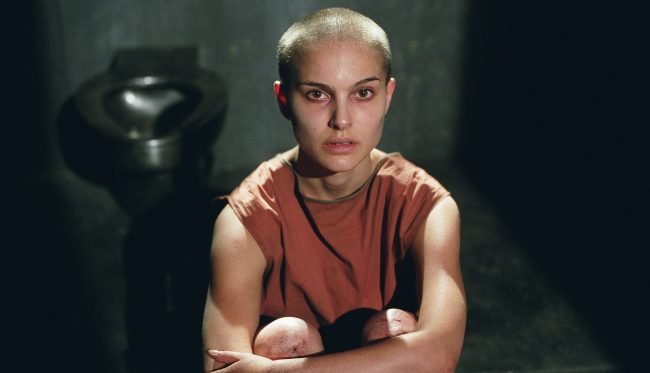
Aside from the mask, one of the film’s most striking images remains Natalie Portman’s shaved head, which the actress agreed to shave, on camera, as part of the role. To keep Portman from wearing a wig, McTeigue kept the shooting schedule mostly in chronological order. He also opted to cast a member of the film’s hair and makeup team, Jeremy Woodhead, as the guard shaving her head, rather than an actor.
On the day of the shoot, McTeigue used three cameras to capture every angle but was primarily concerned about how Portman would look bald.
“As soon as we shaved her head with all the cameras running, she looked amazing,” he said, “I’m like, ‘Oh my god, she’s got the perfect head for a shaved head.’ The bald head was really striking.”
Wightman had her head shaved the same day in a similar shoot, but oddly enough, she knew what she’d look like bald, having shaved her head two years prior with Elliot Page for the film “Mouth to Mouth.”
“It was a pretty intense situation, because we had to get that in one take,” she said of the “V for Vendetta” shoot. “Your adrenals are up because there’s a large film team there, but you’re really in character. I’m not Natasha going, ‘Oh, the second time.’ I was Valerie the first time.”
Portman cited the shaved head as the source of numerous fan interactions over the years and says she’d “absolutely” make that choice again, looking back.
“Many women told me how comforted they were by seeing me when they had to go through chemo and lose their hair,” she said. “And the amazing activist, X Gonzalez, told me they used the pictures in a PowerPoint for their parents to advocate for letting them shave their head.”
As it turned out, the shaved head also worked as what McTeigue called “the best free publicity you could ever get.” Freshly shaven, Portman walked the red carpet at the Cannes Film Festival for “Star Wars: Revenge of the Sith.” “Every single person in the world asked her, ‘Why have you got a bald head?’” McTeigue said. “And she goes, ‘Oh, I’m working on this movie, ‘V for Vendetta.’”

The Controversial Valerie Page
At the heart of “V for Vendetta” is a six-minute-long sequence in which Evey, locked in prison and being tortured, receives messages, written on toilet paper, from a woman in the next cell named Valerie. The notes tell Valerie’s story as a lesbian actress who falls in love on a film set, only to be later imprisoned for her homosexuality. The visually stunning sequence — complete with Dario Marianelli’s score, Wightman’s affecting voiceover, and a cinematic same-sex kiss — is what Lana Wachowski called the “heart of the movie.”
While LGBTQ+ plotlines are more common in 2026, when “V for Vendetta” was filmed in 2005, months before “Brokeback Mountain’s” release, an overtly gay plotline in a major studio film was nearly unheard of. Nevertheless, the Wachowskis, who would later both transition publicly, felt it was integral to their script.
“Emotionally, you needed to step outside the cycle of revenge,” Lana said. “I thought Valerie was powerful because it is the pain of knowing you are different from the way a society wants you to be, and yet you feel you still have a place in that society. This was an idea that, of course, Lilly and I were experiencing, and so we were close to this perspective.”
While Wightman left acting after “V for Vendetta” and now works as a multidisciplinary artist, she feels proud of her work bringing Valerie to life, but credited McTeigue and the Wachowskis with shaping her empowering performance.
“I got to the day where I was recording that speech, and they kept saying to me, ‘Bring it down. Bring it down,’” she saids. “It was the best performance anyone had ever brought out of me. They’re saying, ‘Just say the lines. The lines are enough.’ For me, it was a real breakthrough.”
Stephen Rea’s warning, however, echoed in McTeigue’s brain months later, when he received a phone call from Silver asking him to return to Los Angeles for notes from Warner Bros. McTeigue was in London recording the film’s score with a 110-piece orchestra and was confused as to why the meeting needed to take place in person.

“You’ve got to come back. The studio wants to give you notes, and I don’t want the notes to be written down,” McTeigue recalled Silver saying.
“So I go back, and I sit down, and there’s the head of the studio and all the execs around the table,” McTeigue said. “The first thing they asked me was, ‘Can you cut the Valerie sequence?’ I said, ‘No, you can’t. It’s the thing that changes Evey. It’s the thing she responds to that lets her not be fearful anymore. No, I’m not cutting it.’”
The executives then asked one other question before the meeting ended, and McTeigue flew back to London.
“I grew up in Sydney, had lots of gay friends, and so for me, it felt so integral,” he said. “It was like the crucible. It didn’t feel like you couldn’t have it in there. Whether it was Thatcherite Britain or Nazi Germany, going back in time, there’s always this fear of otherness. It’s always the first people that governments go to because it’s super easy to be fearful of those people.”
In the end, Warner Bros. yielded, and the scene stayed.

Marching on Parliament
The film’s final sequence, and the most difficult to shoot, involved hundreds of Londoners, dressed up as V, marching through Trafalgar Square at night to the British Parliament and Big Ben. A lesser film (or perhaps just a more modern one) would have used green screen and CGI to build out the crowds and iconic London skyline, but for McTeigue, the plan was always to shoot on location.
Filming on that scale had never taken place in the heart of London before, which meant a logistical nightmare requiring months to coordinate and meetings with 16 government agencies. The film’s location manager, Nick Daubeny, hosted regular Monday evening meetings with British government department heads, which he called the “Chablis Club,” to discuss logistics.
“He always came back and said, ‘Really, the hardest person to get to agree to this is the bus guy. We have to get the bus schedule worked out,” McTeigue laughed.
With the bus timetable sorted, the crew shot the sequence over three nights between 1:00 and 4:30 a.m. on a meticulously planned schedule. On the first night, McTeigue was stunned to see sharpshooters posted atop the buildings for security as the 500 masked extras walked down the street towards the film’s armored tanks.
“We were all goose-bumpy,” said Lana. “You see this army of V faces walking towards you, and. I was crying. Lilly was crying. It was very emotional.”
Following the film’s release, the Guy Fawkes masks became ubiquitous parts of both pop culture and protest.
“People started wearing those masks in demonstrations and things,” said Rea, “That had all died a bit, but it became a bit more like the ’60s for a while.”
McTeigue, who reworked the masks for the film, quipped, “I wish I got a piece of the residuals.”

“V for Vendetta”: 20 Years Later
Twenty years later, “V for Vendetta” still feels prescient. “I wish it weren’t so relevant today, but it feels more necessary a story to tell than ever,” Portman said.
As with the graphic novel’s initial stand against Thatcher and the film’s rebuttal to George W. Bush, the “V for Vendetta” team hopes that new viewers will use the film as a rallying cry against new forces of fascism worldwide.
“We’re now in this very dreadfully right-wing time,” Rea said. “The world is in a state, particularly because of Donald Trump, and I would hope that [viewers] would see the chink of possibility for more radical politics, and they might see this dreadful authoritarianism for what it is.”
Two decades ago, “V for Vendetta” changed the way Lana and Lilly Wachowski thought about their filmmaking. “We felt this galvanizing power like, yes, we want to make art that continues to expand the possibility of our world rather than contracting it,” Lana said. “We felt there was something revolutionary about making ‘V.’ We wanted to use art to make the world bigger for difference.”
Now, she hopes the film will have a similar galvanizing force for audiences.
“When people feel that the government wants only one point of view, and they are targeting some of the weakest people in society and blaming them, you know something is wrong,” she said. “This is what ‘V’ asks of people: Hey, if you see what I see, then stand with me.”



