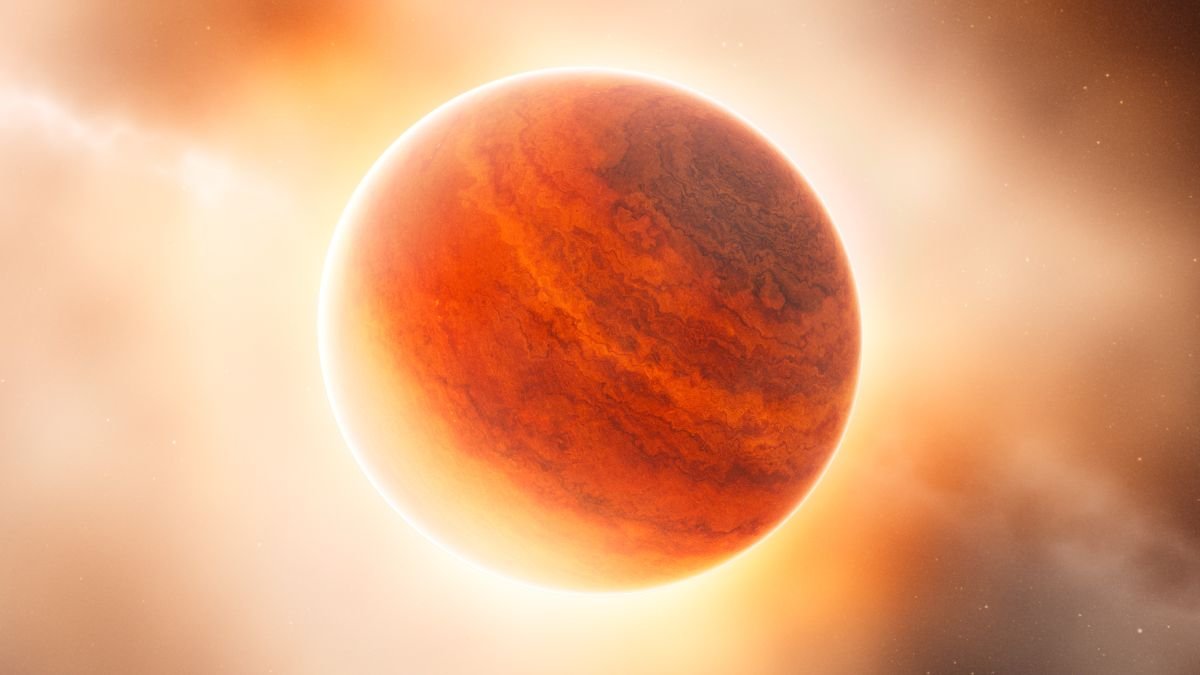
Jupiter may be the king of planets in our Solar System, but in other star systems across the galaxy, even larger planets orbit billions of miles from their stars – in places where traditional formation theories struggle to explain them.
In a new study, researchers examine three massive gas giants about 130 light-years away, using their atmospheric chemistry to probe how such enormous planets form.
Four known gas giants orbit HR 8799, an F-type star in the constellation Pegasus. They’re all colossal, ranging from 5 to 10 times the mass of Jupiter.
Using moderate-resolution spectra from JWST’s NIRSpec instrument, the researchers conducted a detailed analysis of the atmospheric composition of the system’s three innermost planets at wavelengths between 3 and 5 microns.
Gas giants can approach the mass range of brown dwarfs – objects that briefly fuse deuterium – yet astronomers believe the two form in fundamentally different ways.
Brown dwarfs form like stars, with a top-down gravitational collapse, but lack the mass to sustain hydrogen fusion.
Planet formation is attributed largely to core accretion, a bottom-up process in which cores grow slowly as solid matter clumps together in a protoplanetary disk. Some large cores may also collect leftover gases from their ancestral nebula, eventually becoming gas giants.

That’s the prevailing backstory for Jupiter and Saturn, but could it work in a system like HR 8799, where heftier behemoths orbit at greater distances?
Those distances range from 15 to 70 astronomical units (2 billion to 10 billion km), which means the planets are roughly 15 to 70 times farther from their star than Earth is from the Sun.
At that scale, some experts question whether such massive, far-flung planets could form by core accretion. Accretion is expected to proceed more slowly so far from the star, potentially leaving too little time for planets to gather enough material before the disk dissipates. One solution is that such worlds could emerge from gravitational collapse, similar to brown dwarfs.
To test that idea, researchers used JWST data from HR 8799’s planets to search for sulfur, a refractory element that is largely locked into solid grains in protoplanetary disks. Detecting sulfur in a planet’s atmosphere would therefore point to the accretion of solid material during formation.

“With its unprecedented sensitivity, JWST is enabling the most detailed study of the atmospheres of these planets, giving us clues to their formation pathways,” says co-first author Jean-Baptiste Ruffio, an astronomer at the University of California, San Diego (UC San Diego).
The authors found strong evidence of hydrogen sulfide in HR 8799 c and d, and their atmospheric models indicate similar sulfur enrichment across all three inner planets.
“With the detection of sulfur, we are able to infer that the HR 8799 planets likely formed in a similar way to Jupiter despite being 5 to 10 times more massive, which was unexpected,” Ruffio says.
Although the planets are thousands of times fainter than their host star, JWST’s sensitivity allowed researchers to separate their faint signals from the stellar glare.
The researchers overcame that by building complex atmospheric models of the planets, which they could adjust and compare with the data.
“In the end, we detected several molecules in these planets – some for the first time, including hydrogen sulfide,” says astronomer and co-first author of the study Jerry Xuan of the University of California, Los Angeles.
Related: This Giant Exoplanet Is Forming in a Very Strange Way, Astronomers Say
The planets are uniformly enriched in heavy elements – including carbon, oxygen, and sulfur – compared with their host star, indicating that large amounts of solid material were incorporated during their formation.
The level of heavy-element enrichment is difficult to reconcile with some classical formation models, the researchers found.
“There’s no way planetary formation should be that efficient,” says Michael Meyer, an astronomer at the University of Michigan.
The researchers will need to look at other systems beyond HR 8799, but as it stands, the efficiency with which its three massive planets formed is rather perplexing.
“It’s a conundrum. We’re really left with a mystery here,” Meyer says.
The study was published in Nature Astronomy.