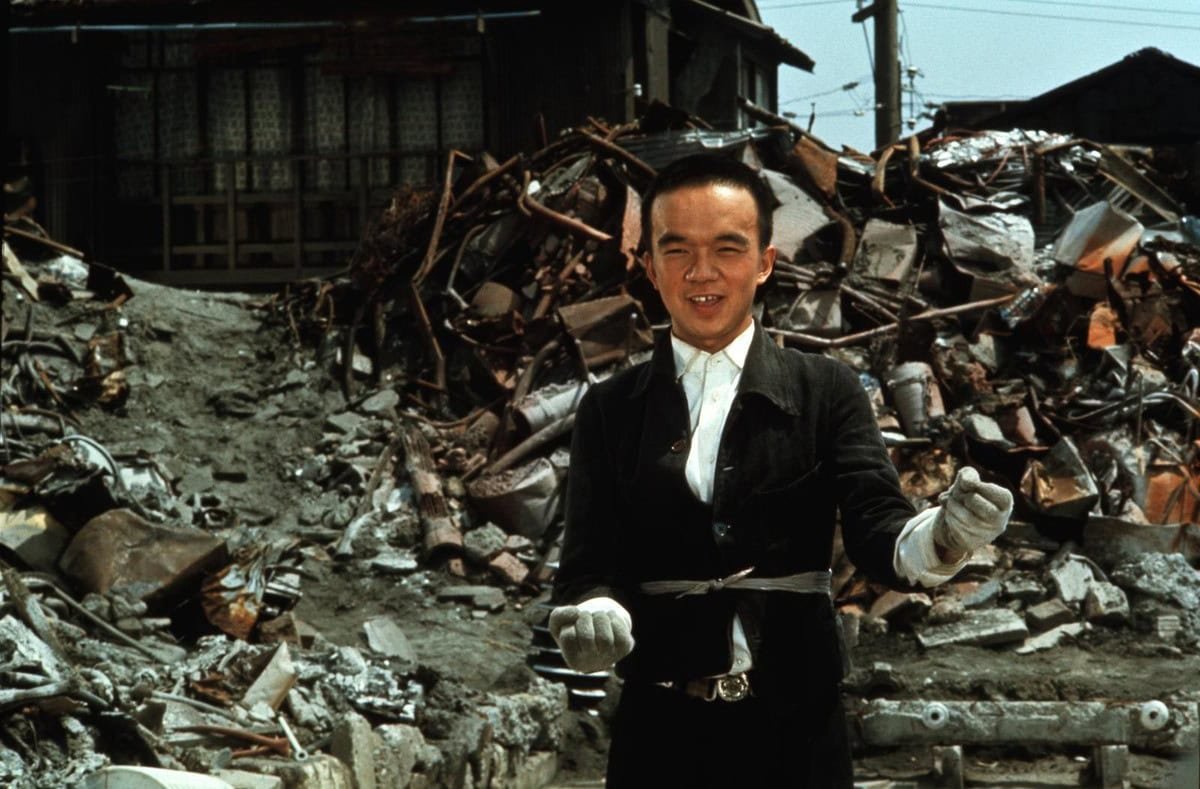
After the lukewarm reception of “Tora! Tora! Tora!”, director Akira Kurosawa found himself at a difficult point in his career. Eventually, he decided on a project that would reflect his predilection for portraying the lower classes, which had previously been the focal point of “The Lower Depths” and “One Wonderful Sunday”. “Dodes’ka-den”, based on a novel by author Shugoro Yamamoto, tells the stories of the inhabitants of a slum on the outskirts of Tokyo. Kurosawa regarded the movie as a story about how fantasy and imagination can not only help one escape dire circumstances, but can actually become an “existential force”.
In order to emphasize this idea, Kurosawa employed color for the first time in any of his works, which at times manages to portray fantasy as a liberating force, while at other times it highlights the miserable conditions in which the characters are living. Unlike the aforementioned features, “Dodes’ka-den” – perhaps due to its episodic nature – feels uneven, especially when it comes to the delivery of its themes.
Buy This Title
by clicking on the image below
A few people live in a slum outside of Tokyo and try to get by while dealing with poverty, neglect, and domestic violence. One of them is Rokuchan (Hiroyuki Kawase), a mentally disabled boy who believes he is a streetcar driver. As he “drives” his imaginary streetcar through the slum, the various inhabitants either get out of his way or, at times, make fun of him. Others tend to ignore him, as they have other issues in their lives, such as Ryotaro (Shinsuke Minami), who tries to be the best father possible to his children, as his wife and their mother Misao (Yuko Kusunoki) is having several affairs behind his back.
There are also two workers (Hisashi Igawa and Kunie Tanaka) who come home drunk each evening. At times they are so inebriated that they swap wives, causing much gossip among their neighbors, even though their wives (Jitsuko Yoshimura and Hideko Okiyama) do not seem to mind the occasional switch of husbands.
Then there is a beggar (Noboru Mitani) and his son (Hiroyuki Kawase), who envision their dream home while trying to get by and look for food each day. However, a moment of carelessness results in their situation becoming even more desperate than it already is.
Although “Dodes’ka-den” follows a similar thematic and aesthetic vein as, for example, “The Lower Depths”, it feels more like a collection of various perspectives and notions. One could even go so far as to say that the feature is a somewhat uneven series of stories, with some of them being quite impressive and powerful, while others miss the mark and feel too programmatic. “Dodes’ka-den” is more like a predecessor to “Dreams”, even though the latter is much more experimental and tonally cohesive (and satisfying).
Whereas the story of the two workers swapping wives when drunk – while more comedic in tone and execution – illustrates quite eloquently the camaraderie among people unwilling to have their lives dictated by misery and poverty alone. Similarly, the story of a man who has found solace and peace in being a father tells a touching story of identity not being ruled by pessimism and amoral behavior. These two examples could easily serve as the foundation of a great story – in film or literature – with Kurosawa finding the right balance between realism and fantasy as well as distance and closeness, which sadly cannot be said for all the elements of “Dodes’ka-den”.
Humanity and compassion are at the core of the best parts of the movie. Atsushi Watanabe, who plays the character of Tanba, serves as one example of someone who always sees the best in people and tries his utmost to prevent his neighbors from giving in to despair. The episode in which he consoles a suicidal man (Kamatari Fujiwara) is yet another instance of Kurosawa finding the right tonal balance, with both actors emphasizing the drama as well as the comedic undertones of the scene.
Yoshitaka Zushi as Rokuchan has the most memorable as well as aesthetically pleasing segments, with his mimicry of a streetcar driving through the slum standing as the best reflection of what Kurosawa was aiming for in “Dodes’ka-den”. At the same time, it also reminds us how this group of people – although they may be social outcasts – are nevertheless a mirror of society, its conflicts, and its character traits.
However, “Dodes’ka-den” is also painfully programmatic at times, with some stories bordering on “misery porn”. While it is certainly the story most reflective of Kurosawa’s ambition with this project, the episode with the beggar and his son is among the weakest within the whole feature. Its core metaphor – the imaginary house the father builds and constantly redesigns – is not only predictable, it becomes quite frustrating as the situation of the two becomes more and more desperate. Considering the subtlety present in Kurosawa’s works, which can be seen in other parts of the film, having a message delivered so heavy-handedly and even one-dimensionally is quite surprising.
“Dodes’ka-den” tells different stories about a group of people living in a slum on the outskirts of Tokyo. While its ambition is undeniable – with some moments being aesthetically and narratively skillful and compelling – Kurosawa also misses the mark, as some elements are heavy-handed and predictable, thus resulting in an overall uneven experience for the audience.