
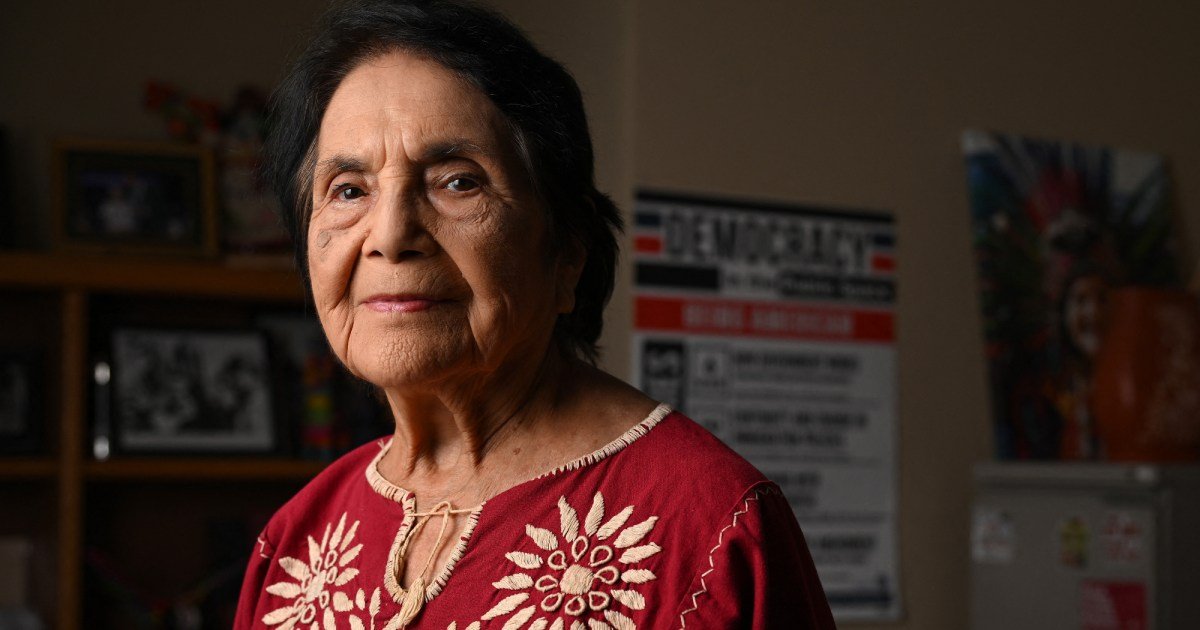
Co-founder of the United Farm Workers of America (UFW) labor union Dolores Huerta, 95, poses in her office in Bakersfield, California, on July 21, 2025. OBYN BECK/AFP via Getty Images
United Farm Workers co-founder and labor activist Dolores Huerta went public Wednesday with her own account of being raped by Cesar Chavez, following a stunning New York Times investigation that uncovered decades of sexual abuse, including of young girls, by the civil rights icon.
Prior to speaking with the Times, Huerta had never publicly disclosed the allegations against Chavez, who died in 1993.
Huerta, now 95, said in the statement that she kept the secret for the last sixty years because, “I believed that exposing the truth would hurt the farmworker movement I have spent my entire life fighting for.”
She told the Times about two separate encounters with Chavez that turned sexually violent, one in 1960 and another in 1966. In the first one, she explained feeling pressured to have sex in a hotel during a work trip. In the second, she recounted Chavez driving her to a secluded area, parking, and raping her inside the vehicle. Both instances, Huerta said, resulted in pregnancies.
“I chose to keep my pregnancies secret and, after the children were born, I arranged for them to be raised by other families that could give them stable lives,” her statement, shared on Medium, reads. Huerta added that, over the years, “I have been fortunate to develop a deep relationship with these children.” But, she continued, “no one knew the full truth about how they were conceived until just a few weeks ago.”
Huerta would ultimately be in a domestic partnership with Chavez’s brother, Richard. They have four children.
The Times investigation, published Wednesday, is based on interviews with more than 60 people, hundreds of pages of union records, confidential emails and photographs, as well as hours of audio recordings. Reporters Sarah Hurtes and Manny Fernandez spoke with Ana Murguia and Debra Roja, now adults who told, in detail, about how Chavez groomed and sexually abused them as children in the 1970s. Other women were propositioned by Chavez and made to feel unsafe or uncomfortable, the Times reports.
Huerta told the Times and repeated in her statement that she was not aware of Chavez abusing children.
“I am telling my story because the New York Times has indicated that I was not the only one — there were others,” she said. “The knowledge that he hurt young girls sickens me. My heart aches for everyone who suffered alone and in silence for years. There are no words strong enough to condemn those deplorable actions that he did.” When the Times told Huerta about specific reports of Chavez abusing children, she broke down and sobbed, according to the outlet.
Huerta is a lifelong activist for workers’ and women’s rights. In her statement, she included a link to a list of resources for sexual abuse survivors curated through her eponymous foundation. The women who spoke with the Times shared a common sentiment. They didn’t want their testimonies of abuse to tarnish a movement that they believed in so wholeheartedly, pointing to an era where sexual abuse was handled through private pain instead of by public disclosure.
“I had experienced abuse and sexual violence before, and I convinced myself these were incidents that I had to endure alone and in secret,” Huerta’s statement read.
“I have never identified myself as a victim,” she added. “but I now understand that I am a survivor — of violence, of sexual abuse, of domineering men who saw me, and other women, as property, or things to control.”



