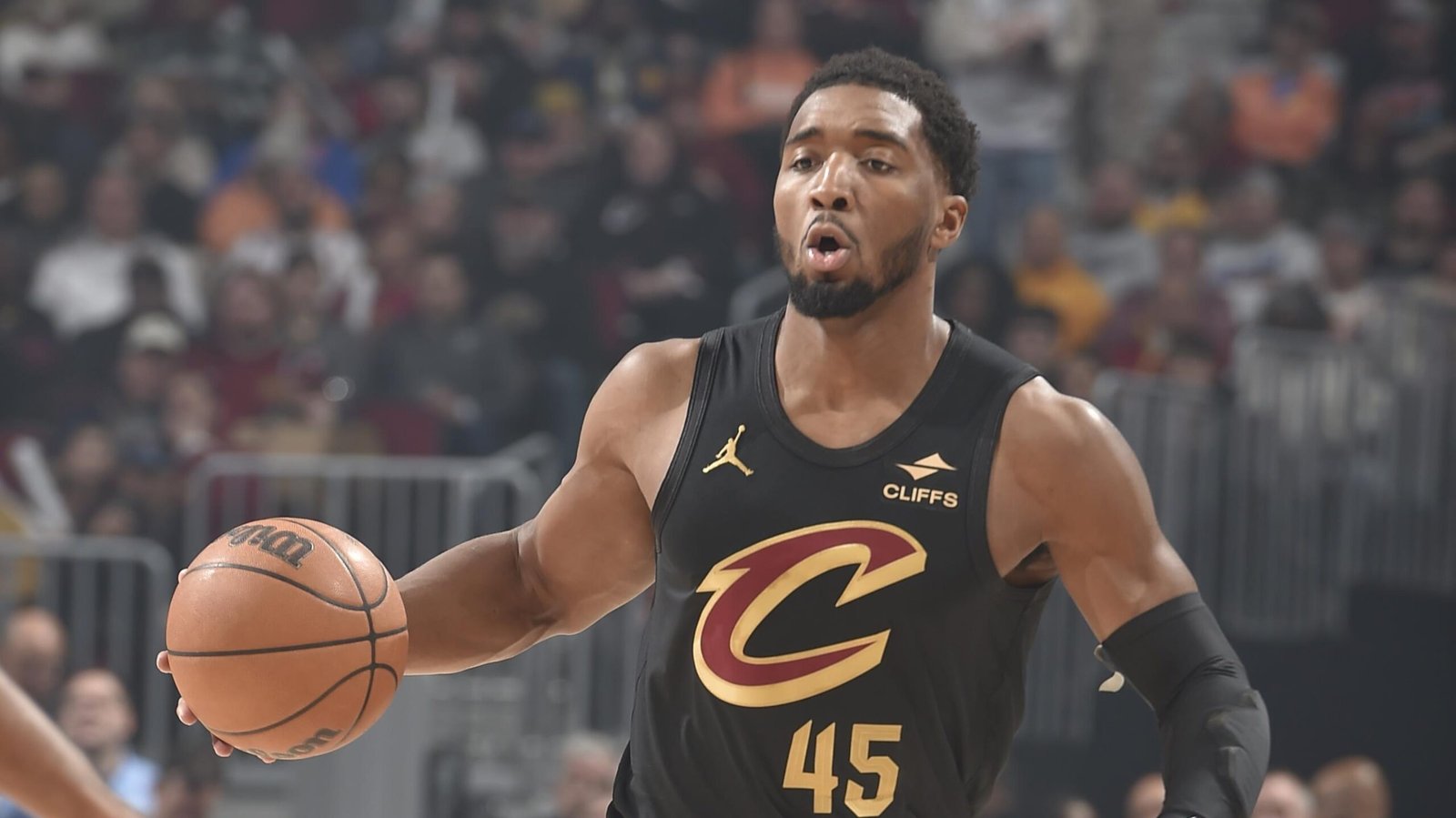
Just ahead of Donovan Mitchell’s matchup with the Oklahoma City Thunder, during the league’s annual slate of games on Martin Luther King Jr. Day, the NBA revealed its 10 starters for the 2026 All-Star game.
In the West, Luka Dončić, Nikola Jokić, Stephen Curry, Shai Gilgeous-Alexander and Victor Wembanyama got the nod. In the East, it was Giannis Antetokounmpo, Tyrese Maxey, Jalen Brunson, Cade Cunningham and Jaylen Brown.
All 10 are, without question, worthy All-Stars. But, as has become tradition, there are also plenty of arguments that others were snubbed.
This year, most of those are in the West. Social media immediately featured plenty of posts questioning how and why Anthony Edwards wasn’t announced. There are cases for each of Kawhi Leonard, Kevin Durant and a handful of others. But none of those omissions are egregious.
His Cleveland Cavaliers (now 24-20, following Monday’s loss to OKC) are nowhere near the same pace they set last season, but it’s hard to blame him.
Entering his MLK Day tilt with the Thunder, Mitchell was averaging 29.2 points (a career high), 5.7 assists and 3.9 threes, while shooting 39.1 percent from deep. He currently leads the league in total threes
And if basic numbers don’t tickle your fancy, Mitchell is tied for second (with Maxey) among Eastern Conference players in estimated plus-minus (one of the most trusted catch-all metrics in NBA front offices). He’s also tied for third among all NBA players in estimated wins (the cumulative version of EPM). SGA and Jokić are the only ones ahead of him there.
In other words, though his team’s record will probably preclude him from ever being mentioned as one, at least on paper, Mitchell is closer to being an MVP candidate than he is to being a non-starter in the All-Star game.
And if that record is enough to make the determination for you, consider Cleveland’s point differential when Mitchell is on the floor. It’s plus-7.1 per 100 possessions, higher than Brown’s (plus-5.9) and Brunson’s (plus-4.4). What’s more, the difference between the Cavs’ differential when Mitchell is on the floor and when he’s off is 12.5. Brunson’s is 1.6. Boston’s net rating is actually worse when Brown plays.
That’s not to say either of those starters are wildly overrated or unworthy of All-Star status, generally. They should clearly be in the game, but neither has been on Mitchell’s level this regular season.
- Mitchell: 30.6 points, 6.0 assists, 5.1 rebounds, 3.2 turnovers, 1.5 steals and 0.3 blocks per 75 possessions, 62.6 true shooting percentage, 4.8 EPM, +7.1 net rating (+12.5 swing)
- Brunson: 30.0 points, 6.5 assists, 3.4 rebounds, 2.4 turnovers, 0.7 steals and 0.1 blocks per 75 possessions, 60.0 true shooting percentage, 3.0 EPM, +4.4 net rating (+1.6 swing)
- Brown: 32.9 points, 5.3 assists, 7.1 rebounds, 4.1 turnovers, 1.1 steals and 0.4 blocks per 75 possessions, 58.5 true shooting percentage, 2.5 EPM, +5.9 net rating (-4.8 swing)
The numbers seem relatively clear and in favor of Mitchell, especially when you venture much further than per-game averages for points, rebounds and assists (which, to be fair to the voters, are comparable among those three, Cunningham and Maxey).
So, the question has to be: What about Mitchell isn’t connecting with the fans?
His game itself can’t be the problem. He’s a dynamic pull-up jump shooter who can take games over from deep. His 6’2″ frame makes his above-the-rim finishing feel even more spectacular than that of bigger players. He can comfortably shift back and forth from lead creator to alpha scorer. He often melds both in a single possession.
Few, if any, players in the East can singlehandedly take over a game quite as quickly and thoroughly as Mitchell.
So, what’s the answer? Why did Mitchell finish sixth in the conference in fan voting?
Is it simply market size? New York, Boston, Detroit and Philadelphia are all higher on that scale than Cleveland. That’s probably part of the problem for Mitchell, but it goes beyond that.
Giannis, who’s in an even smaller media market than Mitchell, is still in his own category. His production and star power set him apart. Winning a championship probably helped, too.
This is more about where Mitchell stands relative to Maxey, Cunningham and perhaps to an even greater degree, Brown and Brunson.
Two of the above can reasonably still be said to be on the rise. Maxey and Cunningham are ascending to superstar status. Catching players on that upward slope is fun, and Mitchell hit his several years ago.
Brown doesn’t check that box, but he plays for perhaps the most iconic franchise in the league. And his story is different this season than it’s been in previous campaigns. He’s having to carry the Celtics without Jayson Tatum, and he’s successfully doing it.
As for Brunson, well, maybe that is just market size.
A bunch of factors are in play here, which can make it difficult to zero in on one for attack.
Ultimately, what Mitchell has to do to improve the perception between now and next season’s fan voting is take Cleveland back to the top of the league.
Fair or not, for those who’ve been in the NBA for as long as Mitchell has (this is his ninth season), the analysis of countless fans and media personalities starts to be influenced by one simple point: whether or not that player has won a title.
To get the respect his numbers say he deserves, Mitchell might have to start winning those games he just hasn’t yet.
He has a career playoff scoring average of 28.3 points, but he’s never made it to a conference finals.
This version of the Cavs may not give him his best shot to finally do that, but that could also make the breakthrough even sweeter.