
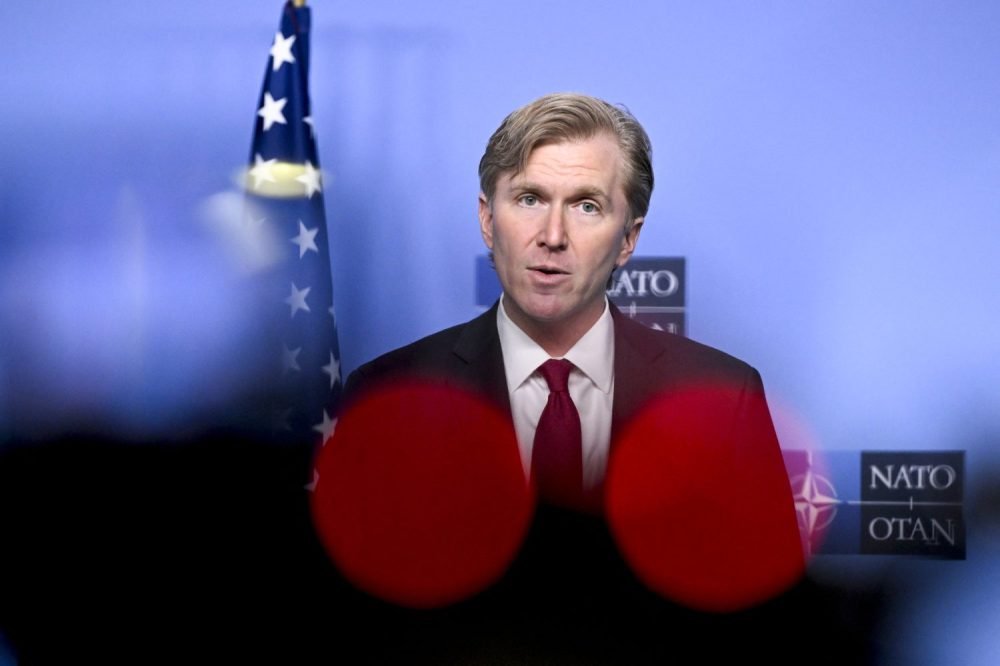
If a European member of NATO invokes the military alliance’s call for help, will the White House pick up the phone? Has the United States suddenly become less hawkish on China? Is a world carved up into spheres less or more safe for countries? I had a chance to ask those and other questions to Elbridge Colby, the U.S. undersecretary of defense for policy—essentially the top policymaker in the Pentagon—on the main stage of the Munich Security Conference. You can watch the full discussion on the video box atop this page or listen to it on the FP Live podcast next week. What follows here is a lightly edited and condensed transcript.
Ravi Agrawal: I’ve been speaking to many European leaders here who wonder how strong the trans-Atlantic alliance is, and more specifically, how robust the NATO alliance is. They often ask if Article 5—the clause that says an attack on one NATO member is an attack on all—still works. So, I have to ask: Let’s say Russia attacks a member of NATO, and that country invokes Article 5. Will the United States definitely come to that country’s defense?
Elbridge Colby: Well, let me be clear from the perspective of the Department of War. The United States is committed to NATO. It is committed to Article 5. The administration from the president on down has made that clear.
The frame that we often hear from our European friends is almost a theological frame that’s asking about the purity of heart, if you will. It was very important to the administration in 2025—starting with Vice President [J.D.] Vance, and the president, Secretary [of Defense Pete] Hegseth—to reframe NATO. The way we think about it is: You had a NATO 2.0, which was kind of a post-Cold War NATO, very focused on these abstractions that Secretary [of State Marco] Rubio talked about very eloquently this morning—the liberal rules-based order. And it became very dependent on the United States. Some of that, to be honest, was the fault of the political establishment in the United States. So we’re not putting the fault all on our allies; it’s shared.
But what we’re looking for and what we’re pushing now is a NATO 3.0. The good news is that, as [NATO] Secretary-General [Mark] Rutte has eloquently said, thanks to President Trump, NATO is actually stronger than ever. That involves a couple of things. It involves the kind of flexible realism, sort of brass-tacks, practical, results-oriented mindset, in a sense, going back to what you can think of as NATO 1.0: NATO as a military alliance. When you think of it that way, I think it’s very compatible with the zeitgeist, if you will, of [German] Chancellor Friedrich Merz’s speech yesterday, which is, “Let’s get down to business.”
The main thing that we want to do looking forward with this NATO 3.0 approach is to come to a much more equitable and thus sustainable model that’s focused on an effective, rational defense of NATO, with Europe taking primary responsibility for its conventional defense, backed up by meeting those spending pledges led by President Trump with Secretary-General Rutte and the European leaders. That will enable that. And if you look over time, that is a really promising vista where we’re going to have a Europe that is strong, that is populous, that is wealthy, that is able to field really serious military force. I see friends of ours from the Indo-Pacific, and we’re asking the same thing. I was in South Korea, the first non-NATO ally to commit to 3.5 percent, the new global standard, as the National Security Strategy has said. That’s where we see not a retreat of the United States from its alliances, but a kind of moderate approach that puts it on a much more sustainable path.
RA: That was a great answer, but it was a yes-no question. Even if everyone buys that this is where NATO 3.0 is headed, the reason why the question is, as you call it, “theological,” is because it could be real. For example, take the Russian-speaking town of Narva in Estonia. Russia could attack and say, “We take this territory.” Estonia then could invoke Article 5, which, as you know, only the United States has ever done. You can’t give a NATO 3.0 answer to that. It has to be a yes-or-no answer.
EC: No, I think the NATO 3.0 answer is the answer to that. I’m a government official; we don’t engage in speculation. When I was in a think tank, I might have given you a different answer. The president has shown in places like Venezuela and in Operation Midnight Hammer that he is prepared to use military force decisively to back up his pledges to work with our allies, like our model ally Israel. We train, we ready our forces, we think intimately, and we have discussions about these practicalities. This is the spirit at the Department of War, but I would say throughout our administration: We are more in the delivering-results-and-readiness business than in the cheap-talk business. That distinguishes us from our predecessors. I will say that directly because you challenged me on this point. President Trump and his administration under his historic leadership are doing more, and we are going to be ready. But we’re putting things on a more sustainable basis. I think that’s the best answer I can give. That’s an answer that Europeans should—actually, that’s a credible, honest, candid, realistic answer. You can have all the shibboleths, the recitation of the shibboleths, you can have all the promises, but if you can’t practically and realistically back it up and make it worthwhile to the American people, that’s an empty promise.
RA: I don’t defend the Biden administration here, but words do matter, signals matter. As far as that goes, there is a sense of fear in Europe that Article 5 doesn’t matter as much anymore.
EC: Can I just say one thing on that? I think words do matter. What we’re saying is we are going to make sure that we and our allies are making commitments and we’re following through on it. We’re about delivering results, and I think the last administration was a lot of overpromising and underdelivering. We’re in the opposite camp: being strong and clear but quiet, not looking to peacock, if you will, but really focusing on building up strength. President Trump has committed to pursuing a $1.5 trillion military budget. We have a historic attempt to overhaul our laggardly and in some cases moribund defense industrial base to get it fit for purpose. National mobilization of our defense industrial base—that’s what our allies should actually want. That’s results.
RA: Fair enough. Again, Mark Rutte, when he was asked this question at Davos, said very clearly, “Mr. President, we will come to your defense.” But let’s move from Europe to the Indo-Pacific because you’ve been arguing for a while, and now the administration does as well, that shifting burden sharing in NATO allows the United States to have more of a focus on Asia. Talk to us about what that has meant in the last 14-odd months of this administration.
EC: What we say in both the National Security Strategy and the National Defense Strategy is that we’re going back to a commonsense, pragmatic focus on Americans’ interests and mapping our overall strategy onto where our interests are most impinged upon and most threatened and where our contributions make the most difference, but also, critically, where we think our allies’ interests lie realistically and also where they can make the most material and relevant contribution. So this is a very different model from the last administration’s one-theater approach, which was a non-military, non-realistic, much more normative, rules-based-international-order approach. Ours is saying that we’re going to meet our allies where they are.
We’re saying that we’re going to work with the warp and weft. We’re going to work with the current of those interests, and that’s where countries will be willing to put up. Then we’ll take where our contribution is going to make the greatest difference and where our interests are most engaged, relatively speaking, and that’s where we’re going to focus. It doesn’t mean we’re going to do nothing in those other areas. But if you look at our strategy, it says homeland and hemisphere. We need to refocus the military as a critical part of that. Secondly, the first island chain and stability there; deterring China through strength, not confrontation. We have a very similar approach to our allies and partners there. In other theaters, we’re looking at Europe and NATO vis-à-vis Russia, looking to our wealthy allies. Chancellor Merz made this point eloquently yesterday, saying that Germany alone is a larger economy than Russia. This is a viable, tractable problem. Similarly, South Korea is saying, “North Korea is our primary threat,” and they’re willing to take the lead for conventional defense on the peninsula. That’s what we’re seeing.
We’re going to get the force back to a focus on lethality and readiness. Secretary Hegseth has made a historic approach to get back to the basics there. On the industrial side—we see this tragically in Ukraine—these modern conflicts are going to be wars of production, so we need to have a defense industry that can produce for ourselves and for our allies. We’re also very supportive of our allies growing their defense industrial base. We’re confident that this will be the recipe for stability but also deterrence and defense.
RA: Let’s talk about China now. There’s a sense that between, say, 2016, the start of the first Trump administration, and, say, 2024, there was a real ascendance of China hawks in D.C. writ large, but also in the White House and in two administrations. There’s a sense now that that trend has reversed a little bit, and I’ll just cite a couple of things that suggest so. One is pulling back from some of the tariff policies from early last year after China imposed export controls on rare earths and critical minerals. There’s also the United States pulling back on chip restrictions for the highest-end chips. There’s a growing sense that when you add all of this up, the United States has actually changed its posture on China. It’s much less hawkish. Would you agree with that?
EC: I’m not sure I could characterize the overall trajectory. I think the United States wants a stable and respectful relationship with China. Obviously, we want to avoid conflict. We also want to be able to engage in mutually beneficial commerce, but we recognize from the president on down that we need to do that from a position of strength. That’s commercial and economic strength. On the military side, we’re very clear about that. We’re strong and clear but quiet, focused on the first island chain. And we need to work with our allies, particularly our allies in the Indo-Pacific, to build collective strength. I think we’ve actually been quite clear. I wouldn’t presume to characterize it, but it’s a coherent approach that’s very akin to this commonsense, “America First” approach. Under the president’s visionary leadership—
RA: Can you define America First, just so we have a dictionary definition?
EC: A little bit of the hack for America First is the commonsense approach. The president talks about common sense—
RA: But my common sense is different from your common sense.
EC: OK, it’s not a scientific theorem, but it’s basically saying: “Are things working out for regular Americans?” People are going to contest what that means, and that’s actually good.
RA: That also sounds like [former President Joe] Biden’s “foreign policy for the middle class.”
EC: Our conceit is that we’re doing a lot better job. That’s the president’s contribution, taking the international trade regime and saying, “Wait a minute. This is not working for Americans,” and saying that the orthodoxy of the economist class is not actually working. OK, we’re going to relook at that. NATO—like when you come to a place like the Munich Security Conference, and I say this with respect, but for many, many years it was the same recitations. The president’s saying, “Wait a minute. How does it make sense for very wealthy, prosperous, developed countries to be spending close to 1 percent and we’re spending 4 to 5 percent of GDP?” Again, a lot of the blame goes on Americans for those decisions. But that’s a commonsense reassessment.
With China, we understand and we respect China’s tremendous achievements in the development of its economy, its very significant military buildup. And we’re acting accordingly, but we treat it respectfully and look at it in a clear-eyed way with the goal of a favorable balance of power and stability. In our engagements with the Chinese, it resonates with them. Obviously, both sides are looking for advantage and negotiating, and that’s a very direct matter, but we’re not trying to strangle China. You’ve probably heard this over the years, the Chinese belief that we were trying to strangle their growth or hold them down. That’s not what we’re trying to do, but we’re going to make sure that we and our allies and partners are operating from a position of strength. That to me is common sense.
RA: I will say, though, that this morning Wang Yi, the Chinese foreign minister, did say that, for example, the U.N. works just fine, which was a direct refutation of what Secretary of State Marco Rubio said, and then he did point a finger at “certain countries.” Inasmuch as there’s a change in policy, I’m not sure I’m seeing a great change in the Chinese tone.
EC: We’re not naive. This is a tough, clear-eyed relationship. Fortunately, our presidents have an excellent relationship. But we’re going to agglomerate our strength and position. We’re going to be engaging. We’re going to be direct. We’re going to be realistic. We’re going to be respectful. But we’re also going to look after the American people and also our allies and partners.
RA: You were very influential in the writing of the National Security Strategy and the National Defense Strategy. The word “Taiwan” doesn’t show up in either of those. Is there a reason why? Tell us how you’re thinking about deterrence for Taiwan.
EC: I have nothing to say in terms of any policy change or position or emphasis even on the issue of Taiwan. Our president is actually quite consistent with our traditional position. We understand that people look at these public documents very carefully. We measure our words carefully, as I said earlier, and obviously the president is our spokesman on anything, but certainly on matters of great sensitivity. We have hewed closely to our position, and we’re focused on our position in the Western Pacific, but we’re seeking stability. But stability involves both a willingness to engage, but also clarity and strength, and we’re all about building up a position of strength. If you look at the budget, if you look at what we’re doing with our defense industry, if you look at how we’re enlisting our allies—I wouldn’t even say enlisting—encouraging our allies to do it for their own reasons. That’s the right mix under President Trump’s leadership.
RA: There’s an element of cognitive dissonance for me sometimes when I look at utterances from the White House and documents and then conversations like this. One of them, of course, was Greenland. It genuinely befuddled many of us why the United States would threaten either war or coercive economic tactics to take territory from a NATO ally. The second one, which is more related to what we were just talking about, is the idea of a “Donroe Doctrine,” this idea that there are spheres of influence. In that kind of thinking, the United States focuses more on its hemisphere. What happens to the other hemisphere? The implication then is that China and Russia should have their way.
EC: I see zero evidence from the United States government in any sort of authoritative statement that we are conceding hemispheric spheres of influence to anybody else. The authoritative statements of the U.S. government, whether the National Security Strategy or the National Defense Strategy, literally say the contrary. I see that as a projection. It’s sort of this normative frame that people say, “They’re thinking that way, so maybe they have to give it to the others.” That logic is certainly not how I think, and I don’t think that’s how people in the administration think. We’re looking for a favorable balance of power with our allies and partners in a kind of hard-nosed, credible way.
At the same time, we are also engaging. We have negotiations with Moscow designed to try to end the tragic war in Ukraine. We’re engaging with China on a variety of fronts, trade and otherwise, in military channels. The president’s team is negotiating with Iran.
RA: I like that you use the word “normative.” In terms of the critiques, they are normative, in large part because some norms are being challenged, and I think that’s where that critique gains weight.
EC: I think that’s true, and Secretary Rubio owned that. I said the other day that I was very encouraged: I only heard the “rules-based international order” mentioned once while I was in Brussels, and that was real progress.
RA: Why don’t you like the term?
EC: I think it’s a misconception. Whether it exists or not, it actually gets people, especially in this kind of context, and misleads them in terms of the frame in which they approach alliances. So it becomes more about a sort of catechism and how much you hew to this purported catechism, rather than a practical discussion—almost like a businesslike discussion—about how we make sure that this operation is sustainable over the long term, that everybody’s pulling their weight. I don’t want to harangue the point too much, but there’s sort of a mark-to-market element here, which is like, “This has been way out of whack. Let’s get down, let’s get down to basics.”
Obviously, I disagree with a number of things Chancellor Merz said yesterday, and I say that with respect. We in the administration have a different view. But overall, the frame was him very much leaning in and saying, “Let’s get down to business. Let’s be practical. We’re going to have differences.”
RA: I will just say, though, that when Chancellor Merz said the international order doesn’t work anymore, I think he meant that as a criticism, and the point was—
EC: He’s free to say that, but he’s not indexing on that and languishing there. Honestly, the German government, including Federal Minister of Defense Boris Pistorius, who’s had a historic role in raising German defense spending and changing the constitution, deserves enormous credit. That’s the greatest evidence. There are people in this orbit who are still indexed on that, and I think they’re going to be left behind. They’re not helping Americans, but more importantly, they’re not helping Europeans.
RA: I take all of those points. Just one last thing on that: The rules matter because, for example, if territorial integrity in Europe doesn’t matter, then China could use that as a rationale for Taiwan later.
One last question for you, Bridge. As you and others have gotten Europe to carry more of the burden when it comes to defense spending, what does that do over time—five years, 10 years from now—to the nuclear umbrella question?
EC: There are a lot of important questions, and if I may say so without presumption, I hope future iterations of this conference are focused more on thinking through these tough issues. As Europe rearms, what does that mean for integration of forces? What does that mean for command and control? What does that mean for stability? What does that mean for defense industrial cooperation that’s more practical and bottom line-oriented? That’s what this conference was discussing in NATO 1.0, and that’s the kind of brass-tacks conversations that are sometimes out of the klieg lights.
The nuclear deterrent is an important one. As I stressed in our department and as the administration has made clear, the U.S. extended nuclear deterrent continues to apply here and to our allies. That is clear. There are discussions I’m hearing about different potential formulations or adaptations. I’m not here to give an official administration position; our view in general is receptive to a greater European coloration to the NATO deterrent. Of course, we already know that the independent nuclear deterrence of the United Kingdom and France—this is NATO policy going back to the 1970s—contributes to the security of the alliance. We want to be very sober, deliberate, given that you mentioned norms, about nuclear nonproliferation treaty obligations, the stability considerations, etc. But those are conversations that we should be having among partners in that businesslike way.



