
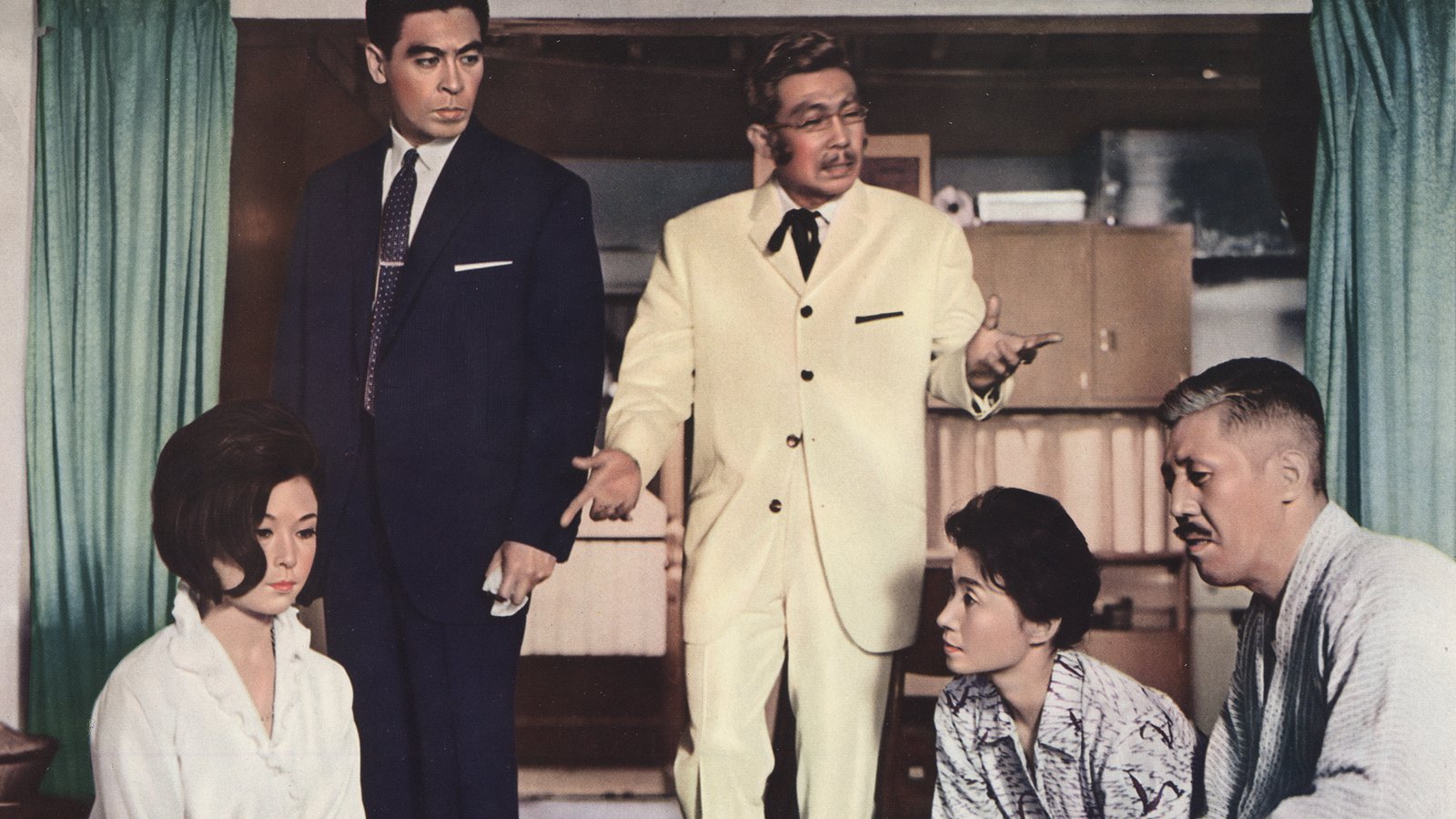
The 1950s marked an era of change for Japan. High economic growth gave hope to many, paving the way for a redefinition of the country’s identity. At the same time, it also fostered a rise in conformity — a desire to fit in and belong rather than stand out from the masses. Directors such as Yuzo Kawashima recognised the problematic aspects of this development and, throughout his career, repeatedly told stories about the conflict between the search for a new identity on the one hand and self-deception, manipulation and mere survival on the other. His 1962 feature “Elegant Beast” is in many ways the thematic and aesthetic culmination of his filmography, while also bridging the gap between Japanese cinema of the 1950s and the more radical tendencies of the 1960s. It is both an important and eye-opening work as well as a biting satire on tendencies within Japanese society that remain relevant today.
Buy This Title
by clicking on the image below
On the surface, the Maeda family appears to be a respectable middle-class household. However, if one cares to look beyond this bourgeois façade, it becomes clear that exploitation, manipulation and deception are key to the family’s survival. Tokizo and his wife Yoshina Maeda (Eiji Funakoshi and Haruko Sugimura) live off the money provided by their children, Minoru (Hideo Takamatsu) and Tomoko (Ayako Wakao). They also encourage them to engage in various schemes to generate more income: their son exploits the goodwill of his employer, the owner of a talent and event agency, while Tomoko manipulates a mediocre yet successful writer who has fallen in love with her.
Over the years, the family has managed to establish a comfortable life for themselves. Tomoko’s lover pays for their apartment, while Minoru’s schemes provide the luxurious goods — furniture and food — they can afford. However, it seems their luck has finally run out, as the writer demands his money back and intends to end his relationship with Tomoko. Even worse, Minoru’s employer is in trouble with the law and has finally discovered who has been stealing from him.
Based on a stage play by Kaneto Shindo, who also wrote the screenplay, “Elegant Beast” wastes no time in dissecting the lies behind the bourgeois surface. The film begins with Yoshina and Tokizo hastily hiding luxurious pieces of furniture and replacing them with cheaper, shabbier items. As their son’s furious employer is about to ring the doorbell, they naturally do not want to give the impression that they have benefited from Minoru’s theft. However, the transformation goes beyond furniture and clothing: the posture and speech of the characters also change, reinforcing the performance of poor, naïve parents who nevertheless stand by their son and claim to want to repay the money.
In “Elegant Beast”, we encounter a particularly sharp form of satire, in which humour exposes a bitter social truth — namely, that cheating and lying have become viable means of maintaining a stable way of life. The true luxury is dignity and respectability, yet these are precisely what the characters cannot afford, as they would make survival more difficult in a world that rewards deceit.
One of the smartest aspects of the movie is how it maintains its dramatic tension even after revealing its core premise in the opening minutes. Once we are introduced to the other family members, a fascinating dynamic emerges, as they repeatedly attempt to deceive one another. Hideo Takamatsu’s Minoru appears to be the most cunning figure in the household, constantly trying to secure advantages for himself and competing with both his sister and his father. Eiji Funakoshi and Haruko Sugimura’s characters form an equally calculating duo when it comes to maintaining the illusion of respectability, with the former clinging to an outdated version of Japanese identity lost after the defeat in World War II. Given that all characters are either on the verge of exposing each other’s lies or are equally adept at deception, Kawashima presents a narrative in which liars are pitted against liars.
Aesthetically, “Elegant Beast” draws on two traditions within Japanese cinema. On the one hand, Kawashima and cinematographer Nobuo Munekawa employ techniques reminiscent of the family dramas of filmmakers such as Yasujiro Ozu. Even though the characters are essentially frauds and cheats, they remain a family attempting to navigate challenges similar to those depicted in films like “Late Spring” or “Tokyo Story”. On the other hand, references to Japanese theatre — particularly kabuki — underscore the moral dimension of the story. While we may find ourselves condemning the characters’ actions, these moments also point to a society that enables and even encourages such behaviour. In this sense, judging the Maedas becomes difficult, as social decline would represent ultimate failure — a fate they are unwilling to accept.
“Elegant Beast” emerges as a ruthless satire of a society in which identity itself becomes a performance. Yuzo Kawashima exposes a world where respectability is no longer grounded in values but carefully staged through deception, forcing individuals to constantly negotiate between appearance and survival. What begins as a family drama gradually unfolds into a broader critique of a system that rewards illusion over integrity — until the distinction between authenticity and performance collapses entirely.



