
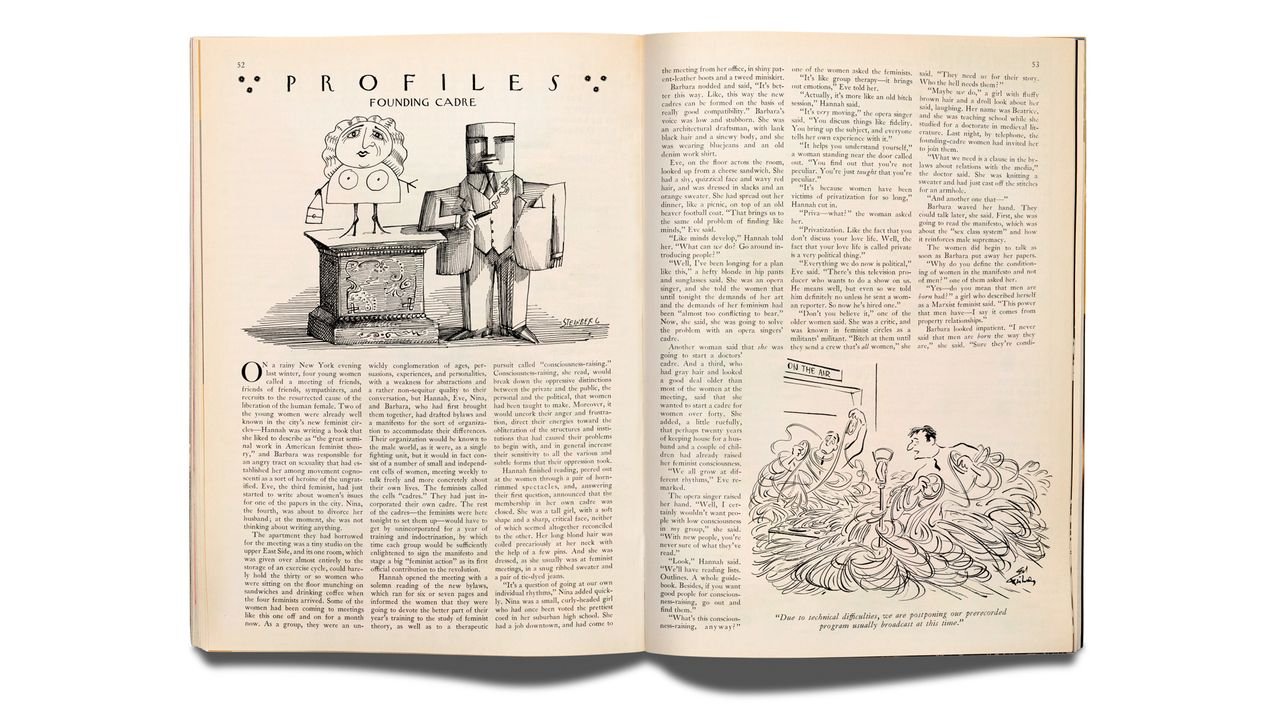
In late 1969, Jane Kramer was back in Manhattan after a spell in Morocco with her husband, an anthropologist. In her absence, the sparks of second-wave feminism had ignited, in two forms: there were the liberals of NOW and also the radicals, whose colorful speak-outs were catnip to journalists. That fall, the Village Voice assigned the writer Vivian Gornick to skewer the “libbers,” but instead she wrote a rousing manifesto that ended with the mention of a new group—and a number to call if you wanted to join.
Kramer followed up, notebook in hand. The New Yorker, then led by William Shawn, was averse to polemical swashbuckling; it would never print a phone number as a kicker. But its writers could take their time. Kramer embedded with the Stanton-Anthony Brigade, the “founding cadre” of a set of revolutionary cells devoted to consciousness-raising, or C.R. She sat in as members shared intimate stories, seeking patterns of oppression and strategizing methods of resistance; she watched sisterhood blossom, then break down. By the time her piece came out, a year after Gornick’s, the brigade had dissolved, but the movement was thriving.
Kramer’s article, “Founding Cadre,” was an outlier for the period. It wasn’t a convert’s plea, like Gornick’s; or an insider’s dishy dispatch, like Susan Brownmiller’s movement roundup in the Times; or a bitingly confessional essay, like Sally Kempton’s “Cutting Loose,” in Esquire. But it wasn’t dismissive, either, like “The David Susskind Show.” Instead, it was icily observational, documenting the group’s rich, clashing perspectives in granular detail. There were pages of dialogue, as in a play, and long block quotes resembling monologues. The one thing the piece didn’t include was the women’s identities; the magazine concealed them with pseudonyms and radically altered identifying details. Even so, I could sort out who was who: “Hannah” was Shulamith Firestone, midway through writing “The Dialectic of Sex,” and “Barbara” was Anne Koedt, the author of “The Myth of the Vaginal Orgasm”; the others were Celestine Ware (“Margaret”), Martha Gershun (“Beatrice”), Diane Crothers (“Nina”), Minda Bikman (“Eve”), and Ann Snitow (“Jessica”).
Kramer’s piece is barely mentioned in histories of the era, and when I stumbled on it I was astonished: it was baggy, almost exhausting, at thirty thousand words, but full of wild spikes of insight and emotion. Like the recent play “Liberation,” it replicated the feeling of being inside a C.R. group, a sensation both grand and claustrophobic. In a typical scene, the cadre met in an East Village walkup and slid from idea to idea, lambasting romance novels, sharing awful tales of marital violence, then musing over who was “male-identifying”—aggressive, careerist. Freud and Marx came up; so did class and race. (Ware was the brigade’s sole Black member, but her race wasn’t mentioned, and, after hosting the first meeting, she quit to write a book.) Tenderness and cruelty overlapped. You can tell whom Kramer liked best.
In 1996, Kramer published a follow-up essay, “The Invisible Woman,” for a special issue on feminism commissioned by Tina Brown, the magazine’s editor at the time. The piece began with a mea culpa. In 1970, Kramer wrote, she had been deeply unsettled by her time in Morocco, where she’d seen a thirteen-year-old girl forcibly married off. She patronized the cadre’s radicals, pitying their singlehood and instability; newly pregnant, she was defensive, afraid that they viewed her as “a dreary housewife in flashy feminist clothes.” The pseudonyms hadn’t been her subjects’ idea, or her own: under Shawn, radical feminism had been viewed as akin to “an odd smell or a kinky preference—something too intimate, too embarrassing, to identify and expose.”
Even so, Kramer defended her methods: she’d let the women speak for themselves, in voices that proved powerful and prescient. Like Gornick, she was a convert. Five decades have only intensified the odd power of “Founding Cadre,” which captures, in its cool frame, the warm sound of women struggling, collectively, to create a revolution. “The Invisible Woman” now feels sadder, given its rosy ending—a celebration of Kramer’s daughter’s generation, which felt secure in the “sweet illusion” of the movement’s triumph. Kramer wrote, “It is hard, as a mother, not to want to see them keep that illusion for just a little longer.” ♦



