The basics:
- NJBIZ panel featured legal and HR professionals discussing 2026 employment law, compliance
- Panelists addressed wage updates, pay transparency, leave, posting requirements and hybrid/remote work debates
- Experts noted hiring slowing, rising layoffs and AI adoption likely affecting workforce numbers
- Discussions included talent retention strategies, skills development and legal compliance for remote workers
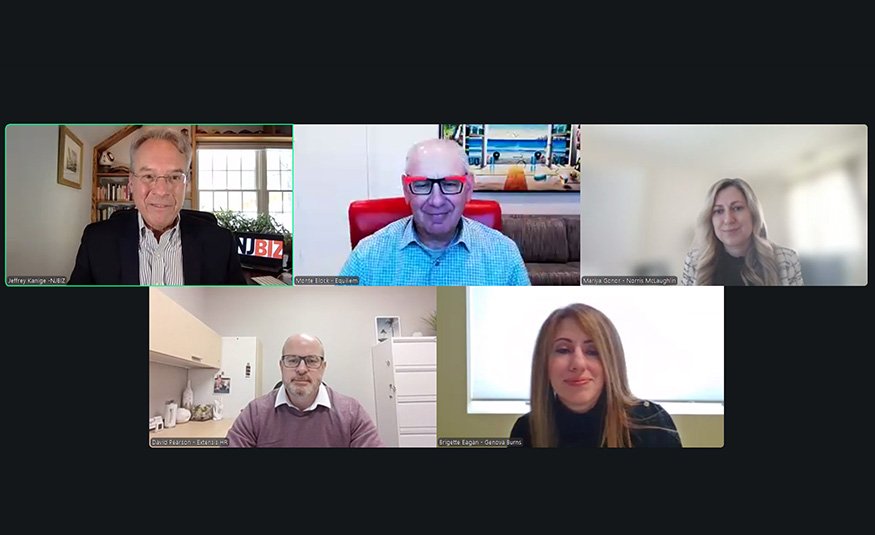
As part of NJBIZ’s latest virtual discussion, legal and human resources professionals dove into various topics related to employment law and compliance in New Jersey.
Moderated by NJBIZ Editor Jeffrey Kanige, the Feb. 25 panel featured:
- Monte Block, CEO of East Brunswick-based staffing and recruiting agency Equiliem
- Brigette Eagan, partner and employment law advisor at Genova Burns LLC in Newark
- Mariya Gonor, co-chair of Bridgewater-headquartered Norris McLaughlin PA‘s executive compensation and employment strategics group
- David Pearson, chief human resources officer at Iselin human resources consulting firm ExtensisHR
During the 90-minute roundtable discussion, panelists addressed 2026 law updates related to wages, pay transparency, leave and posting requirements. They also spoke about the continuing debate over hybrid, remote and office-based work models, as well as how employers are handling the topic of diversity, equity and inclusion.
Hiring trends
After the pandemic and the Great Resignation, workers had the upper hand. With employees seeking higher pay, increased benefits and more perks, companies tried to meet those demands to attract and retain the best possible workforce.
But now the tide has turned. Hiring is slowing, layoffs are rising and companies are back in the driver’s seat, leaving employees more cautious about switching jobs and negotiating raises.
Eagan said, “Right after COVID, you couldn’t get help and you wanted people back to work … So, I do see a shift.”
“For the last year, my larger employers have been doing drips and drabs of layoffs to stay under the WARN Act … And my larger ones are struggling with retention packages to keep the people that we really need so that they are not jumping ship. My smaller employers are getting hit, too,” she said.
AI effect
Eagan went on to say the continuing adoption of artificial intelligence across industries is also likely to affect workforce numbers.
“My employers don’t know where AI will fit in. Most are embracing it in some way, shape or form. It’s either here or coming for them. They do see that there will be layoffs once AI is implemented,” she said.
“I think the economy has been in flux for a while, and I think what we’re seeing now with my employers is not going to surprise you. It’s coming. You’re going to be impacted by it, but they will be fair about it and give that advanced notice,” Eagan said.
Pearson said, “What I’m seeing from my client base, who really is predominantly small-to medium-sized businesses, is that they’re having to pick and choose what makes the most sense. So, are they eroding points of their benefit program? Are they amplifying their compensation program? Pay transparency is pretty significant, but if there’s compression within the organization, that’s where they’re starting to say, OK, what do we need to do from a layoff standpoint?’”
He continued, “We are seeing some of the organizations that are hyper-focused on it, and then other folks are saying, ‘We are going to stay flat and invest heavily in technology because that’s where this catch up is going to be.’”
Talent demand
Gonor said, “For the executive level personnel, the packages are still very attractive, and I think there’s still a great demand for talent … With respect to the employer side, we see some of the smaller levels of layoffs.”
“But I also see employers preparing for AI and integrating AI. And then what are we going to do with our staff once we are fully integrated with all of these AI solutions?” she said.
Gonor continued, “I think at this point, we’re focusing more on talent and retaining, and we’re not as concerned with employees … that could be replaced potentially by technology that’s coming in.”
Replay: Employment Law & Compliance Panel Discussion
Click through to register to watch the full panel discussion!
Pearson said, “What I’ve been finding is a lot of focus falls into skills development where there has to be transferable skills … I think as employers, it’s our obligation to have those transferable skills and upskill folks and then really retain them.”
Block shared, “Many companies have engaged our organization for solutions, and we change with the industry.”
“In one company, we developed a retiree program where they were able to offer people early retirement and then recall them back through our company when needed for peak needs, so it satisfied their budgets and their cuts and whatnot. Then we had another group that we were able to take out and upskill them into new things,” he explained.
Remote feelings
Years after the pandemic, the debate over remote, hybrid and in-office work is still going strong.
Companies want people back in the office to boost teamwork and culture, but many employees aren’t ready to give up the flexibility they’ve gotten used to. As a result, employers must figure out a schedule that keeps both the business productive and their workers happy.
“I think it really does depend on the business itself,” Pearson said. “It’s starting to be tamped down, but the reality is we have been having this conversation for six years.”

Block said, “The problem is with the compliance and laws of what do you do when you have someone in Colorado working for a company in New Jersey?”
He urged companies to consult with experts to discuss the situation, figure out the pain points and develop a plan. Block also noted that employees nowadays are savvier than ever when it comes to what they’re entitled to under employment laws, so it’s key to work with trusted partners.
Eagan said many of her clients in the private equity space prefer to work remotely and that she has developed “very structured rules” for companies that like digital workplaces.
That includes limiting remote work in certain states due to legal, tax and regulatory issues. And employees who work outside of approved locations without permission are at risk of losing their jobs, she said.
Gonor advised companies to put in writing whatever policies they have regarding remote or hybrid work. “So that you can always point to it and then document your decisions,” she said.
Minimum knowledge
In 2019, the state began incrementally increasing its minimum wage to hit $15 per hour by 2024. After reaching that threshold, the rate now adjusts based on the consumer price index.
As of Jan. 1, 2026, the minimum wage is $15.92 for most employees. Separate phase-ins continue for seasonal workers and agricultural workers, with starting wages set at $15.23 and $14.20, respectively.
Panelists urged employers to read up on those changes, so they are prepared those ongoing annual adjustments. They also noted that many clients have told them they weren’t even aware of the latest rate revisions.

Gonor said, “Anyone in business should understand that employment law is just such a rapidly changing environment – especially in New Jersey and New York … You have to be on top of it and remember to just periodically check in because what was true last year may no longer be true a month from now.”
Pearson said, “When those increases have to come into play or when there’s merit increases, where is the money coming from? Are we passing that increase along to our clients? Are we looking at different avenues in order to build business things to that degree?”
“It has become more of the commonality to review this on a regular basis and then partner with the appropriate firms. If they have a payroll firm, payroll firms should be letting them know like, ‘Hey, listen, this is coming down the pike,’” he said.
Block stressed, “You’ve got to be involved in your business. You’ve got to be involved with your law firms, your accounting firms, your insurance firms. You got to be part of the decision-making process on a weekly basis.”
Getting more transparent
Effective June 2025, New Jersey’s Pay and Benefit Transparency Act requires most employers with 10 or more employees to include specific wage or salary ranges and a general description of benefits in all job and internal transfer postings.
The law also mandates those companies to keep current staff in the loop about promotion opportunities before decisions are made. That has meant a major shift toward openness in hiring and career advancement practices.

Pearson said, “I think a big part of it too is pay equity. So as long as organizations are doing pay equity assessments on a regular basis, it’s a little bit more comfortable with these postings.”
He continued, “What it does too is opens employer’s eyes to pay compression. So, if they have somebody that’s been enrolled for 20 years, their rate may not be exactly what the floor of that range is, and they have an obligation to start to dive deeper into their pay philosophy.”
Gonor believes, “I think it may go back to not managing your staff … Because if you have a promotional opportunity … and people internally not getting that opportunity and somebody else being brought in, the question is why is this not the right skillset or are you really not managing your workforce and not managing people out when you should be?”
Family time
Under recently signed legislation, the state significantly expanded the New Jersey Family Leave Act to boost job-protected leave access to hundreds of thousands more workers statewide.
The law that takes effect July 17 lowers the employer threshold from 30 to 15 workers, and eventually down to five by 2028. It cuts employee eligibility to three months’ tenure and 250 hours worked. Additionally, the measure strengthens reinstatement rights for employees who go on temporary disability or family leave, and requires employers to let those workers return to equivalent roles.
Eagan described it as “a game changer.”
“What I tell my employers right now, especially my small ones, is ‘How are you going to staff it? Do you need to cross-train? Do you need to start working with agencies on when somebody will get those 12 weeks of leave? … How are you going to pay for staffing? How are you going to pay for a temporary replacement?’ So, we are strategically trying to prepare,” she said.
The gig is up?
Since taking office in January, Gov. Mikie Sherrill hit pause on a New Jersey Labor & Workforce Development Department rule tightening the “ABC test” for classifying independent contractors. The move comes amid concerns from businesses that stricter guidelines could raise costs and make hiring contractors trickier. Meanwhile, freelancers worry it could limit opportunities.
The administration has said the 90-day freeze gives the state time to figure out a balance between protecting gig workers and keeping things workable for employers.

Eagan said, “I tell my employers, ‘We’re in New Jersey and Jersey goes after misclassification … and if it looks like an employee, the state will treat it like an employee. We monitor how many sites shut down or actually closed over misclassification because … the government does have that power to do that. And that’s what we talked to our clients about.”
“Misclassification is always a hot button issue and just as strong as gender pay equity. Audit yourself. Look really, really hard if you have people there six months or longer. That’s the advice I generally give,” she said.
Opinion
The president of Jersey 1st writes that Gov. Mikie Sherrill’s pause on independent contractor rules should stand. Read more here.
Gonor said, “If you are treating somebody as an independent contractor, you are not paying them overtime … I’ve had this with a client who treated themselves as a staffing agency and sent out detailers, car cleaners and valets to different dealerships. And they just treated all of them as independent contractors. So, they weren’t keeping track of the hours that they were working and were not making sure that they’re not going over the 40 hours and getting time and a half.”
“And when the DOL looked at that, it was like a hundred people, so the penalties and the fees and the investigation fees all adds up. The initial penalty evaluation was I think $2 million by the DOL. And then you’re standing on the other side of the state government or worse federal government and that’s pretty scary,” she recalled.
Diverse divide
In January 2025, the Trump administration began taking steps to roll back diversity, equity and inclusion initiatives, such as closing DEI offices and limiting DEI rules for federal contractors and grants.
While DEI programs remain a focus for many companies, they have also sparked a backlash from employees and politicians who see them as overreach or divisive, creating a tricky balancing act for employers.
Join us
Check out more of our upcoming panel discussions and in-person events here.
Gonor said, “At the end of the day … if we were to take a step back, go back to the law and the language of the law and realize that you cannot make a promotional decision based on someone’s gender protected characteristic, ethnicity and all that other stuff.
“Even though there are these regulations that are coming out and they make for great sound bites, if your DEI policy was [written] in a way that’s just made those characteristics a determinative factor in the promotion, it was always illegal. So again, it’s just being mindful of how you draft your policies. And what we advise our clients now is don’t call your policy A DEI policy, call it something else, use a different term, but then have the same sort of idea of trying to promote people from within,” she said.
Block said, “[W]hen you have an executive order, a regulation or a law that gets passed, it takes time; it takes years for things to happen. And then when cases come up and then when it comes to the courts, it takes years to get it done. You’ve got to make a decision, and the decision is what’s best for your business, in staffing and human resources and it’s hire the best person for the job. And document it. Why are they the best person?
“You won’t get knocked down or sued if you can prove that they are the best person for the job … and document it so that if you get called in on anything, you can say, ‘I did what I thought was right, I did my diligence.’ And you usually don’t get caught for doing diligence and documenting things,” he said.
The post Experts analyze 2026 employment law and compliance trends appeared first on NJBIZ.