
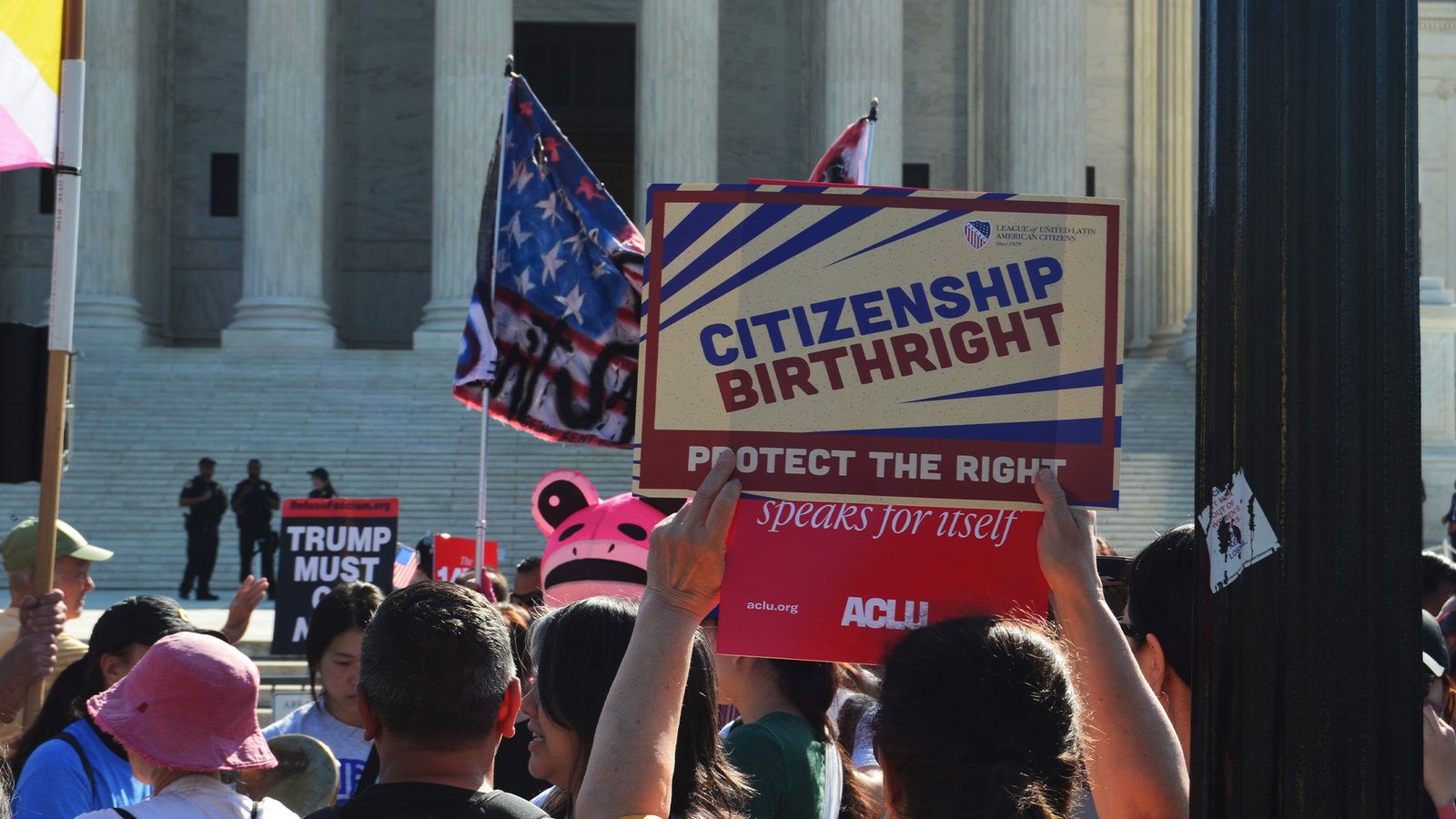
 WASHINGTON — At oral arguments Wednesday, Supreme Court justices appeared skeptical of the Trump administration’s reasoning to end birthright citizenship, a move that would sow legal chaos and fundamentally alter what it means to be American.
The case originated from an executive order Donald Trump signed on his first day as president last year, having declared on the campaign trail that immigrants were “poisoning the blood of the country,” an echo of Adolph Hitler’s rhetoric in “Mein Kampf.”
Legal scholars largely believe that Trump’s order violates the U.S. Constitution. The document has not entered into force, and lower courts have ruled against the administration. In its briefs to the high court, the Trump administration argued that citizenship through birthright should be more narrowly applied.
“We’re in a new world where eight billion people are one plane ride away from having a child who’s a U.S. citizen,” John Sauer, the solicitor general and former personal defense attorney to Trump, told the court Wednesday morning.
“Well, it’s a new world. It’s the same Constitution,” Chief Justice John Roberts replied to Sauer, who argued the administration’s case. At one point, Roberts called some legal elements beneath Sauer’s arguments “quirky and idiosyncratic.”
Conservatives hold a 6-3 majority on the court, which is expected to hand down its highly anticipated verdict at the end of the court’s term, in late June or early July.
The case, Trump v. Barbara, is one of the most important legal matters of the Trump era. He attended during oral arguments at the court on Wednesday, the first sitting president to do so, and did not speak.
 Credit: (Benjamin J. Hulac/NJ Spotlight News)
What’s at stake?
A ruling for Trump could dramatically reshape immigration law and personal rights for millions of people in the U.S.
Every year, an estimated 250,000 infants are born to undocumented citizens across the country. Removing American citizenship from those children would create practical questions, as justices, including Brett Kavanaugh, of the court’s conservative wing, pointed out during oral arguments of a related case in May 2025.
“On the day after it goes into effect — this is just a very practical question — how’s it going to work? What do hospitals do with a newborn?” Kavanaugh asked Sauer, who did not have a clear answer.
Justice Neil Gorsuch had tough questions for Sauer and Cecillia Wang, legal director for the American Civil Liberties Union, argued the case to protect birthright citizenship.
Gorsuch, known for his attention to tribal issues, asked Sauer if Native Americans are U.S. citizens at birth. “Do you think they’re birthright citizens?”
Sauer replied: “I think so.” He added: “I have to think that through.”
Would the order lead to a new type of citizen? Would this different class of citizen be afforded rights similar to those of a full citizen? Would they get Social Security numbers? Passports? How would their rights vary state by state if a legal patchwork emerges under Trump’s order?
In the court fights over Trump’s order, clear answers have not emerged for any of these questions.
The case’s backstory

Democratic attorneys general, including former New Jersey Attorney General Matt Platkin, sued last year to block Trump’s order. Legal confusion would reign if the White House wins, Platkin told NJ Spotlight News on the Supreme Court steps last year.
“For people in South Jersey who give birth in Philadelphia, which many people do, the citizenship of your child would turn on whether you go to a hospital in South Jersey or Philadelphia,” Platkin said.
He added: “I’m confident that we’re going to prevail.”
The court ruled 6-3 against the administration in the previous case, which involved nationwide injunctions.
Democratic attorneys general, including Jennifer Davenport, New Jersey’s top law-enforcement official, said they were confident the administration would lose in court. “The president’s executive order redefining birthright citizenship violates our Constitution, federal statutes, and the rule that has governed our Nation for more than 150 years,” the attorneys said in a statement.
Legal history
Considered legally established since the 1800s, birthright citizenship makes an American of any child born on U.S. soil to parents without permanent legal status. In 1868, birthright citizenship was folded into the Constitution via the 14th amendment.
“All persons born or naturalized in the United States, and subject to the jurisdiction thereof, are citizens of the United States and of the State wherein they reside,” the amendment reads.
The Supreme Court tacked on to that jurisprudence in 1898, when it ruled, 6-2, in U.S. v Wong Kim Ark, that a child born in the U.S. — in this case, San Francisco — to Chinese parents was a U.S. citizen. Congress has weighed in on the topic, too. In 1940, then in 1952, Congress passed a statute that held anyone “born in the United States, and subject to the jurisdiction thereof” is a U.S. citizen.
Erasing that legal building block could hit New Jersey harder than other states. More than one-quarter of the state’s residents were born in another country, versus the rest of the nation, where about 14.8% were born abroad, according to U.S. Census Bureau data.
Trump campaigned two years ago on ending birthright citizenship and conducting a coast-to-coast deportation operation. On the campaign trail in 2024, Trump said immigrants are “poisoning the blood of the country.” A descendant of Scottish and German immigrants, he instituted policies in his second term that favor white immigrants from South Africa, creating a State Department refugee program for descendants of Dutch colonizers.
Separately, Trump created a “Gold Card” immigration program that allows anyone with $1 million to gain entry.



