
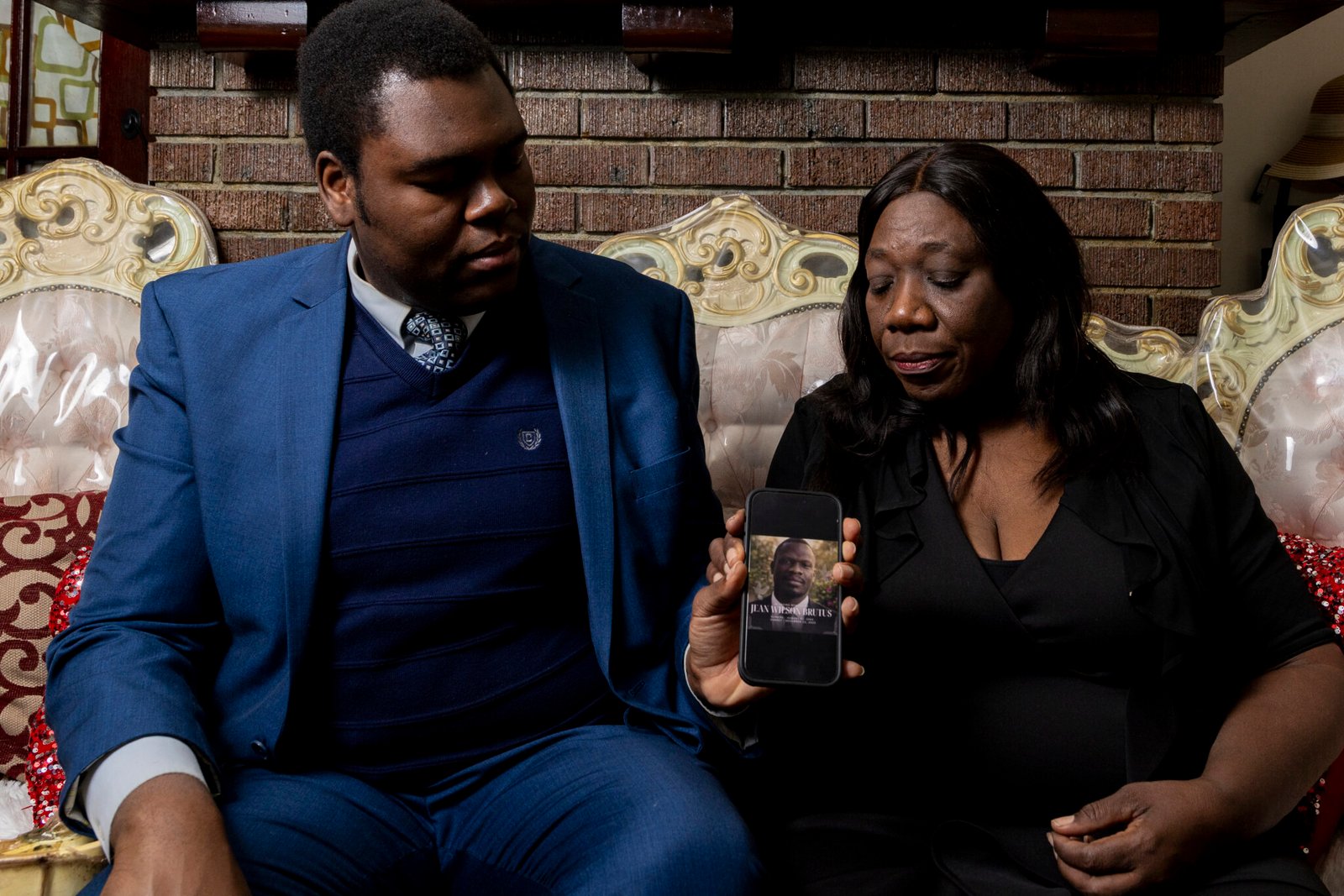
On Sunday evenings after church, the Belony family gathers around the white dining room table in their Irvington home for a weekly family dinner.
Until recently, the loud and joyous ritual included their cousin, Jean Wilson Brutus, who shared stories of his journey from Port-au-Prince, Haiti, through Brazil and Mexico before reaching New Jersey. Brutus would joke about how the green-brown water off the coast of the Jersey Shore compared to the clear Caribbean Sea.
Those dinners Evans and Marie Belony shared with Brutus came to an abrupt end after he died Dec. 12, less than 24 hours after immigration agents detained him at Delaney Hall in Newark. Family members didn’t know he had been arrested until immigration officers called the family to report that he was ill and, soon after, that he had died.
Rising anti-ICE sentiment seen in NJ special primary results
Now, they are still struggling to understand how the man they describe as gentle and selfless has been added to the growing list of immigrant detainees who have died in federal custody.
Evans Belony, 28, is Brutus’ cousin. He described Brutus as more like a brother.
“It’s frustrating to not have answers, especially almost going to two months now. We’re still seeking answers. It’s some frustration, sadness, and sometimes hopeless,” Belony said.
Federal officials say Brutus, a 41-year-old asylum seeker, was arrested in Elizabeth for criminal mischief and called him a “criminal illegal alien” in the release announcing his death.
U.S. Immigration and Customs Enforcement has not provided any timeline or details on what happened while Brutus was in custody or about his death. The agency is required to publish a public report on the circumstances surrounding his death within 90 days, or by March 12.
Brutus is believed to be the first death of a person who was in custody at the privately run Delaney Hall, which opened in May under a 15-year, $1 billion contract.
Brutus’ family disputes any claim that he was a criminal or had entered the country illegally. They stressed he underwent a four-month vetting process to enter the United States through the Hidalgo, Texas, entry point and began asylum proceedings, which were still ongoing.
They say his legal proceedings were why he wasn’t scared of venturing out in his home of Irvington, a Haitian immigrant enclave, even as President Donald Trump’s administration moved to detain and deport millions of undocumented immigrants.
“He didn’t feel fearful because he knew he did it the right way,” Evans Belony said. “He believed it doesn’t apply to him because he was legally vetted, screened, spent months from February to June waiting for the vetting process to be processed to come here legally through the border, seeking asylum.”


New Jersey is home to the fourth-largest Haitian community in the United States, with more than 6,000 Haitians living in Irvington. Many of them moved here after a 2010 earthquake devastated the nation, and they rely on Temporary Protected Status, which gives people legal status to live and work in the United States without a long-term path to citizenship.
The Haitian Bridge Alliance, which advocates for the Haitian community, condemned the arrest of asylum seekers and called for an impartial investigation into Brutus’ death.
“What happened to Mr. Jean Wilson Brutus is not just a medical failure — it is the predictable outcome of a carceral immigration system designed to warehouse Black and Brown bodies out of sight,” executive director Guerline Jozef said in a statement. “Detention is not about safety; it is about control, profit, and racialized exclusion. When the state cages people for seeking protection, death becomes policy.”
ICE officials referred to the Dec. 18 press release announcing Brutus’ death when asked to comment. U.S. Department of Homeland Security officials did not respond to a request for comment.
More than 30 people died last year in ICE custody, the highest since record-keeping began in 2004, according to groups tracking the deaths.
Delaney Hall, the largest migrant jail on the East Coast, can hold as many as 1,000 migrants. Since it opened last year, it has become a focal point of controversy amid Trump’s mass deportation effort. The Newark mayor was arrested there, a congresswoman faces charges for allegedly assaulting an agent in the jail’s parking lot, and four detainees escaped through a shoddy wall and were later captured.
Brutus’ family is awaiting the results of a private autopsy they hope will shed more light on what happened to him. The family is weighing whether to pursue legal action against the jail or ICE officials, and has retained civil rights attorneys.
Brutus was arrested four times between July 2024 and November 2025 for criminal trespassing. Oliver Barry, one of the attorneys retained by the family, stressed that Brutus was not convicted of those charges, and that they do not paint a full picture of him.
Brutus was not involved in any criminal disputes in Haiti, Mexico, or Brazil, Belony said, so he said it was disheartening to see federal officials describe him as a criminal.
“For me, I think it’s unfair. It’s a lie. I believe it’s a tactic just to dehumanize him in a way and reduce him to a criminal, and to justify the loss under their care,” Evans Belony said.
Lawmakers have also called for an investigation into Brutus’ death. Sen. Cory Booker (D) conducted an oversight visit to Delaney Hall earlier this month, and Reps. LaMonica McIver and Rob Menendez, both Democrats, visited the jail shortly after Brutus’ death was announced.
“There must be a clear accounting of what happened in this tragedy, and Delaney Hall must be closed so that this stain can be removed from our community of Newark,” Booker said after Brutus’ death was made public.
After Brutus arrived in New Jersey in 2023, he helped Marie Belony, Evans’ mother, with tasks around the house, became a brotherly figure to Evans, and befriended congregants at the local church, where he played the hand drums. He fit into their big family seamlessly, Marie and Evans said while speaking to the New Jersey Monitor in their living room, which is adorned with old and new photos of their family.
For Marie Belony, her grief remains raw. Wilson, as she called Brutus, was more like a son than a cousin, she said.
She said she replays the two chilling calls from officers she received, one informing her that Brutus was sick, and another 10 minutes later saying he was dead.
“I’m telling you, I cry a lot,” she said. “He do a lot for me. I lost Wilson, I lost somebody. Nobody is like Wilson.”
Belony said that while he is an American-born citizen, he fears what lies ahead for his Haitian neighbors in Irvington. He pointed to the Trump administration’s push to strip deportation protections from roughly 350,000 Haitians living and working in America.
A federal judge last week blocked the administration’s move, pending judicial review, and denied the government’s motion to dismiss a case challenging the program’s termination. Homeland Security officials said they plan to appeal to the U.S. Supreme Court.
Belony said Haitians come to the United States in search of the American dream. They escaped a war-torn country that has suffered political turmoil and violence following the earthquake, and deporting them back there is “a very immoral thing to do,” Belony said.
“I’m not ready to lose some of those friends and family members,” he said.
GET THE MORNING HEADLINES.



