
Vera Drew doesn’t talk about windows and platforms for her underground hit, “The People’s Joker.” She talks about versions.
There’s the MUBI and the Tubi and a theatrical cut that plays festivals and repertory houses. There’s a 35mm print that travels like a roadshow. There’s a handmade VHS edition she personally reformatted and cropped shot-by-shot. And now there’s a new digital-physical version that will live on a thumb drive.
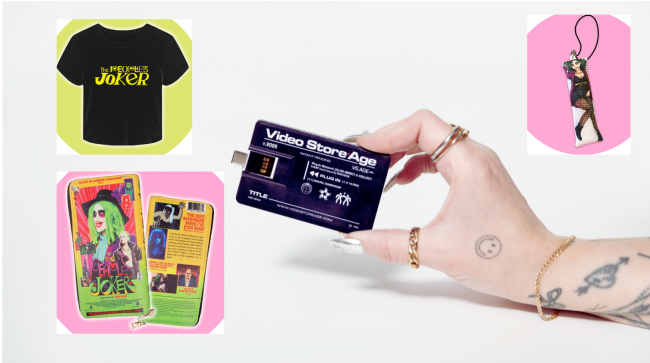
For her, the movie isn’t an object that gets “released” once. It’s a living thing that keeps evolving, generating touchpoints, and giving audiences new ways to engage — like zippered wallets that look like the VHS, part of the latest “The People’s Joker” merch drop.
“The movie kind of was always like a living, breathing text,” she said. “It’s just always kind of been this thing that’s sort of evolving. Merch drops and stuff, it’s fun. It keeps me kind of creatively engaged.”
Merch comes up a lot. Studios also like it, of course; they build franchises to sell it. For indies, it can be part of the creative process and a mechanism that lets the film — and the filmmaker — keep going.

Think Like a Band
Streaming trained audiences to treat movies as temporary access. However, what Drew describes sounds more like a band tour. The film screens, an audience shows up, and maybe they leave with something tangible: a shirt, a keychain, a copy they own. The audience relationship doesn’t end with the screening.
“I think of myself as like a small business owner basically, for better or worse,” Drew said. “And what a gift because I get to make film and art that is meaningful to me.”
That framing is a direct rebuttal to pessimism she heard at the recent Sundance Film Festival. “You talk to filmmakers of a certain generation and they’re very cynical about where film is at financially,” she said.
She has no patience for that mythology. Her view is the work is thriving, but the operating system has changed. You build a business around the work instead of waiting to be chosen.
Behind the Merch Table
“That dream of handing off to a distributor and just them taking it all the way home is kind of obsolete,” said Ash Cook, founder of the just-launched Video Store.Age (VSA).
Cook was a longtime Sundance programmer who recently left the festival to build VSA. His idea: Most distributors stopped caring about print rights when streaming took over, so why not use them?
The print rights that fueled DVDs (and sustained independent film economics, as Matt Damon explained so memorably) go all but ignored today. Ownership is one of the quiet defeats of the streaming era.
As a physical media distributor, VSA exploits those dusty print rights to produce branded USB drives. Plug it into your computer and the film plays. No login or platform deciding whether it still exists.
The drives retail for $29.99, with profits split 50/50 after production costs. There’s no advance, no minimum guarantee, and no upfront fee.
And of course, there’s no VSA algorithm. “Our hope is that we actually are going to be in partnership with the artists,” Cook said.
Drives are sold online, but also after screenings and at launch events where the ticket includes a copy.
The launches aren’t screenings; they’re like-minded gatherings with entertainment curated by the filmmaker. As Cook put it: “Let’s have a party and then go home and we’ll watch the movie on the couch.”
Why the Math Works
VSA’s economics work because the structure is light. Drives are cheap and loaded on demand, so there’s little inventory risk.
“We can do a hundred of X film and 200 of another film,” Cook said. “The risk is low for them and for us.”
That flexibility makes even modest sales meaningful in a market where streaming payouts are often negligible.
Cook noted that “making 20 grand on a title… is exciting in a real material way to filmmakers who are facing either $0, negative dollars, or maybe a $3,000-in-pennies deal from Amazon.”
For Drew, that flexibility is the point. She knows streaming has devalued film, but, as she put it, “we just accept that and we move on and we figure out a new way of doing things.”
“The People’s Joker” is on MUBI, Tubi, Blu-Ray, VHS, and soon VSA. None negate the other. The goal isn’t one perfect window. It’s durability.
Small-Business Mindset
Listening to both Cook and Drew, all of this sounds unromantic in the best possible way.
It’s supply chains, margins, and carrying a box of merch to screenings. Whether Drew calls VSA or her theatrical distributor at Altered Innocence, it’s one person, not a conglomerate. Decisions get made quickly and creatively instead of disappearing into bureaucracy.
“You just don’t wait for any sort of green light,” Drew said. “You just have to do the thing. Look to your left and look to your right — what friend of yours is willing to show up and act in your movie or hold the camera for you? That’s how we get this done.”
It’s a small business. And that mindset — the tour, the merch table, the direct relationship with audiences — is more stable than trying to jump the dream factory’s razor-wire fence.
Sometimes the future of distribution looks like a folding table in a festival lobby stacked with thumb drives, T-shirts, and a filmmaker who actually gets paid that night.
For independent film, the merch table might be the most important infrastructure we have.

📦 Video Store.Age, Explained
A physical media partner for indie films.
Product: USB drives loaded with the film
Price: $29.99
Split: 50/50 profits with filmmakers
Upfront cost: None
Rights: Print/physical media only
Sales: Online, after screenings, festival lobby tables, launch events
Security: Encrypted, copy-protected
Cadence: Quarterly drops (5 features + 5 shorts)
“Distributors like Oscilloscope and Utopia have been extremely open and warm to collaborating with us,” said Cook. “Offering to handle physical media is a real value add.”
First titles: “The People’s Joker,” “Heightened Security,” “Higher Education,” “This Much We Know,” “Valencia”
Why it matters: Selling a few hundred copies directly to fans can generate more real cash than many streaming deals.



