
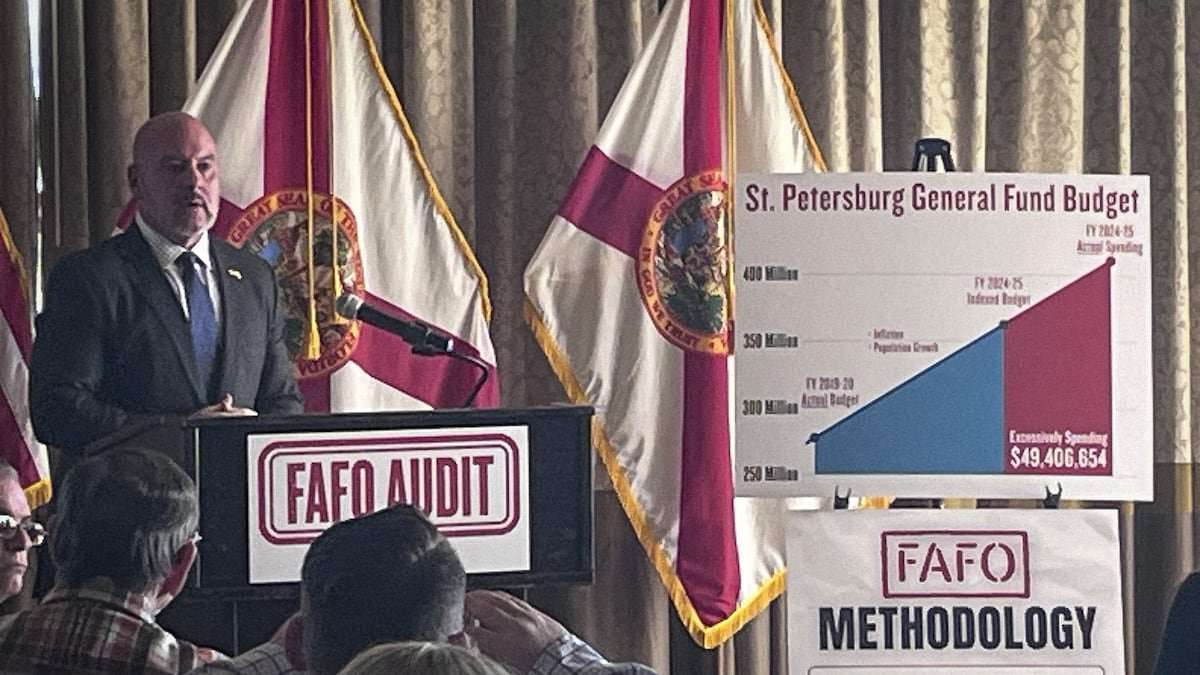
Florida Chief Financial Officer Blaise Ingoglia accused the city of St. Petersburg on Wednesday of overspending in its 2025-26 budget by $49.4 million compared to a pre-pandemic baseline.
Ingoglia has been leading a statewide effort to audit cities and counties to find examples of wasteful government spending. He came to St. Petersburg last summer with questions about diversity, equity and inclusion — or DEI — initiatives, environmental goals and homeless services. This comes as the state has been exploring eliminating property taxes for residences with a homestead exemption.
“This is money that they could have easily cut, in our estimation, your millage rate by and offered property tax relief last year, they just chose not to,” Ingoglia said. “They chose to take the extra money and expand government.”
During a news conference at The Birchwood in St. Petersburg on Wednesday, Ingoglia said the bulk of the city’s overspending went toward hiring new employees. In that six-year time frame, he said that though the city gained 11,504 new residents, it hired 371 new employees. Of those, he said only 65 were first responders.
“I think we made the case here that a lot of that is personnel costs. They are not adding the same amount of first responders,” Ingoglia said in response to a question about how $49 million was spent. “So I do not have to look at the granular details. Basic math tells me a big chunk of it is personnel cost that they probably don’t need.”
In a statement, Mayor Ken Welch, who did not attend the news conference, took issue with comments Ingoglia made about local governments using “every excuse in the book” to justify spending. He said the city just received the report from Florida’s Department of Governmental Efficiency — or DOGE — on local government spending, which has a four-page section on St. Petersburg, and is working to verify Ingoglia’s statements.
“Recent events remind us of the harm that false and politically motivated official statements can create,” Welch said. “The CFO’s claims are unsubstantiated and targeted to support the obvious political agenda of justifying property tax changes, regardless of the impacts on police and fire service delivery by local governments. We will continue to operate based on facts, not conjecture.”
Welch encouraged residents to review the city’s budget documents online.
DOGE’s report was provided to the Tampa Bay Times following a public records request. In St. Petersburg’s four-page section, it said the city had “modestly reduced” the tax rate several times but has “focused its attention on diversity programs and policies, rather than on spending restraint.”
“Florida DOGE’s site visits identified The City of St. Petersburg as having some of the most egregious examples of wrongful DEI among the locations visited, and elected officials have publicly defended these programs,” the report read.
Ingoglia said at the news conference that he was speaking about FAFO audits, with FAFO standing for Florida Agency for Fiscal Accountability. He said DOGE and FAFO are two separate things.



