
I stopped this weekend to gas up our car, and it took longer than usual. The pumping wasn’t the problem. The delay came from securing a big enough bank loan.
In case you’ve been holed up in your bedroom for the past three weeks, the doddering old dude who got elected president in 2024 by promising lower prices and no new wars managed to break both promises at once. On Feb. 28, he launched an attack on Iran, and now gas prices are soaring as fast as a firework on the Fourth of July.
As of Wednesday, AAA says gas cost an average of 3.93 per gallon in Florida, a dollar more than a month ago. Oil industry officials say it’s about to get even worse.
“Gas prices … could potentially reach $5,” the Naples Daily News reported. Or as someone joked on Facebook, fuel costs now break down this way: Regular, “Arm,” Plus, “Leg,” and, for Premium, “Soul.”
Obviously, this is the PERFECT time for the Florida Legislature to force us all to use even more fossil fuels.
That’s right, our duly elected dunderheads passed another law, HB 1217, that requires everyone in Florida to ignore the damage being done by climate change.
Their target: Counties and cities pledging to cut their greenhouse gas emissions to zero. Such “net-zero” pledges will now be verboten in the “Free” State of Florida, where you’re only free to do, say, and believe the things the state wants you to do, say, and believe.
“The Legislature finds that net zero policies, carbon taxes and assessments, and emission trading programs are detrimental to this state’s energy security and economic interests and inconsistent with the energy policy and the environmental policy of this state,” the bill says.
The Sierra Club calls it “one of the most sweeping and preemptive restrictions on local energy freedom in recent years.”
And it’s all at the behest of one really rich guy.
Paying dramatically more
There was a time, not long ago, when Florida was a leader in battling climate change. That was because no state was facing a greater immediate threat from rising sea levels.
This was under Florida’s second Republican governor since 2000, avid boater Charlie Crist. In his first State of the State address in 2007, Crist called climate change “one of the most important issues that we will face this century.”
Crist convened a climate-change summit in Miami that attracted 600 participants. During the summit, he signed a series of executive orders imposing far-reaching changes in the state’s energy policies, such as reducing greenhouse gas emissions to 1990 levels by 2025 and mandating that statewide building codes seek a 15% energy-efficiency increase.
He even persuaded the Legislature to pass a bill — the Florida Climate Protection Act — calling for the state to pursue “market-based solutions” to reduce greenhouse gases. The goal was to set up a cap-and-trade system to limit emissions from power companies and other polluters, but also to create a marketplace through which they could buy or trade credits to go over the limit.
Crist was prodding the state to do all the things that are now being prohibited by HB 1217, things that are being declared “detrimental to this state’s energy security and economic interests.”
We wouldn’t be facing this mess, except Crist chose not to run for reelection, instead pursuing an open U.S. Senate seat that he lost to Marco Rubio. His place as governor was taken by Rick Scott, a wealthy lawyer and retired health care executive.
He not only didn’t want to fight climate change, he didn’t even want to hear the words spoken. Scott gathered up all of Crist’s programs and tossed them in the trash bin behind the Governor’s Mansion. We’ve been going backwards ever since.
Until this bill passed, I thought we’d hit rock bottom in 2024, after we got clobbered by not one but two major hurricanes in a row.

When a reporter asked Gov. Ron DeSantis about the role climate change played in making Hurricanes Helene and Milton into more intense storms, DeSantis first attacked the reporter for daring to ask such an impertinent question. Then he claimed, erroneously, that trying to combat climate change would ruin our economy.
“I think you should be more honest about what that would mean for people, taxing them to smithereens, stopping oil and gas, making people pay dramatically more for energy,” he contended. “We would collapse as a country, so this whole idea of climate ideology driving policy, it just factually can’t work.”
Imagine if we could jump in a DeLorean and zoom back to that day. We could warn him that in just two years, we’d be paying “dramatically more for energy” because we were relying on his favored fuels, oil and gas.
Close your eyes
The same year those two hurricanes hit, DeSantis signed into law a bill deleting most mentions of climate change from state law — mentions that had been put in during Crist’s tenure.
In a classic bit of Florida irony, he did this while South Florida was experiencing record high temperatures.
“The heat index rose as high as 109 degrees Fahrenheit in Fort Lauderdale, 107 degrees in Hollywood and Kendall, 105 degrees in Key West and Opa-locka, and 104 degrees in Miami,” WSVN-TV reported.
That’s why I call this the “Close Your Eyes Act.” Pay no attention to the hotter nights, higher storm surges, more intense hurricanes, heavier rain bombs, and sharp increase in mosquito-borne diseases.
Meanwhile, though, Florida voters have expressed an eyes-wide-open interest in both alternative energy sources and saving money. In 2016, a constitutional amendment to provide property tax breaks for people who install solar panels on their homes passed by an overwhelming 73%.
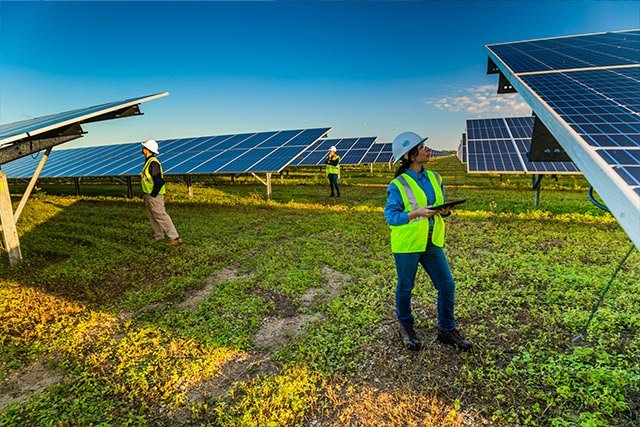
Thus, a lot of local governments continued pursuing solutions dating to the Crist era. That included switching their fleets of vehicles to electric, finding ways to power their buildings with solar panels, and pledging to work toward not emitting any greenhouse gases at all.
The list of local governments that committed to a net-zero future included St. Petersburg, Sarasota, Gainesville, Orlando, Tampa, South Miami, Dunedin, Safety Harbor, Largo, Cocoa, Satellite Beach, and Clearwater.
The specifics varied by locale. In Orlando, for instance, the city has promised to run all its government buildings and vehicles on clean energy by 2030, and to phase out two coal-fired power plants by 2027.
Note that, politically, these towns are all over the map. The mayor of Orlando is a Democrat. The mayor of Safety Harbor is a Republican. Dunedin is the governor’s hometown, for crying out loud.
Can you blame them for pursuing these net-zero goals while state officials stick their heads in the sand? “Emissions” is just a fancy word for “pollution.” These local governments are working toward not producing pollution. That’s a noble thing, isn’t it?

“Local governments are closer to the people than state government,” noted Brooke Alexander of the Sierra Club of Florida. “They passed these goals because people showed up at their meetings and said, ‘We want this.’”
There’s even a Southeast Florida Regional Climate Change Compact, led by Broward, Miami-Dade, Monroe, and Palm Beach counties.
Yet our fine Legislature — which failed to pass a bill banning first cousins from marrying each other — considers this push for clean energy to be a grave threat that must be stopped.
I wondered: Who’s backing this odd and unpopular move? The answer might surprise you.
Lapses in logic
HB 1217 was sponsored by Rep. Berny Jacques. An attorney in Seminole, Jacques is a Haitian immigrant AND a member of the political party led by two politicians who falsely claimed Haitian immigrants are eating people’s cats and dogs.

Jacques chairs the House Intergovernmental Affairs Subcommittee, so I watched the subcommittee’s Feb. 12 meeting during which he had to explain his bill. He focused on the financial aspect and never mentioned climate, sea level rise, or hurricanes.
“When you have these types of financial burdens, it makes things more costly,” Jacques told his colleagues. “That is what this bill is trying to prevent.”
Rep. Ashley Gantt, a Miami-Dade Democrat, asked Jacques to name somewhere in the state where net-zero pledges were causing such problems. He couldn’t. Yet he insisted it was a big danger.

“This can become a much more costly situation when you limit it to one particular product,” Jacques said. He failed to explain how fuel from the sun, which is free, could be more expensive than gasoline, which is not.
Despite the obvious lapses of logic in Jacques’ argument, his bill still passed by a vote of 11-4 and went on to success in the full House and Senate.
One of the nifty things about our Legislature is that the website for reading over the bills also includes a listing of the lobbyists who have signed up to talk about them.
When I clicked on the link for Jacques’ bill, I saw a lot of people and organizations opposed to it — environmental groups, local government officials, and groups like the Florida League of Cities. There were also a number of utilities.
That list included Florida Power & Light, America’s largest electric utility. Since 2009, its parent company has been the largest producer of solar and wind energy in the nation.
“FPL operates dozens of solar energy centers across the Sunshine State, each of which quietly generates clean, American-made energy for Floridians,” the company’s website boasts.
Usually, whatever FPL wants from the Legislature, it gets. But not this time.
Lined up on the other side, supporting the bill, was one entity and only one: Americans for Prosperity — or as I call ’em, “Americans for One Guy’s Prosperity.”
Driving up the cost
AFP is a dark-money group co-founded by Wichita oilman Charles Koch, long a purveyor of climate change denial.
The fact that he’s worth around $75 billion should tell you how he’s able to have so much influence on our politicians. AFP spent $157 million on campaigns in just 2024, at least $1,000 of which went to Jacques.
In 2021, AFP’s longtime president stepped down after word got around that he was having an extramarital affair with a Virginia Republican official. Meanwhile, the organization quietly settled a lawsuit alleging gender discrimination and retaliation in its North Carolina branch.
Nevertheless, AFP is still thriving here in Florida. In fact, its state director, Skylar Zander, wrote a piece for Florida Politics four months ago headlined, “Hidden climate taxes hurt Florida families, small businesses.”

I don’t want to say the piece was entirely fact-free, but the last time I saw something containing this much fertilizer, it was a bag labeled “TruGreen.” There was nary a mention of any location in Florida where pursuing net-zero emissions was weighing down everyone’s taxes.
“When the government drives up the cost of energy,” Zander warned, “families pay more in utilities, at the gas pump and at the grocery store.”
Gee, when the government drives up the cost of energy — that sounds bad! You mean like when the U.S. government attacks Iran? That’s sure driven up the cost of energy.
Maybe the smart move here, Mr. Z, would be to stop relying on particularly volatile energy sources like fossil fuels.
What will Ron D do?
The big question now is what DeSantis will do with this bill once it lands on his desk. Although he’s said he accepts that climate change exists, he’s been no fan of fighting it.
I asked Alexander if he might veto it, and she said, “We can dream.”
Occasionally, though, DeSantis surprises everyone.
Take what happened in 2022. At the behest of FPL, the Legislature passed a bill that would have killed the practice of net-metering, which allows residential solar customers to sell energy back to the power companies.
DeSantis vetoed the bill. He insisted he did it because of the cost involved, not because he’s got any deep love for solar power. But he’d also been bombarded with letters from voters pleading with him to thwart FPL’s plans.
A similar campaign this time might work if participants make sure to be complimentary. Don’t mention his failed presidential campaign, his Hope Florida scandal, or his white boots.
Instead, they might want to play up the cost involved, telling the governor that looking to fossil fuels to power everything we need is an idea that’s clearly run out of gas.
Independent Journalism for All
As a nonprofit newsroom, our articles are free for everyone to access. Readers like you make that possible. Can you help sustain our watchdog reporting today?



