
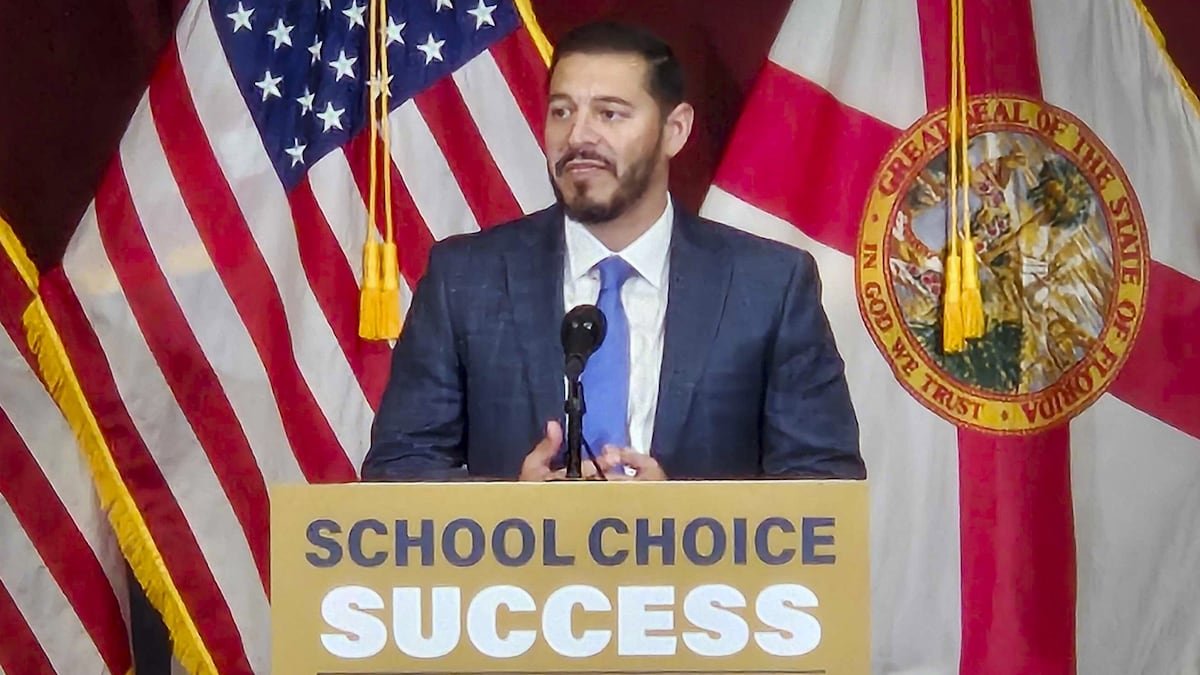
The big story: The Florida Department of Education has a new email hotline for public school students and staff who believe their religious rights have been violated.
Asserting the department’s commitment to constitutional protections for voluntary prayer and religious expression, as outlined in recent federal guidance, education commissioner Anastasios Kamoutsas on Tuesday unveiled FLFaith@fldoe.org as a place to submit complaints.
In a letter addressed to parents, Kamoutsas said department officials would investigate each email received, reporting every complaint and any legal charges to the federal government. He offered examples of what should be expected from the schools, such as treating religious speech the same as secular speech.
“An essay with religious content should be graded with the same grading standards as a secular essay,” he wrote. “Religious student organizations should be treated the same as secular student organizations.”
The federal rules are not new. But the latest set of guidelines are intended to replace those promulgated by the Biden Administration.
They state that while individuals may pray in school, they may not do so on behalf of the school and they may not coerce or require others to participate. Also, schools may regulate student speech that disrupts course work or invades the rights of others.
The latest directive comes weeks after Kamoutsas warned educators against indoctrinating students with anti-law enforcement messages, and threatened to take action against anyone who encourages student protests and walkouts.
Students have a right to express their political views, he said, as long as they follow state law and school district policy.
In related news … Two national groups have called on the Duval County school board to stop opening its meetings with prayer, Jacksonville Today reports. • A federal judge struck down an Arkansas law requiring the Ten Commandments be prominently displayed in public school classrooms, Associated Press reports.
Hot topics
Session postmortem: Florida lawmakers had a light load when it came to education legislation this year. Take a look at three bills that passed, and four that didn’t. Now attention turns to how they handle the budget. • Some Arizona politicians have their eyes on Florida’s debate over accountability measures for school vouchers, KNPX reports.
Excess property: The Wakulla County school district is offering to transfer its former Education Center to the county government, WCTV reports.
Campus threats: At least five Volusia County juveniles were arrested in one week on accusations of making threats of violence against schools. What happens to them next? WKMG explains.
Budget cuts: Miami-Dade County school district officials are looking to stabilize their reserve accounts as enrollment shrinks, WLRN reports. • The Leon County school board is poised to slash nearly $7 million in spending as it confronts a growing revenue shortfall, the Tallahassee Democrat reports.
Artificial intelligence: Miami Dade College debuted its AI Innovation Hub to train students in emerging technology and applied artificial intelligence, Refresh Miami reports.
From the court docket … An Alachua County teacher continues to fight the education commissioner’s effort to have her disciplined amid accusations that she targeted a conservative student, WCJB reports.
Hot takes

“Florida cannot afford vouchers that are unaccountable and have no income limits. Legislators, as you consider our budgets that are facing deficits, do the right thing. Implement the recommendations of the Auditor General and of SB 318. If not, we have to ask, why not?” — Laura Hine, Pinellas County school board member, in Florida Politics
Florida’s social studies standards are “exactly what civics education ought to be and precisely what Thomas Jefferson had in mind when he envisioned an American public education system that would not only create an informed citizenry, but also a virtuous people who would uphold the American republic for generations.” — Chris Talgo, The Heartland Institute editorial director, in The Hill
Quick quiz
As Florida and other states require professors to publicly post their syllabi, free speech advocates predict a chilling effect. How has it played out at the University of North Florida?
a) A professor changed his syllabus after being asked to remove the words “diversity,” “equity,” “inclusion” and “culture”
b) A professor was fired after refusing to revise her syllabus or course content
c) A professor was disciplined after reframing his course description without shifting course materials or objectives
Find the answer in this story from Higher Ed Dive.
Don’t miss a story. Here’s a link to yesterday’s roundup.
Jeffrey S. Solochek is a reporter covering education as a member of the Tampa Bay Times Education Hub. You can contribute to the hub through our journalism fund by clicking here.



