
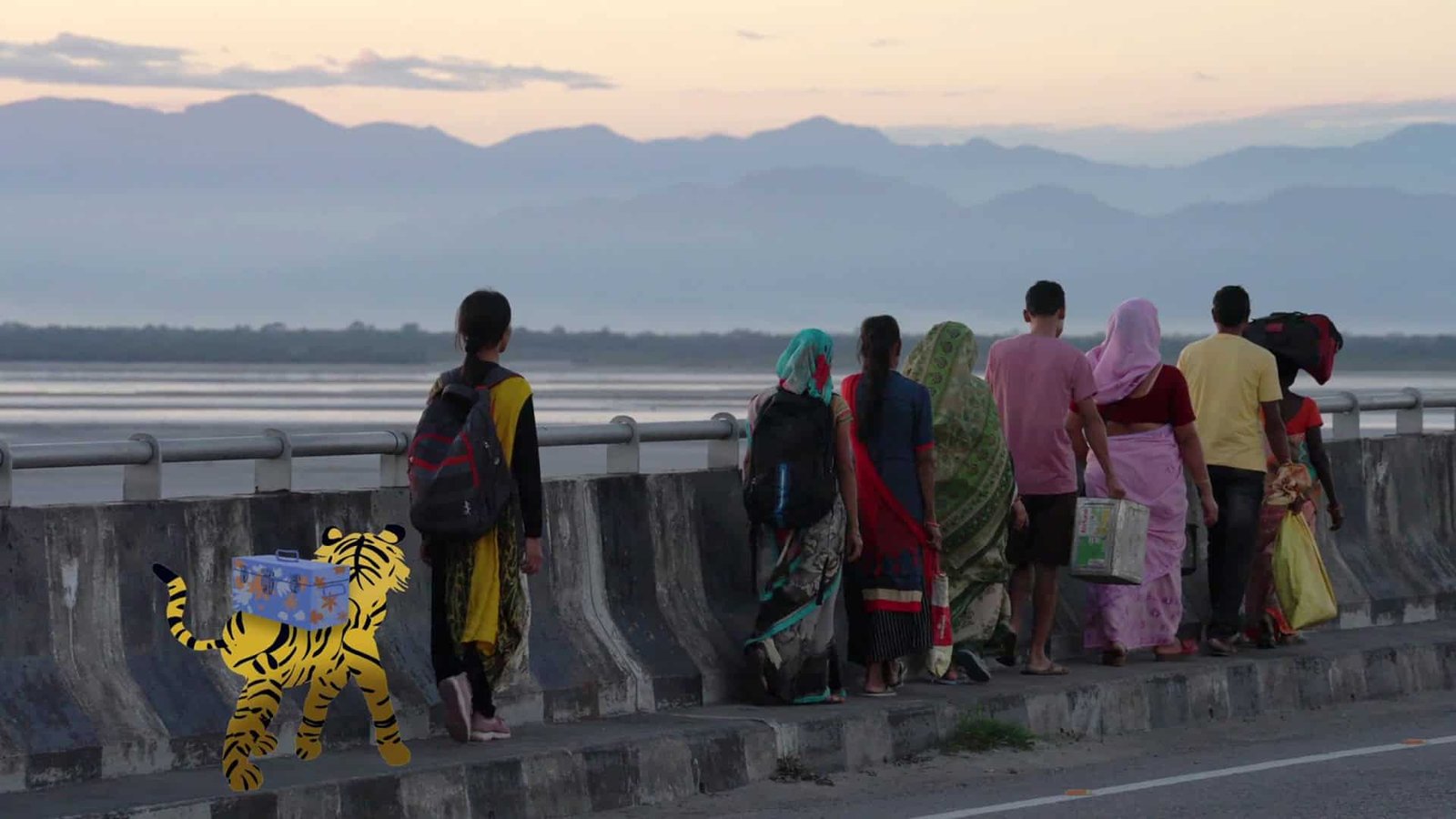
“Every local agenda is claiming some memory legacies”. It is with these words that the Chinese media scholar You Mi responds to Dutta’s musings on people’s relationship to memory and the past in general in the key scene of her documentary “Flying Tigers”, which serves more as an explanation of the story than anything else.
The two women, who struck a friendship in Germany, have embarked on a project to explore a very specific chapter of “a common moment of history between two countries (India and China) with closed borders.” With the same goal and fully different approaches to the subject matter, Mi follows a more artistic path, while the director stands firm behind hers, at least when it comes to “Alzheimer as a clue”. They exchange experiences to create a mosaic of personal anecdotes, talks, letters, and messages, and finally embark on “a journey between times and territories, between fragile memories of unknown pasts and invisible corners of the present” – to quote the director’s words. On that journey, they are joined by the young Assamese writer Purav Goswami, who proves useful for understanding the many layers of a complicated history chapter, “written” in a multi-ethnic, politically complex region.
Inspired by intimate conversations with her Alzheimer ’s-affected mother, who, stuck in the past, would (for instance) insist on shutting all windows in her Mumbai apartment because “she could smell the tiger”, the Indian director has decided to use the illness as a kind of cinematic formula. “Alzheimer’s patients refuse to fix the past in any time and space”, she explains, noting that all of them would put any memory into any other configuration.
This could be seen as a perfectly good reason for the choppy editing, or as a fantastic excuse for it. We’ll leave the second option to the sceptics and stick to our gut feeling that nothing in Madhusree Dutta’s film is accidental. The movie, although documentary at its core, is heavily scripted, which is nothing new in the filmmaker’s practice. Words uttered in front of the camera, be it by the two main protagonists/ artistic collaborators or their conversations with other people on their quest to explore two things: the history of “Flying Tigers” or The First American Volunteer Group of the Republic of China Air Force, formed to help oppose the Japanese invasion of China actively operating from 1941 to 1942, and the irreparable damage that the construction of an enormous infrastructure to support the first airbridge across the Himalaya in order to send military aid to Kunming in China, are strictly under control.
This is clearly visible in the stiffness that many people who exchange experiences with Mi or Dutta display on camera. In all its occasional awkwardness, this doesn’t really harm the movie. On the contrary, it adds to its authenticity.
Madhusree Dutta returns to filmmaking after a twenty-year break during which she dedicated herself to art. The founder and former director (1998-2016) of Majlis, a centre for interdisciplinary art initiatives in Mumbai, she served as artistic director (2018–2021) of the Academy of the Arts of the World (Akademie der Künste der Welt) in Cologne. Now back in the directorial saddle, she continues with her tradition of unusual storytelling.
It is a jumpy road that the audience embarks on. But it is adventurous as well. It brings interesting historical facts to the table and lets us learn about things we would probably never hear about. Documentary at heart but hybrid in form, “Flying Tiger” combines many elements, from standard documentary to art performance, purely acted scenes, and animation.
The film celebrates its world premiere in the Berlinale Forum festival programme.



