
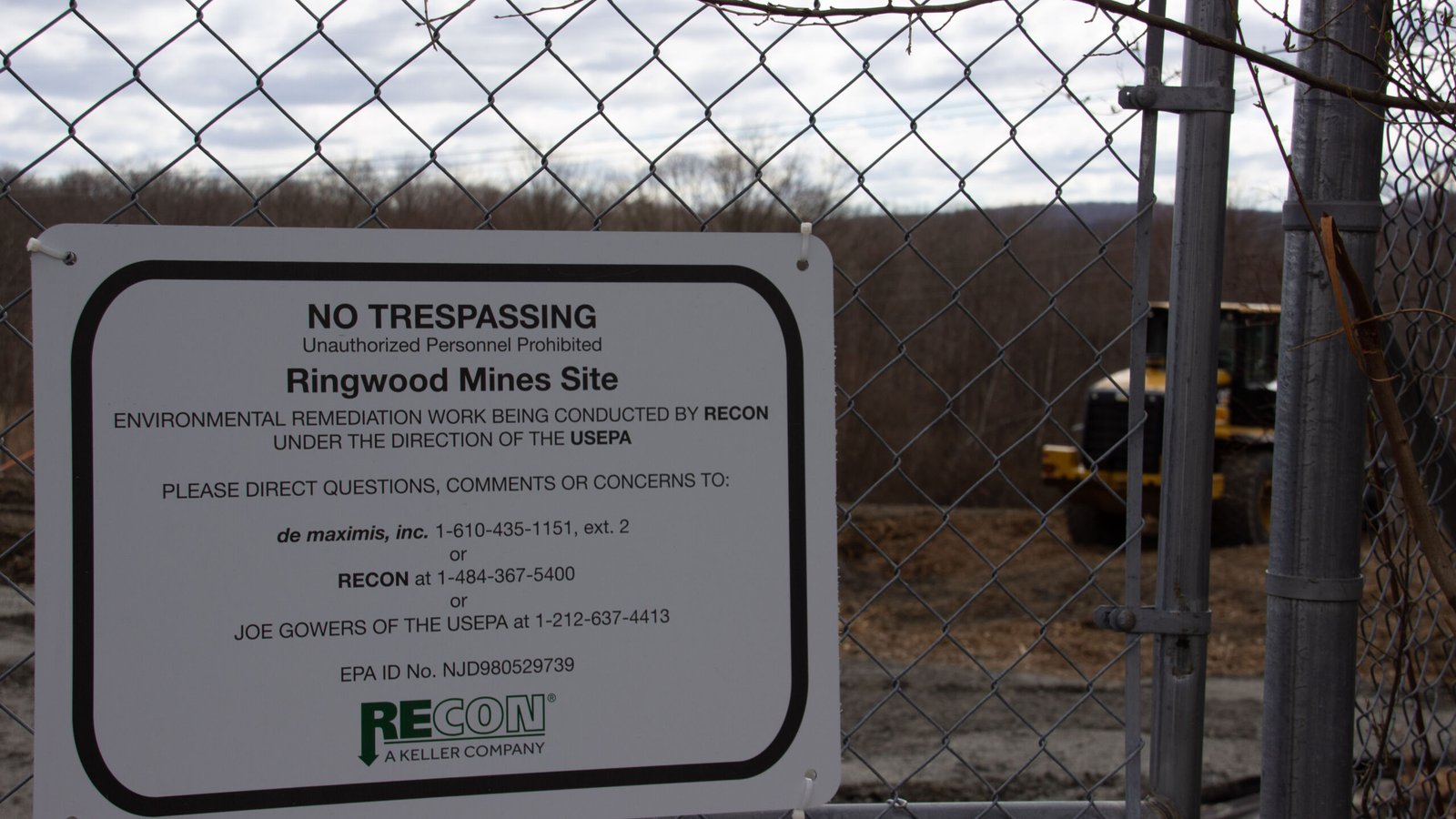
 WASHINGTON — Under a pending legal agreement, Ford Motor Co. would pay the remaining cleanup costs at a toxic waste site in Passaic County, where the automaker’s decades-long dumping of dangerous chemicals and parts left a legacy of contamination and tribal dislocation.
The remaining costs for the site, the Ringwood Mines, are an estimated $3.4 million, according to the U.S. Department of Justice.
Ford would also reimburse New Jersey and the federal government for remediation expenses they have paid. In exchange, prosecutors would not file site-related lawsuits against the company in years to come.
The agreement, known as a proposed consent decree, is not final. It is subject to a public comment period and requires court approval.
A spokeswoman for Ford, Randi Berris, declined to comment beyond the proposed deal. Darwin Pham, a representative of Gov. Mikie Sherrill, a Democrat, declined to comment, citing ongoing litigation.

The potential deal stems from a lawsuit the Department of Justice and the state attorney general filed in federal court in New Jersey, demanding costs to clean up the site, where iron mines operated in the late 1700s and 1800s.
In the mid-20th century, Ford used abandoned mine shafts to dump toxic waste and chemicals, including benzene, arsenic and lead, sludge and paint cans.
Though the Environmental Protection Agency in 2025 found the roughly 500-acre site to be safe, a study from NYU-Langone Health published last year, after the EPA’s determination, said the location remains dangerous to public health.
“We found lead in the soil at rates about 4.7 -old higher than the rest of Ringwood,” Judith Zelikoff, an environmental toxicologist at NYU-Langone Health who worked on the study, said last year. “We also found arsenic at high levels, about tenfold higher than the standards.”
Ringwood in the 1980s was labeled a Superfund site, the national system that uses a mix of funding from a tax on the chemical industry to payments from companies directly responsible for pollution.
Pollution at Ringwood has forced out members of the Turtle Clan of the Ramapough Lenape Nation, an Indigenous group that has lived in the region for centuries.
Tribal members fell ill to cancer and other severe health problems after toxic industrialization.
After a first cleanup round, Ringwood was removed from Superfund, then added back in the early 2000s.
New Jersey has 115 Superfund sites, the most of any state.
New Jersey has benefitted from a federal infrastructure law, which cleared Congress in 2021, that reinstated a tax on chemical companies used to pay for Superfund work.
Republicans on Capitol Hill are trying to eliminate that tax, which first expired in the 1990s.
The 72-page proposed deal, filed under the Superfund law, requires Ford to notify federal and state officials of any “emergency” events or “releases” during the clean-up process.
It also allows Ford to ship “hazardous substances, pollutants, and contaminants” from Ringwood to an external site, potentially out of New Jersey, if they notify officials within the state receiving the waste material.
The deal also empowers EPA to monitor the remediation process and to scrutinize Ford’s clean-up work for a year after the agreement is finalized. “There shall be a shakedown period of up to one year for EPA to review whether the remedy is functioning properly and performing as designed,” the deal reads.



