
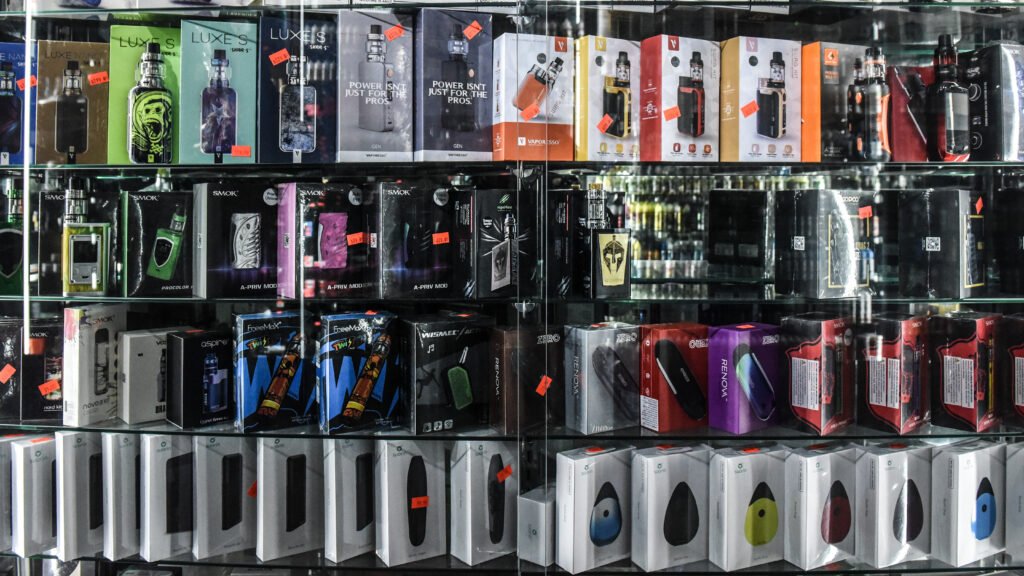
With thousands of illegal e-cigarettes for sale in the U.S., both the Trump and Biden administrations have vowed to crack down on the illicit fruit- and candy-flavored vapes that hold particular appeal to minors. But a new government report suggests law enforcement efforts by the Department of Justice lag far behind the scope of the problem.
Most DOJ enforcement actions between fiscal year 2022 and fiscal year 2025 — 50 out of a total of 88 — were to add the names of remote e-cigarette sellers to a list of unauthorized businesses, according to the report from the Government Accountability Office. The second-most common type of enforcement actions (20 out of 88) noted in the report were injunctions to stop legal violations.
The GAO report was focused on actions that involved the DOJ, so those tallies do not take into account enforcement actions like the seizure of more than 6 million illegal products by the Food and Drug Administration and U.S. Customs and Border Protection between 2024 and 2025. To put those seizures in context, a large seizure of $76 million worth of products in 2024 — 3 million vapes — equated to about 4% of China’s e-cigarette exports to the U.S. in a single month, said Steven Xu, an adjunct assistant professor at the University of Waterloo who studies e-cigarettes.
Sen. Dick Durbin (D-Ill.), who requested the report, said it shows that much more work needs to be done to combat the public health threat posed by illegal vapes.
“This GAO report helps shed light on FDA and DOJ’s failure to protect children from a lifetime of nicotine addiction. Despite court mandates and congressional deadlines, thousands of dangerous, kid-friendly e-cigarettes are still on the market illegally,” Durbin said. “FDA and DOJ must use their enforcement tools instead of cowering to the tobacco industry.”
That sentiment was shared by Kathy Crosby, president and CEO of the anti-nicotine addiction nonprofit Truth Initiative. “The GAO report underscores a concerning mismatch between the scale of illegal e-cigarette sales and the priority being placed on tackling this issue at the federal level,” she said, adding: “The burden of closing this enforcement gap should not fall on states. This is a national problem that requires a coordinated federal response, backed by the full weight of federal regulatory and enforcement authority.”
The Department of Justice did not respond to a request for comment.
About 6,000 e-cigarette products are sold in the U.S. as of June 2024, according to the most recent data available from the Centers for Disease Control and Prevention. Just 41 of those products have so far been authorized for sale by the FDA, from the brands Glas, Logic, Juul, NJOY, and R.J. Reynolds Vapor Company. The majority of illegal vapes on the market are made in China and imported illegally into the U.S., then sold everywhere from convenience stores and gas stations to tobacco shops. In 2025, e-cigarette exports from China to the U.S. topped $10.6 billion.
While youth vaping rates have fallen in the U.S. in recent years, public health experts warn that recent data shows 1.6 million children are still using e-cigarettes — and that they’re drawn to sweet-flavored varieties that haven’t been authorized by the FDA precisely because of concerns over their outsize allure for young people.
In June 2024, in recognition of the exploding black market for illegal e-cigarettes, the government formed an inter-agency task force aimed at stepping up enforcement against illegal vapes, led by the DOJ and FDA and including Customs and Border Protection, the U.S. Postal Inspection Service, and the Federal Trade Commission.
The FDA’s ability to take action independently against the tide of illegal vapes is limited to warning letters and pursuing civil money penalties, said Mitch Zeller, who led the FDA’s tobacco division from 2013 to 2022. Everything else involves other agencies. His biggest takeaway from the report is that the FDA “has not gotten the support from law enforcement agencies, starting with the Justice Department, that is needed to aggressively enforce against illicit vaping products.”
The fact that the largest category of actions taken by the DOJ was putting unauthorized online e-cigarette sellers on a list to be distributed to carriers like the U.S. Postal Service was also “disappointing,” Zeller said.
The overwhelming majority of illicit vapes are sold in physical locations like gas stations, convenience stores, and vape shops, said Xu. “There is a mismatch between DOJ’s resources and the actual retail landscape,” he said via email.
Last month, a group of congressional lawmakers asked the Trump administration to focus on the issue of stemming the tide of illegal vapes during trade negotiations with China. When it comes to enforcement actions, Zeller said, he thinks the single most impactful option would be to go after the middlemen — the wholesalers and distributors responsible for getting illegal imports of e-cigarettes to sellers.
“It’s very hard to keep the stuff from coming into the country. There’s just too many ports,” Zeller said. “And on the back end, with retailers, we’re talking about possibly tens of thousands, if not more.” Just one or two big enforcement actions going after the top middlemen responsible for moving the vaping supply from entry points to stores and warehouses, he said, “could do a lot to clean up the market.”
STAT’s coverage of chronic health issues is supported by a grant from Bloomberg Philanthropies. Our financial supporters are not involved in any decisions about our journalism.



