
For decades, Germany’s approach to Israel rested on a politically protected consensus. Across the main parties, two assumptions held together a distinctive postwar settlement. Israel’s right to exist was treated as nonnegotiable, and Germany’s historical responsibility for the Holocaust was understood to impose special obligations. That order has not broken down, but it has begun to lose its immunity. Since the Oct. 7, 2023, attacks on Israel and the war in Gaza, the German debate has shifted from affirmation to qualification, and from automatic support to conditional support. The most visible pressure is coming from the radical left, but the deeper story is the gradual normalization of that pressure within Germany’s political system.
Former Chancellor Angela Merkel gave this consensus its most famous formulation in 2008, when she declared Israel’s security to be part of Germany’s Staatsräson, literally translated as “reason of state.” The phrase was never a legal doctrine but, rather, a moral and political compact, one that fused memory, identity, and statecraft. Chancellor Friedrich Merz has reaffirmed that logic in different language, presenting himself as a committed friend of Israel and insisting that Germany’s historical responsibility remains binding today and tomorrow.
For decades, Germany’s approach to Israel rested on a politically protected consensus. Across the main parties, two assumptions held together a distinctive postwar settlement. Israel’s right to exist was treated as nonnegotiable, and Germany’s historical responsibility for the Holocaust was understood to impose special obligations. That order has not broken down, but it has begun to lose its immunity. Since the Oct. 7, 2023, attacks on Israel and the war in Gaza, the German debate has shifted from affirmation to qualification, and from automatic support to conditional support. The most visible pressure is coming from the radical left, but the deeper story is the gradual normalization of that pressure within Germany’s political system.
Former Chancellor Angela Merkel gave this consensus its most famous formulation in 2008, when she declared Israel’s security to be part of Germany’s Staatsräson, literally translated as “reason of state.” The phrase was never a legal doctrine but, rather, a moral and political compact, one that fused memory, identity, and statecraft. Chancellor Friedrich Merz has reaffirmed that logic in different language, presenting himself as a committed friend of Israel and insisting that Germany’s historical responsibility remains binding today and tomorrow.
On paper, that continuity still stands. In practice, however, the consensus is now contested more than at any point in recent memory.
In the immediate aftermath of Oct. 7, Berlin continued to supply Israel with arms and defended that position as part of a broader commitment to Israel’s security. But by August of last year, Merz announced a suspension of approvals for military exports to Israel that could be used in Gaza. The move did not amount to a full embargo. Nor did it signal the abandonment of strategic cooperation. Yet it marked something politically significant. A policy that had long been treated as near automatic was suddenly subject to domestic bargaining.
The government later reversed the suspension in November, when it returned to case-by-case reviews after a cease-fire began in Gaza. Officially, the justification was procedural. But the sequence matters more than the explanation. The suspension and the reversal together suggest that German support for Israel is no longer insulated from the shifting tides of public opinion.
Humanitarian concerns played a role. So did coalition dynamics. But beneath both was a broader change in the political climate. Germany’s postwar consensus on Israel had been sustained by strong informal sanctions: politicians who crossed certain rhetorical lines faced reputational costs, institutional pushback, and political isolation. That enforcement mechanism is now weakening. Criticism of Israel no longer carries the same penalties.
Public opinion helps explain why. Polling now suggests that favorable views of Israel among Germans have declined sharply since 2021, while negative views have risen. More striking is the collapse of the old assumption that Germany’s special responsibility for Israel remains broadly shared. A relatively small share of Germans now say that Israel’s security should be treated as Staatsräson. At the same time, a large share believes that Israel committed genocide in Gaza. These attitudes do not directly determine policy, but they do set the terms of political debate. They make it easier for parties to justify tougher language, more skeptical rhetoric, and more conditional positions. In a parliamentary system, that matters.
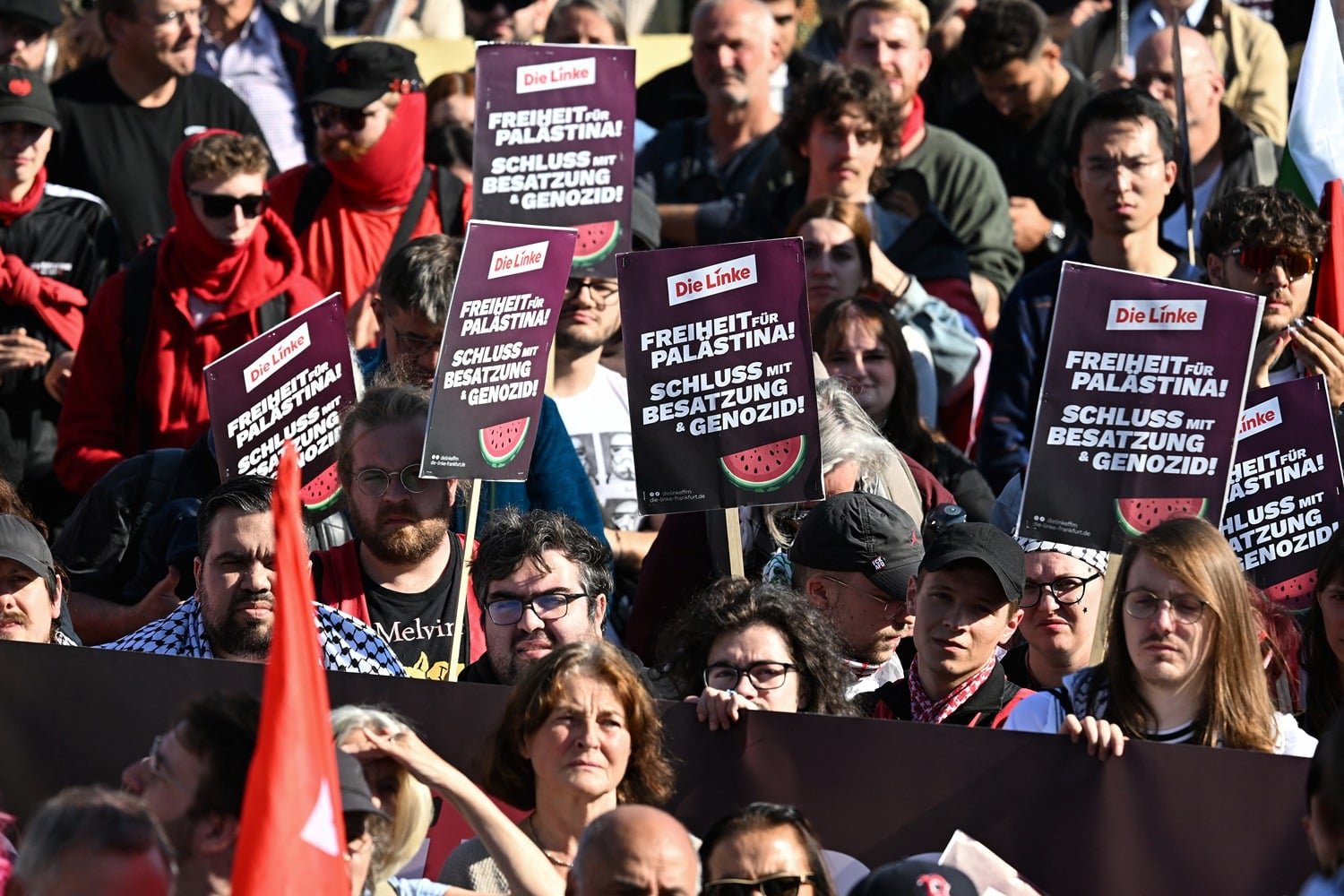
No party has done more to exploit this climate than Die Linke, the Left Party. The party has long lived under suspicion of antisemitic tolerance, ambivalence toward Israel, and a tendency to blur the line between anti-Zionism and hostility to Jews. After Oct. 7, those suspicions were borne out. A resolution adopted at the party’s recent Lower Saxony congress rejected “the currently existing Zionism” and accused Israel of genocide and apartheid while referring only obliquely to Hamas and omitting any direct mention of the Oct. 7 attacks.
Predictably, the backlash was severe, and included the resignation of one of the party’s antisemitism commissioners, Andreas Büttner. The incident showed that the problem was not simply external criticism but also internal contradiction. The party wanted to retain its credibility as an anti-racist force while allowing language that many Germans regard as antisemitic or at least politically toxic.
But this contradiction is not an accident. Rather, it reflects the party’s strategic position. Die Linke has become more attractive to younger voters, especially those who are dissatisfied with what they see as the caution or moral evasiveness of the Social Democratic Party, the Greens, and the Christian Democratic Union/Christian Social Union. It has also benefited from a broader left-wing political culture in which Gaza has become a defining moral issue. In that environment, the party’s leadership has tried to discipline its rhetoric without abandoning the energy that gives it electoral momentum. Before its June congress, the party’s federal executive has now, in its response to the Lower Saxony incident, stressed that antisemitism has no place in the party. While this might well be language of containment, the latter only works if the base accepts constraint.
And evidence suggests the base is moving faster than the leadership. At a Berlin congress in late 2024, attempts to condemn Hamas and acknowledge left-wing antisemitism were diluted by amendments and factional infighting. At the federal congress in Chemnitz in May 2025, the party voted to adopt the Jerusalem Declaration on Antisemitism rather than the International Holocaust Remembrance Alliance definition used by the German government and most major institutions—a choice that reflected a political preference for a narrower standard that leaves more room for harsh criticism of Israel.
Even party figures such as Bundestag Vice President Bodo Ramelow have acknowledged that pro-Palestinian slogans now have significant traction inside Die Linke. That is important not because Die Linke is about to govern Germany but because it has become a pressure system, one that pushes the Overton window on Israel without immediate political penalty.
Its recent resurgence makes that pressure all the harder to ignore. After appearing electorally moribund in 2024, the party has regained momentum. Polls now put it around 11 percent, slightly above its 2025 federal election result. Membership has doubled over the past year and now reaches roughly 123,000, with an influx of younger voters and people with migrant backgrounds who are deeply engaged in pro-Palestinian politics.
Parties, among other things, are institutions that absorb new social coalitions, and as Die Linke changes internally, its stance on Israel is likely to harden, not soften.
The larger question is what this means for Germany’s status quo.
The answer begins, in part, with the far-right Alternative for Germany (AfD), which has managed to recast itself, particularly to international audiences, as a defender of Israel and a guarantor of Jewish life in Germany. However, this positioning sits uneasily alongside elements of the party’s rhetoric and personnel, and it is best understood not as an ideological shift but as a strategic maneuver. By framing support for Israel as part of a broader opposition to Islam, the AfD constructs a binary that allows it to claim moral legitimacy, attack domestic rivals, and deflect scrutiny from controversies surrounding extremism within its own ranks. The Central Council of Jews in Germany considers the party to be a threat and antisemitic, nonetheless.
Meanwhile, both the Social Democratic Party and the Greens are under immense electoral pressure, which is unlikely to lead to immediate policy defection but will rather prompt gradual rhetorical migration. It is a dynamic that reflects a familiar pattern in fragmented parliamentary systems. As electoral competition intensifies and voter blocs become more volatile, centrist parties adapt not by immediately shifting policy but by recalibrating rhetoric to preserve coalition flexibility. Positions that originate on the fringes are not adopted wholesale, but they can be partially internalized to prevent voter leakage and maintain governing viability.
This matters even more because Germany’s governing coalition is not in a commanding position. A modest Bundestag majority leaves little room for political slack, especially on issues where coalition discipline can be tested. In that environment, even small shifts in the rhetoric of opposition parties can have outsized effects. They influence how ministers frame decisions, how backbenchers talk about policy, and how quickly hard positions can be abandoned after crises. Berlin will not suddenly turn hostile to Israel, but it may become less predictable, more conditional, and more vulnerable to domestic swings.
Such uncertainty carries consequences beyond Germany. For Israel, it means that one of its most important European partners is becoming less reliable as an unconditional shield. For Europe, it means that a country long regarded as the moral anchor of postwar pro-Israel politics is entering a period of greater ambiguity. And for Germany itself, it raises a larger question about the durability of its postwar identity.
The language of Staatsräson still exists. The moral burden of history is still invoked. But the practical meaning of both has become more conditional, more contested, and more exposed to domestic political calculation. That does not mean that rupture is inevitable. But it might well mean that the old certainty is gone.



