
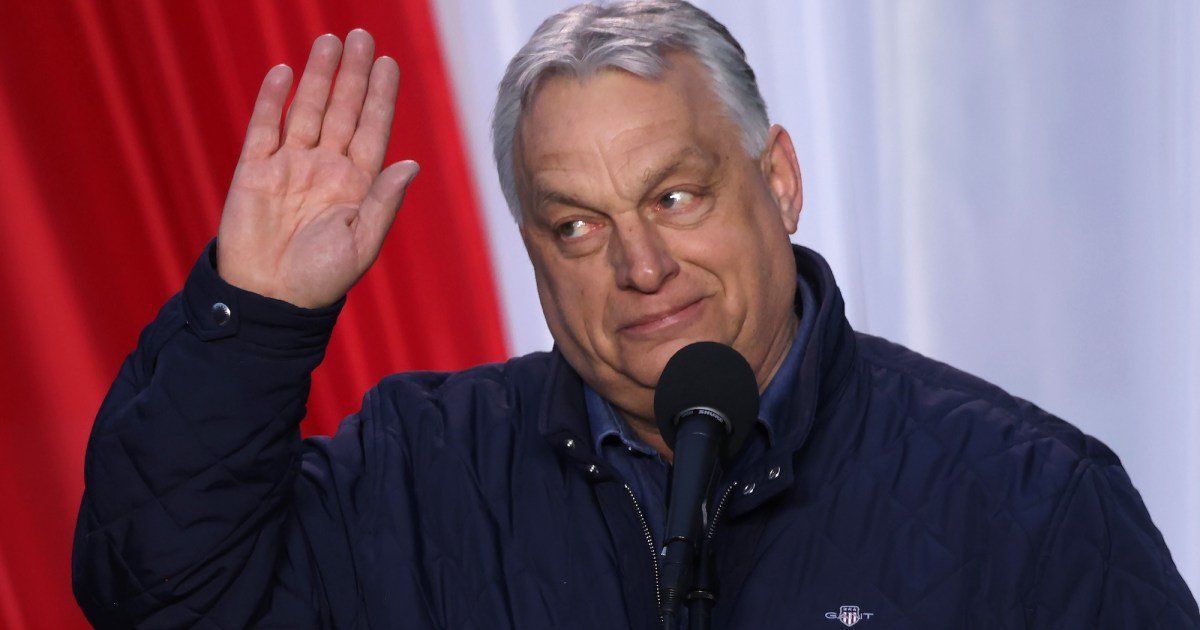
Viktor Orbán gestures as he speaks to voters at a campaign rally in Székesfehérvár, Hungary, April 10, 2026.Sean Gallup/Getty
Hungary’s much-watched national election—a competition between Trump and Putin-aligned authoritarian Prime Minister Viktor Orbán and centrist opposition leader Peter Magyar—has ended with a devastating rebuke to the right-wing leader. Orbán conceded his party’s defeat before midnight today.
Already sixteen years in power, Orbán was looking for another four-year term and a renewed majority for his hard-right party, Fidesz. Instead, Magyar appears to have clinched a clear win for himself and a two-thirds parliamentary majority for the opposition party Tisza.
My colleague Marianne Szegedy-Maszak covered the race, its outsized implications, and the quest of “one of the most successful populist strongmen of the 21st century” to save his career in a comprehensive piece this week—just updated to reflect Magyar’s win.
For Hungarians, this election is existential, and exhausting. A pervasive sense of anxiety permeates conversations in social media and within families, and even casual interactions are charged. Hungarians have faced the complete Fidesz takeover of traditional media channels, and turned to Facebook and alternative media channels, which are abuzz with conversation, debate, and sharing of insights—or the latest Fidesz outrage. A friend in Budapest hinted darkly at a national curfew after the election, and one of my Hungarian cousins said her hairstylist was so spent that he planned to take Monday off to recover—as did her husband.
For many Americans, of course, Orbán’s Hungary is a miniature version of Trump’s US—indeed, in some ways, it may have served as a role model for MAGA in its crusade to dismantle democratic institutions and crucial elements of civil society. When Trump first ran for election in 2016, Orbán had already “built the wall”—in his case, an electrified razor wire fence constructed by prisoners—on Hungary’s southern border, attempting to staunch the flow of Syrian refugees who, to be sure, were more likely to use Hungary as a transit point than a final destination. This also allowed Orbán to declare a “state of emergency,” which has not been lifted since. Sound familiar?
Among its many implications internationally, the defeat is a public rebuke to Vice President JD Vance, who campaigned for Orbán during several days before Sunday’s election. And in at least one respect, Orbán—an erstwhile democracy activist—might be less autocratic than Trump: He’s already publicly conceded his loss.



