
New Jersey taxpayers spend hundreds of millions of dollars annually to cover the cost of health insurance for employees at big companies like Amazon, Walmart, and Target who are on Medicaid, a practice Gov. Mikie Sherrill said this week she wants to curtail.
On Tuesday, Sherrill unveiled a state budget plan that proposes to fine large employers with workers on Medicaid $145 million by charging these companies fees of up to $725 annually for every person covered by the public health insurance program.
Massachusetts operates a somewhat similar program, and the concept has been discussed elsewhere. It is largely opposed by business interests.
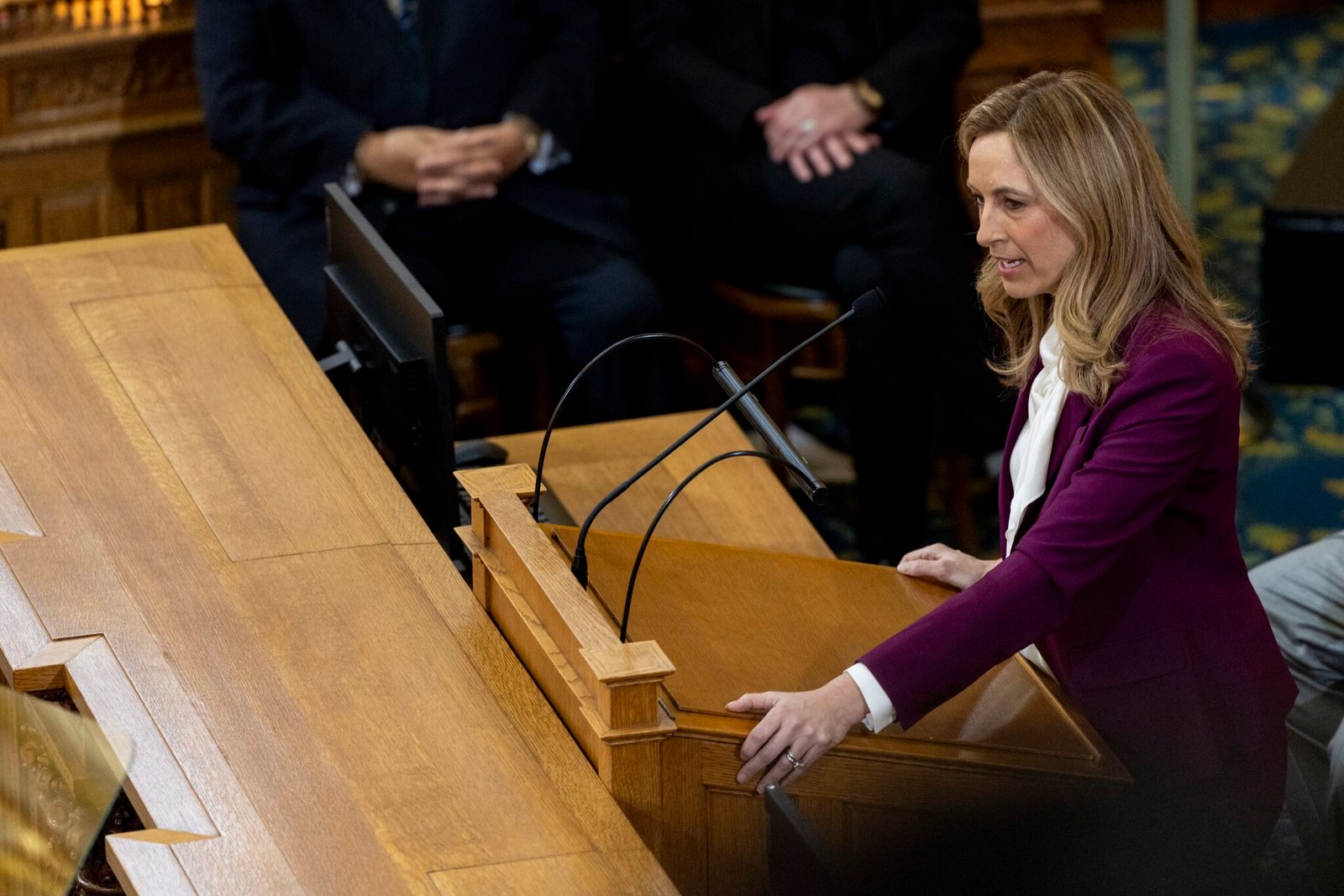
“Instead of asking taxpayers to foot that bill, this budget looks to large employers. It asks any company with 50 or more employees on Medicaid — companies like Amazon and Walmart — to cover their workers, which they should do anyway, or pay a fine,” Sherrill said Tuesday during her first budget address at the Trenton Statehouse.
Sherrill, a Democrat who took office on Jan. 20, said the plan would help “people who keep the economy running,” like warehouse workers, cashiers, and health care aides.
“It’ll reduce strain on the hospitals, easing the expected surge in E.R. care, the most expensive kind,” Sherrill said.
The extra funding is critical, Sherrill said, given changes the Trump administration has made to Medicaid that state officials predict will force more than 300,000 New Jerseyans off the plan and eventually cost the state $3.3 billion annually in hospital aid. Other federal funding changes have significantly inflated the cost of Obamacare policies, which experts said will leave even more people uninsured.
Under Sherrill’s $60.7 billion budget proposal – which now goes to state lawmakers for their review — New Jersey would spend a total of $28 billion next year on Medicaid, also known as NJ FamilyCare, with $7.2 million from state taxpayers. The program covers 1.8 million people, many of whom are disabled or in nursing homes.
Heather Howard, a Princeton University professor and former state health commissioner, called the corporate health care fee a creative and intriguing idea.
“It is based on the principle of shared responsibility: we all benefit from a healthy population and ensuring access to care. Given the draconian federal cuts we’re facing and the threats to the safety net, it’s not fair to expect individual taxpayers to shoulder the increasing burden of health care costs,” Howard told the New Jersey Monitor.
But business leaders immediately flagged the fee as a major problem.
“This is perhaps the most troubling part of the budget proposal for the business community,” Chris Emigholz, government affairs leader at the New Jersey Business and Industry Association, said in a statement.
Health care costs are a big problem for businesses, the group’s annual survey always shows, and Emigholz said the state should be looking for ways to incentivize employers to provide benefits, rather than penalizing them for relying on publicly subsidized plans.
Emigholz said the impact of Sherrill’s plan would be hard for businesses to calculate, since many don’t know how many employees are on Medicaid and some industries struggle with high turnover.
“Some employees actually choose not to work more hours so they can keep certain government benefits. And it creates a disincentive for businesses to employ part-time and seasonal workers,” he said.
According to a 2024 report from the state Department of Human Services, which oversees Medicaid, three months of Medicaid coverage for 382,000 people tied to 748 large companies cost $427 million, including $137 million in state funds. These employers include national retail companies, food service industries, and health care providers, among others.
The report lists Amazon as the largest employer of Medicaid recipients in New Jersey as of that summer, with some 5,600 workers and more than 10,000 family members covered through NJ FamilyCare. Walmart had more than 10,000 workers and beneficiaries on public health insurance at that time, Century II Staffing slightly more than 9,000, Wawa around 7,600, and Target some 5,200.
Efforts to reach Century II Staffing were unsuccessful. Wawa and Target did not respond to a request for comment.
The report also says that employees at 80 school boards and other government agencies and their family members – totaling nearly 26,000 beneficiaries — cost Medicaid close to $29 million during the three-month period, with $8.7 million covered by state taxpayers.
The governor’s office declined to say if her proposal would also apply to government agencies that depend on Medicaid for employee benefits.
In a statement to the New Jersey Monitor, Walmart said it is proud to offer workers a pathway from lower-skilled jobs to a longtime career. The company also offers low-cost insurance to most workers, it said.
“We also run a thin-margin business built on affordability. New targeted taxes raise system-wide costs and make groceries, essentials and pharmacy items more expensive for the very families these programs are meant to support. Strengthening Medicaid and public assistance requires sustainable funding solutions, not policies that single out employers investing in New Jersey workers and communities,” Walmart spokesman Jimmy Carter said in an email.
Amazon spokeswoman Eileen Hards told the New Jersey Monitor by email that the company recently announced a $1 billion investment to raise pay and lower health care costs for its warehouse workers and drivers. Health care coverage is available to entry level workers at minimal costs, she said, and the changes at Amazon will make health care more affordable for workers and their families, Hards said.
Dubbed the “employer healthcare assistance contribution,” Sherrill’s plan would in its first year hit between 700 to 750 companies who have 50 or more employees insured through Medicaid. These firms would need to pay a portion of these health insurance costs through fees that range between $325 and $725 per worker, depending on the number of workers enrolled on the public plan, or provide alternative coverage of their own.
“It is essentially a responsibility tax on employers that don’t offer affordable health insurance to their employees. It is worth exploring to raise money to support the cost of Medicaid or other state health care spending,” Linda Schwimmer, president and CEO of the New Jersey Health Care Quality Institute, a policy organization long focused on expanding Medicaid, told the New Jersey Monitor.
New Jersey does not force businesses to provide health insurance, but it does have an individual mandate that requires residents who earn more than a certain amount to pay a fine if they don’t have at least a basic health plan. Nationwide, more than half of the non-disabled, working-age adults covered by Medicaid and not caring for children work at least 80 hours a month, according to KFF, a nonpartisan health policy organization.
Under the pending Medicaid changes, some members will need to prove that they are working, volunteering, in school, or caring for a family member at least 20 hours a week starting next year. This group includes about 550,000 people in New Jersey.
A 2020 report from the federal Government Accountability Office identified Walmart and McDonald’s as the top employers of people using publicly funded programs like Medicaid and food stamps, also known as SNAP. More than 12 million wage-earning adults were enrolled in Medicaid alone, it found, despite working in the private sector, state and local governments, nonprofit organizations, or in academia.
GET THE MORNING HEADLINES.



