
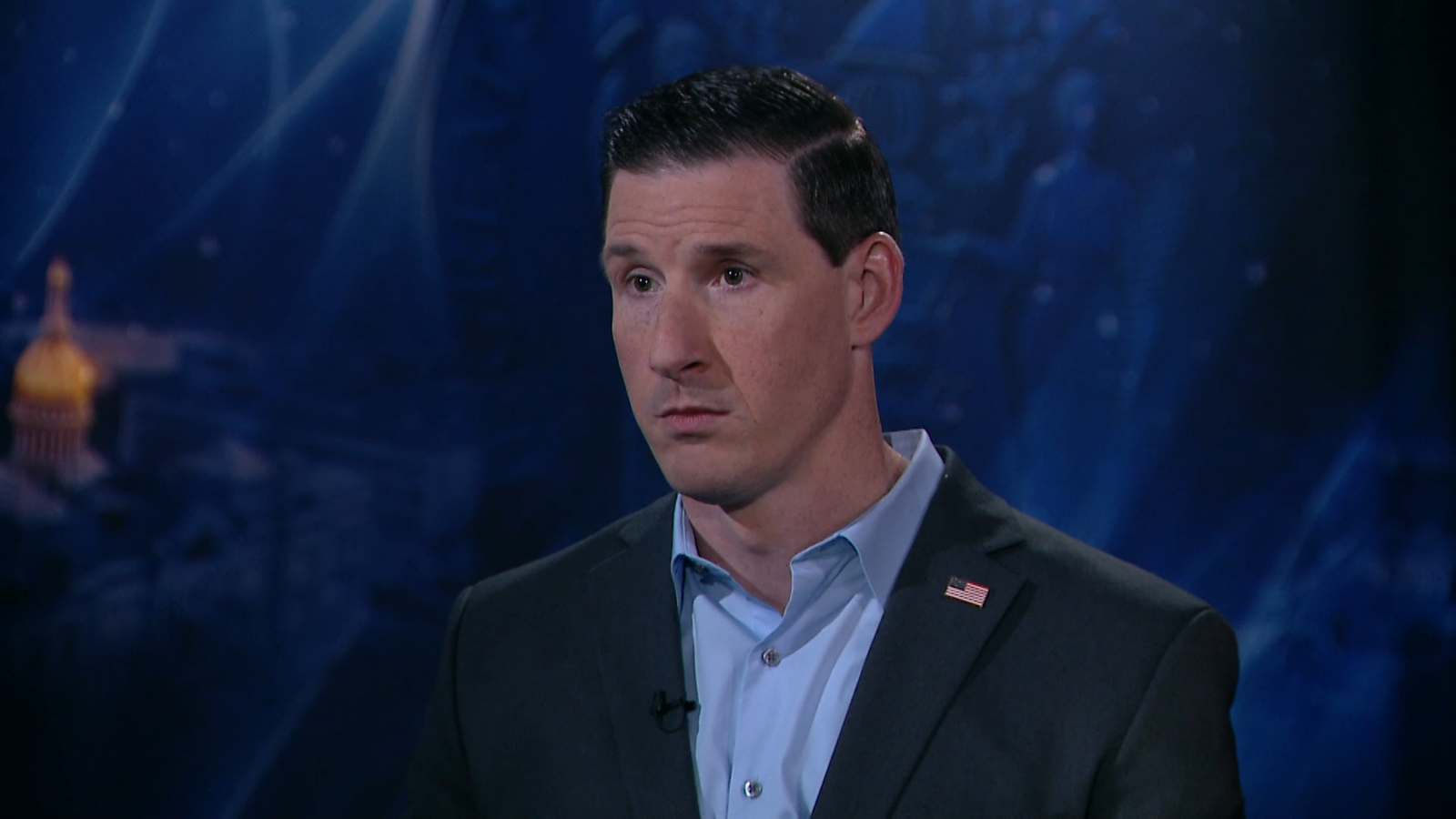
Republican Joe Hathaway and Democrat Analilia Mejia are the major party candidates running to fill the vacant seat in New Jersey’s 11th Congressional District, which includes parts of Essex, Morris and Passaic counties. Gov. Mikie Sherrill represented the district before resigning to serve as governor.
Sherrill was elected to the 11th District in 2018, flipping the historically red district to blue. Since then, the district was redrawn and it now leans blue, with registered Democrats outnumbering Republicans by more than 60,000 voters.
The winner of the April 16 special election will serve in Congress through Jan. 3.
Hathaway is a Randolph councilman and former mayor who served as an aide to former Gov. Chris Christie. In this interview with NJ Spotlight News, Hathaway shares where he stands on major issues — affordability, federal immigration enforcement, U.S.-Israel relations and more. This interview has been lightly edited.
‘Mayor’s mindset’ on affordability
Joanna Gagis, anchor: Why are you running to take over this seat in the 11th District?
Joe Hathaway: This race has been about, in a lot of ways, my dual role both as a mayor and councilman at the local level, someone who is familiar with the local issues that impact all of us in New Jersey, and also my role as a dad of three young children, a six-year-old, a four-year-old and a five- month-old.
I see in both of those roles what a lot of families, especially young families in our district, are dealing with when it comes to issues around affordability, whether it’s owning a home, paying the electric bill, paying for child care. We have an opportunity to send someone down to Washington who’s going to bring that mayor’s mindset of fixing things that matter to our residents, to lower costs and drive affordability.

JG: We heard the president talk about affordability when he was on the campaign trail. We heard Gov. Mikie Sherrill talk about it on her campaign trail. What would you do that’s different? How would you address this nationally for the residents here in New Jersey?
JH: Some of our big platforms are all around things like creating a tax freeze for first-time homebuyers to put money back in their pocket while they’re making that critical life change and planting their roots in their community.
We want to increase vocational training for young people that maybe don’t want to pursue a four-year traditional degree, get them in the workforce, drive our economy. And we also want to institute a child care tax credit to make sure that families that are having to choose right now between my career and my child don’t have to make that choice. These are common-sense things we can do to lower costs to drive affordability, not raise more taxes, to subsidize affordability falsely.
JG: You say they’re common sense. Do you believe that your colleagues in Congress on the Republican side see it that way? Do you think they would be on board?
JH: I think so. A lot of the ideas we’re putting forward are things that can work together in a bipartisan way to move the needle forward. That’s what we need in Congress. If we’re going to be leaders, we need to send common-sense, practical, independent-minded people that can work with anybody if it means getting something done for the people that we represent.
Immigration enforcement
JG: The last time we spoke, we talked about the Department of Homeland Security. That’s one of the headlines that’s been driving the news cycle because there’s so much that’s been happening here in New Jersey and across the country. DHS officers killed two American citizens on the streets of Minneapolis. At that time, I asked you if you believed that reforms were needed. Has your position changed? Do you call for reforms to the way that DHS is carrying out immigration enforcement in America?
JH: There’s a lot of common-sense things we can do to reform the way ICE is operating.
JG: Such as?
JH: Look at things like better technology, things like body-worn cameras, things like better training, de-escalation training. These are all things that we should be bringing to the table.
JG: Masks coming off?
JH: Masks coming off is absolutely part of the conversation as well. I would ask that my Democrat opponent here and that my colleagues on the other side of the aisle also come to the table with common-sense reforms on their side. In New Jersey our local police departments, our county police departments have no role to play in keeping people safe and keeping American citizens safe, especially ones who want to execute their constitutional right to protest.
JG: What do you mean when you say no role to play?
JH: Because of our sanctuary city laws and in states like New Jersey, our local police department can have no communication, have no knowledge about what’s going on with ICE. And when we see some of these tragic incidents happen, it’s when there’s no ability for our local police department to be able to ensure that citizens are practicing their right to protest safely. There’s ways we can both come together on both sides of this issue to make things safer. My opponent’s only answer for anything with this is to defund police at the federal level, state level and local level.
JG: Here in New Jersey, the legislation that’s being proposed, and that the executive order that the governor issued, require a judicial warrant before any arrest is made. Do you think that essentially identifies the sanctuary law here? Do you believe that a judicial warrant should be needed in these arrests?
JH: The warrant process, as it is, is pretty cut and dry, and it’s pretty standard for any kind of arrest in this type of situation.
JG: As of now, it can be an administrative warrant.
JH: Right. Correct. The bigger issue here with the sanctuary state law is the fact that our local PD doesn’t have a role to play. In Morris County, the sheriff’s office has what’s called the FAST team, the First Amendment Support Team, an organization that is literally built for situations like a protest, like a labor dispute where they can come in and help make sure that people are safe.
Right now, with the sanctuary city laws, they have no ability to know where ICE is, where they’re operating, how they can help. That to me makes no sense. And I don’t think it’s beneficial to the people of our district. When we have radical statements like let’s just abolish things, let’s defund police, that’s not keeping our family safe in this district. It’s a dangerous policy.
Roxbury detention center
JG: There is a lot of pushback, bipartisan. The Republican-led town council in Roxbury is pushing back, as is Governor Sherrill. They filed a joint lawsuit against this facility, a warehouse that was purchased by DHS to turn it into an immigrant detention center. Do you believe that center should move forward?
JH: I don’t. I know Mayor Shawn Potillo and the guys over in Roxbury. I know the infrastructure challenges that they have there, similar to what we have in many municipalities in this district. And when you don’t communicate and force these kind of major operations on a town that has challenges with water and sewer, that has challenges with land, challenges with overdevelopment, it’s going to be a burden on the community of Roxbury. I’m opposed to the way this thing has been pulled together. ICE has a very important job to do to get illegal criminals off of our street. I think they went about this in the wrong way.
JG: Do you agree overall with the president’s immigration enforcement and the way it’s being carried out in our country?
JH: It’s an important job. Most people in America want their streets safer. Most people in America want illegal criminals that are committing heinous crimes out of our streets and off our streets and out of our country. There’s some common-sense things that we should do to come to the table to make sure that we can really move the ball forward when it comes to DHS overall, because right now we’re getting hung up and we’re seeing DHS not be funded, the Transportation Security Administration agents not getting paid. These are things that are going to put Americans and New Jerseyans at risk in the long term. We have to come together to find a solution.
‘Antisemitic’ opponent
JG: You have called your opponent here a radical socialist. You’ve criticized her position on Israel. She has been critical of the Israeli government calling Benjamin Netanyahu a war criminal for his actions in Gaza. Do you think the U.S. should rethink its position on Israel, given what recently happened where we saw the top U.S. counterterrorism official exit his position last week saying that Iran posed no imminent threat to our nation?
JH: Not at all. We need to stand in lockstep with our allies in Israel and with our Jewish community here in the district. I can tell you as a mayor in Randolph, we have a strong Jewish community. I remember on Oct. 7th, 2023, about two or three days later, being with our Jewish community, trying to just wrap our heads around what had happened with the Hamas terror attacks.
Our Jewish community deserve someone who’s going to go to Washington and have their back. Where was Ms. Mejia at that exact same time? She was behind a keyboard, taking to Twitter, blaming the Israeli government for the attacks on Oct. 7th. Not Hamas terrorists. She is totally out of step with the people of this district, with our strong Jewish community. And our residents should be concerned with someone with that kind of rhetoric and ideology going down to represent them in Washington.
JG: She has said that your rhetoric against her has been dangerous and put her in dangerous situations. She told us that that is part of the reason why she didn’t want to debate you. She says that you’re calling her antisemitic and you have called her antisemitic. Is it fair to call someone antisemitic for being critical of a government?
JH: I think it’s fair to call someone antisemitic when they do things like blame Israel for the attacks on Oct. 7th. I think it’s fair to call someone —
JG: That’s a government, right?
JH: It’s fair to call someone antisemitic when they say that they don’t believe that Israel should have a right to exist in their ancestral homeland. I believe it’s fair to call someone antisemitic when they’re the only Democrat out of 11 who raises their hands and says, yes, I believe Israel is committing genocide in Gaza. Yes, I call her antisemitic because she takes antisemitic positions.
JG: Do you have any concerns after hearing this U.S. counterterrorism official, Joe Kent, saying that it’s clear that this war was started because of pressure from Israel and its powerful American lobby?
JH: This one is clear as day to me. We need to stand with our Jewish community. We need to stop normalizing rhetoric and behavior that that allows for antisemitism to be driven in our communities. We need to increase things like our security grants for houses of worship. We need to codify the definition of antisemitism, as the International Holocaust Remembrance Alliance urges. I stand in lockstep with our Jewish community in this district. I have as a mayor and I will as a congressman.
No Gateway as ‘pawn’
JG: Gateway funding is still uncertain. There have been many lawsuits. They have won in the courts. The fight to get the federal funding flowing again. But the Trump administration is still fighting. It looks like they could take it all the way to the Supreme Court. What’s your position there? You’ve been critical of the president in the past.
JH: This is something that is too important to the people in New Jersey. It’s certainly too important to the people of the 11th District — it’s a big commuter district into New York. So, look, yeah, I’ve been clear from day one. The president needs to move this forward.
This should not be something we play politics with. This should not be used as a pawn in some broader political game. It’s too many jobs. It’s too many commuters that I would represent in Washington. This role is to do exactly that. It’s to represent the people of our district before our party, before a president, certainly before a squad. And the voters of this district need to know that with me, they’ll have someone who always puts their interests first, no matter what.
Support for SAVE America Act
JG: Do you support the SAVE America Act, which would really change the way that people register for elections here in our country and quite frankly, make it harder for women in particular to register if they have had a name change?
JH: I do support it. This is kind of one of those 80-20 rules that most Americans think. It’s a good idea to have stronger integrity of our elections and stronger voter ID laws and rules. I really disagree that it’s an overall overly burdensome process for women who have certainly many instances where they have to deal with a name change on documents and things like that. But if we can take steps to secure our elections and to make Americans feel more confident, I think it’s a good thing.
JG: Some say that it disenfranchises voters. You don’t agree?
JH: No, I don’t. I don’t agree with that premise.
JG: How do you see your role if you were to be sent to Congress, working with Democrats, working across the aisle, or perhaps pushing back as you have in this conversation, where you don’t agree with Republicans?
JH: If Congress is going to lead, if Congress is going to retake its role as the first branch, we can’t do that by just standing in our corners and yelling and screaming about partisan positions. Congress leads by coming to the table, moving legislation and setting the tone and the direction for our country. I’m the only candidate in this race who can credibly say that they’re going to be doing that.
I’ve done it at the local level. We’ve worked with the Phil Murphy administration to get things done in Randolph. Being able to work across the aisle. You have to remember my opponent, she has built a platform around any old blue won’t do. So, not only is she unwilling to work with Republicans to get things done. She won’t work with moderates in her own party.
That’s not what we need to actually lead down in Washington.



