
In late 2025, Barbara and Robbie McBroom needed more than a new house. After the death of Robbie’s mother, the couple found themselves stretched across two households, caring for their nephew while trying to manage grief, legal matters, and the cost of keeping two homes afloat.
When Barbara, 76, suffered a fall, the precarity of their situation became impossible to ignore. They needed one home where the family could live together.
However necessary it was, the move still seemed impossible. They needed to find a bigger house closer to family, but they also needed to find a way to afford one in a market where even the most essential moves can be blocked by high prices, limited savings, and steep upfront costs.
Luckily, the McBrooms had an edge: Thanks to Robbie’s service in the Navy, they were eligible for a Veterans Affairs loan.
At a time when affordability barriers are delaying or derailing homeownership for many Americans, VA loans can offer eligible buyers a different path in, with no down payment required and more lenient underwriting.
That matters not only for buying a home, but also for staying on the wealth-building timeline that homeownership sets in motion, a new report from Realtor.com® finds.
The McBrooms’ story shows what that can look like in practice: A family using one of the country’s most powerful housing benefits to make a necessary move at a moment when conventional borrowing might have kept that move—and the security it provided—out of reach.
In today’s market, getting in is the hardest part
The same hurdles that made the McBrooms question whether they could buy in today’s market—like limited savings and incomes that have not kept pace with housing prices—are causing many younger house hunters to delay entering the market entirely.
Today, the median age of first-time buyers has hit 40, an all-time high according to research from the National Association of Realtors®. That delay can have a huge impact on future wealth-building potential, the report from Realtor.com finds.
Households that buy earlier have more time to build equity, benefit from price growth, and translate homeownership into higher net worth later on. Buying by age 32, for example, is associated with roughly 22.5% more net worth at age 50 than waiting another decade to buy.
The problem is that reaching that starting line has become much harder. Today, it takes almost a decade to save for the typical down payment. In 1990, it took just over three years.
But VA loans can help compress that timeline by removing the down payment hurdle entirely—and that’s having a big impact on young buyers.
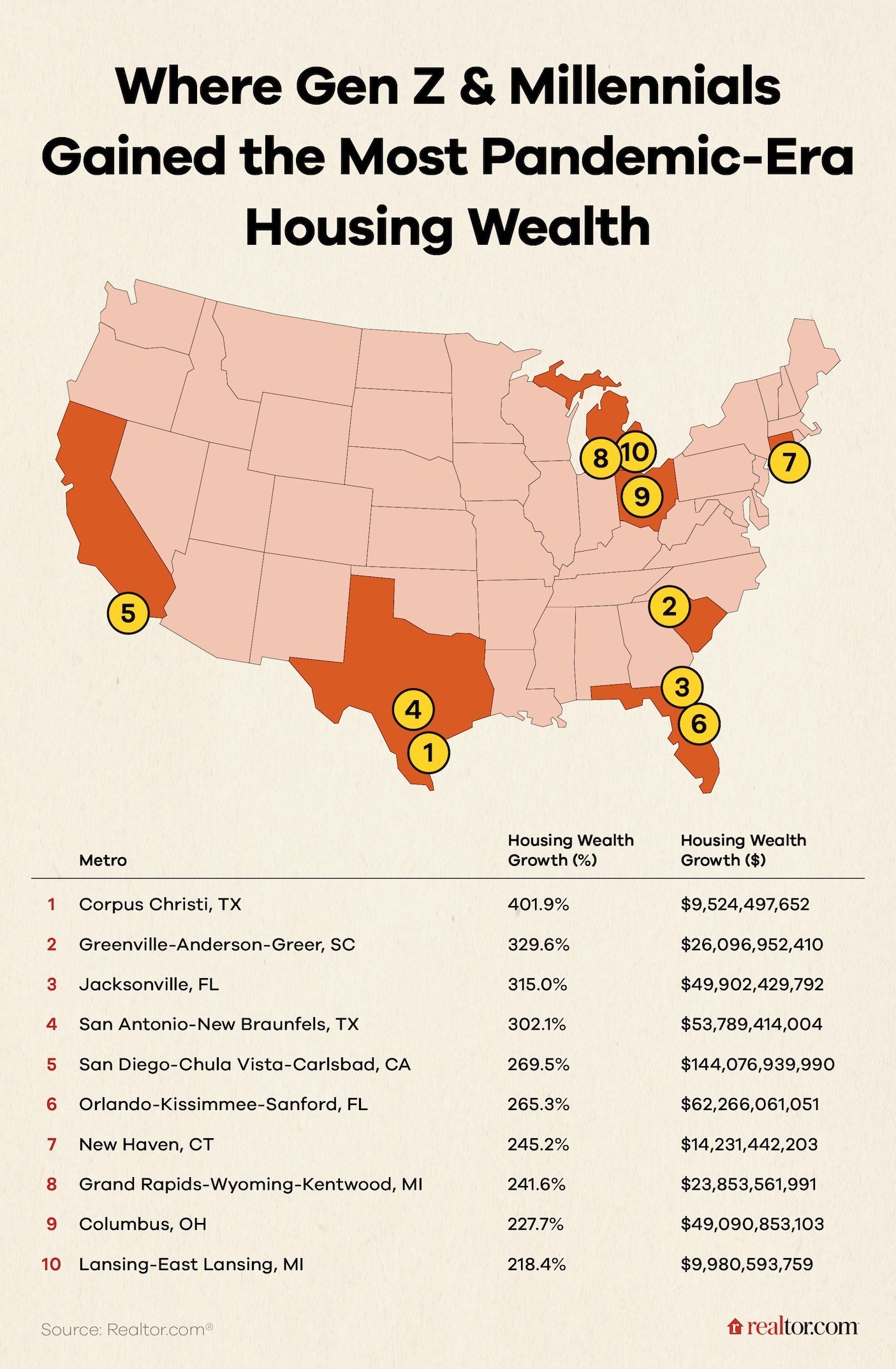
Of the 10 metros where Gen Z and millennial homeowners built the most housing wealth, five rank among the top 25 U.S. metros for Veterans Affairs loans issued per capita, research from Realtor.com shows—underlining what a powerful wealth-building tool VA loans can be.
In effect, this is the VA loan doing exactly what it was designed to do: unlocking homeownership for a segment of young buyers that might otherwise be excluded. And as the market remains punishingly constricted, the affordability VA loans provide is also offering much needed relief to older homebuyers on fixed incomes.
How the VA loan changed the math for this family
The McBrooms were well past the “buy early” window and already owned a home of their own. Even so, they were far from certain they could afford the larger house their family suddenly needed.
“It’s daunting when you sit there and look at the cost of a house nowadays,” Robbie tells Realtor.com.
The couple were living on a fixed income from Social Security and VA disability. They had built up some savings, but much of that cushion had been eaten up as they juggled two households. They had also been denied for a loan in Oregon in the past, leaving them skeptical that another attempt would go anywhere.
Then Barbara’s fall forced the issue.
“You actually go into it thinking, ‘well, you probably won’t get it, but it’s worth a try,’” Robbie says.
He had one reason to hope: Robbie had used a VA loan years earlier, and after repeatedly seeing ads for a VA loan provider, he urged Barbara to make the call.
“The VA loan is literally the best loan a person can have when they’re trying to buy a house, because there’s no down payment,” says Neil Brooks, a Phoenix-area real estate agent and Navy veteran.
Removing that hurdle alone can free up cash for closing costs or moving expenses. A VA loan can also offer a more accessible underwriting path than a conventional loan, helping some buyers qualify when they otherwise might not.
For the McBrooms, the difference was immediate.
Barbara says they were pre-approved for $450,000 the same day they reached out to NewDay USA, a VA loan provider. Less than a month later, they had closed on a home large enough to bring the family back under one roof.
Homeownership builds wealth, but it also creates room for family
“For the younger people, it’s about building wealth,” Brooks says about the affordability VA loans offer. “For the older folk, it’s more about security.”
It’s an important distinction, because the wealth-building power of homeownership is often discussed narrowly. Yes, it’s a story about appreciation, equity, and what a home might someday be worth. But it’s also about what ownership allows a family to do in the meantime: Consolidate resources, share care, and create a more stable base across generations.
It’s hard to overstate the difference that made for a family like the McBrooms. Their new home replaced two stressed households with one. It gave their nephew not only a bedroom, but also enough extra space for what Barbara describes as a man cave.
In other words, a VA loan did more than make the numbers work on paper; it gave them a way to act while their family was in crisis.
“That was another great thing about the process,” Robbie says, “because that took a lot of pressure off me over what was going on.”
And after months of strain, it brought the couple closer to relatives at a moment when illness, aging, and caregiving were becoming more central to daily life.
That, too, is part of the generational wealth story.
A home is an appreciating asset, but it’s also the physical infrastructure that allows families to support one another. It can reduce the cost and chaos of living far apart, make caregiving more manageable, and create a stable place for multiple generations to gather, recover, and plan.
Soon after the move, Barbara was able to spend time with her younger brother after a heart attack and other serious health issues. Family members gathered at the new home for a meal together—something that would have been far more difficult in their previous living arrangement.
That kind of stability is part of how housing creates wealth, too.
The McBrooms are not arguing that this market is easy. In fact, without the help of their VA lender, they don’t know what they would have done. But it’s an important reminder for those who are eligible.
“It is achievable,” Robbie says. “I think that’s the thing people need to know. It is achievable, and the process doesn’t need to be as hard.”



