
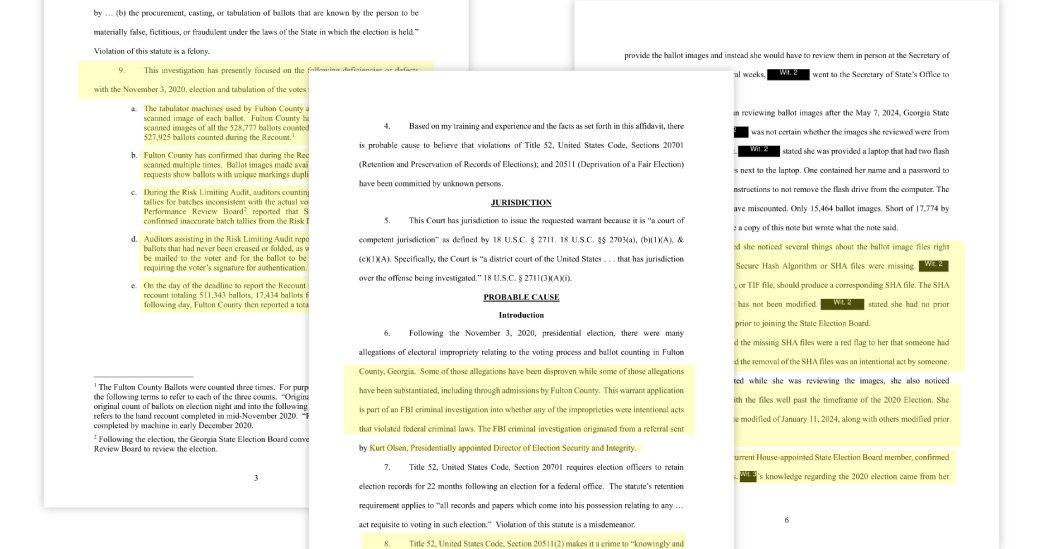
Our reporters analyzed the document, which showed how a criminal inquiry into the 2020 election in Fulton County, Ga., stemmed from a referral from an election denier who works in the Trump administration.
New York Times Analysis
Next »
1
This is the address of the election center in Fulton County, Ga., that the F.B.I. searched on Jan. 28, seizing ballots and other materials. The highly unusual and aggressive move raised questions about what the Justice Department, which has been newly politicized under President Trump, is doing to investigate the 2020 election. He has continued to falsely claim that his loss that year was tainted by widespread fraud.
2
Even though the search warrant was executed in Georgia, the federal prosecutor overseeing the election investigation is Thomas Albus, the U.S. attorney for the Eastern District of Missouri. It remains unclear why the Justice Department has assigned Mr. Albus to the case, but he is part of a conservative legal movement in Missouri that includes several other pro-Trump lawyers and officials, including Ed Martin, who until recently ran the Justice Department’s so-called weaponization working group, and Andrew Bailey, a co-deputy director of the F.B.I. who once served as Missouri’s attorney general.

New York Times Analysis
« Previous Next »
3
Fulton County officials have said that federal agents did not provide an inventory of what they seized, leaving local officials to estimate that roughly 650 to 700 boxes of ballots and other materials were taken.
But taking the ballots out of the election center and breaking open seals ruptures what is known as the chain of custody, meaning that it is no longer known who has had control of ballots nor what was done with them. This could undermine any potential findings.
New York Times Analysis
« Previous Next »
4
The F.B.I. agent who wrote the search warrant affidavit, Hugh R. Evans, has relatively little experience in handling high-profile criminal investigations. Mr. Evans’s former boss, Paul W. Brown, left his post as the special agent in charge of the bureau’s Atlanta field office shortly before the warrant was executed.
New York Times Analysis
« Previous Next »
5
This portion of the warrant introduces a measure of caution early on, indicating that investigators were aware that many false accusations had been made about the 2020 election. By focusing on “intentional acts,” it also suggests that election officials could have made inadvertent errors that do not rise to the level of a crime.
6
Kurt Olsen, who now works in the White House, was a lawyer who helped President Trump seek to carry out his wide-ranging attempts to overturn the 2020 election and even spoke with Mr. Trump on Jan. 6, 2021, the day the Capitol was stormed. The fact that the F.B.I. began its inquiry because of a complaint from him points to how deeply the White House was involved in the investigation. This is a historical departure: Many past presidential administrations took great pains to maintain the Justice Department’s independence.
7
Clark D. Cunningham, a law professor at Georgia State University, has argued that this document does not establish that anyone “knowingly and willingly” sought to deprive Georgia voters of their vote.
New York Times Analysis
« Previous Next »
8
None of the avenues of inquiry set forth in the warrant touch on potential foreign interference in the 2020 election. That omission appears to be significant because Tulsi Gabbard, the director of national intelligence — who was present for the Fulton County search and has asserted that she was sent by President Trump — has said that her involvement was authorized by her mandate to protect against foreign countries or individuals meddling in U.S. elections. Read more ›
9
In 2020, Georgia and Fulton County officials noted that, at the time, the law did not require them to maintain ballot images. More important, the physical ballots exist.
10
This complaint has been reviewed and investigated already by both the State Election Board and the Georgia secretary of state. An independent monitor contracted by the election board found that “poor records keeping led to a multitude of procedural problems” during the recount, but that this did not affect the 2020 result.
11
This was investigated by the Georgia secretary of state and addressed in a report in March 2022. The report said: “The purpose of the risk limiting audit is not to get a precise count, but to confirm the winner of the election, which it did. A precise count of over 5 million ballots by human beings in 159 jurisdictions is impossible. Humans counting will always produce errors.”
It added: “In Georgia, the difference was only 0.1053% in the number of votes cast and 0.0099% in the margin. These differences are well within the expected variances in a computer count vs. a hand count and further support the overall conclusion of the hand audit—that the initial reported result in the presidential contest in Georgia was correct.”
12
There are a host of reasons that a ballot might not be folded. Some overseas and military ballots can be printed and not folded. Ballots that are damaged or cannot be read electronically sometimes need to be duplicated, reprinted and reprocessed, and would be unlikely to have creases or folds.
13
This claim was investigated by the Georgia secretary of state and answered in a report in April 2024. The secretary of state’s office spoke to the Fulton County elections director, who said that some ballots had been scanned with identical tabulator and batch numbers, leading them to be initially rejected.
The county later rescanned those ballots, in the presence of representatives from each political party as well as a monitor from the State Election Board, and arrived at the final ballot total of 527,925.
New York Times Analysis
« Previous Next »
14
As election officials in Georgia have stated, missing ballot images do not mean that ballots are necessarily missing or fraudulent. There are a host of reasons for why a ballot image might be missing, including clerical error or inefficient workflow, which Fulton County has admitted occurred in 2020.
New York Times Analysis
« Previous Next »
15
This affidavit was unsealed after an order on Feb. 7 from Judge J.P. Boulee of the U.S. District Court for the Northern District of Georgia. The order states only that the names of “non-governmental witnesses” should be redacted. But here, the federal government redacts the name of a member of the State Election Board. “Witness 2,” in this case, is Dr. Janice Johnston, a retired obstetrician who is involved in the election-denial movement. On the day the ballots were seized, Ms. Johnston was overheard complaining to Fulton County officials that she could not reach the area where the search took place, according to David Worley, a Democratic former member of the election board, who was also on the scene. “But it’s our subpoena!” Ms. Johnston said repeatedly, according to Mr. Worley.
New York Times Analysis
« Previous Next »
16
An SHA is essentially a digital signature on a file, and election experts say that a missing one is not immediately a red flag. “The fact that they’re missing doesn’t mean that someone deliberately stripped them out and then made efforts to modify something,” said Pamela Smith, the chief executive of Verified Voting, a nonpartisan group focused on election technology.
17
As with other accusations in the affidavit, a modified file date does not necessarily indicate nefarious behavior. The file could simply have been opened recently.
18
Even though only the names of “non-governmental witnesses” were supposed to be redacted, here, the name of a member of the State Election Board was withheld. “Witness 3” is Janelle King, a Republican who was appointed by the Georgia House of Representatives in May 2024.
New York Times Analysis
« Previous Next »
19
Both state and county officials have repeatedly stated that physical ballots, and not ballot images, are the final arbiter in an election, including in any dispute. And the hand recount of the physical ballots in the 2020 election confirmed the result.
New York Times Analysis
« Previous Next »
20
Concerns over the way these tapes were handled erupted in December, when a lawyer for Fulton County acknowledged to the State Election Board that a number of tabulator tapes had not been signed. But Brad Raffensperger, the Republican secretary of state, said that the problem amounted to a “clerical error” that “does not erase valid, legal votes.”
The issue has engendered a hot debate among conservatives. Elon Musk, on his social media site X, said it was proof of “massive voting fraud.” The Wall Street Journal editorial board sided with Mr. Raffensperger, writing that the error “isn’t a reason to throw out tens or hundreds of thousands of ballots cast by Georgians who did nothing wrong.”
New York Times Analysis
« Previous Next »
21
Tabulator tapes “are merely back up documentation for the paper ballots tabulated by the precinct scanner,” an investigator for the secretary of state wrote in a report in April 2024. The report added that any “assumption that because tabulator tapes have not been produced then the paper ballots themselves are unaccounted for is simply incorrect.”
22
Clay Parikh is part of a network of activists who have sought to promote conspiracy theories about elections nationwide. He took part in Kari Lake’s failed attempt to reverse her defeat in the 2022 Arizona governor’s race. His appointment as a temporary employee of the executive branch suggests how tightly the Trump administration has embraced election deniers.
New York Times Analysis
« Previous Next »
23
These claims about “pristine ballots,” and many similar claims brought after the 2020 election, were previously investigated, including by the Georgia secretary of state, the Georgia Bureau of Investigation, the F.B.I. and other officials in the Justice Department, according to a Georgia official familiar with the investigations who was not authorized to speak publicly.
A report issued by the investigations division of the secretary of state in April 2023 said that “investigators could not substantiate the allegations of ‘pristine’ ballots being counted during the risk-limiting audit.”
New York Times Analysis
« Previous Next »
24
Here, an official from the secretary of state’s office explains that it would be extremely difficult, if not impossible, to introduce duplicate or fraudulent ballots into an election.
New York Times Analysis
« Previous Next »
25
This is one of many examples of how a “pristine” ballot would legally exist in an election.
26
Test ballots are used to make sure that voting machines work, and are printed throughout the process to check for errors; this is not a sign of anything nefarious.
New York Times Analysis
« Previous
27
Trump allies had been in court for years trying to get ahold of these ballots. Indeed, before the F.B.I. seized the ballots, a state judge had made it plain that he was preparing to release copies of them. If that had happened, members of the public would have been able to see the ballots, allowing for the cross-checking of any claims that pro-Trump forces might make about them. But now that they have been seized as part of a criminal investigation, the public cannot see the ballots. And that has raised fears that an openly partisan Justice Department seeded with election deniers could manipulate them.
28
Some legal experts say that this “if … then” construction is telling. They say it suggests that the government has failed, in this affidavit, to establish the probable cause standard that the government must meet in order to perform a search. This standard is laid out in the Fourth Amendment to the U.S. Constitution.



