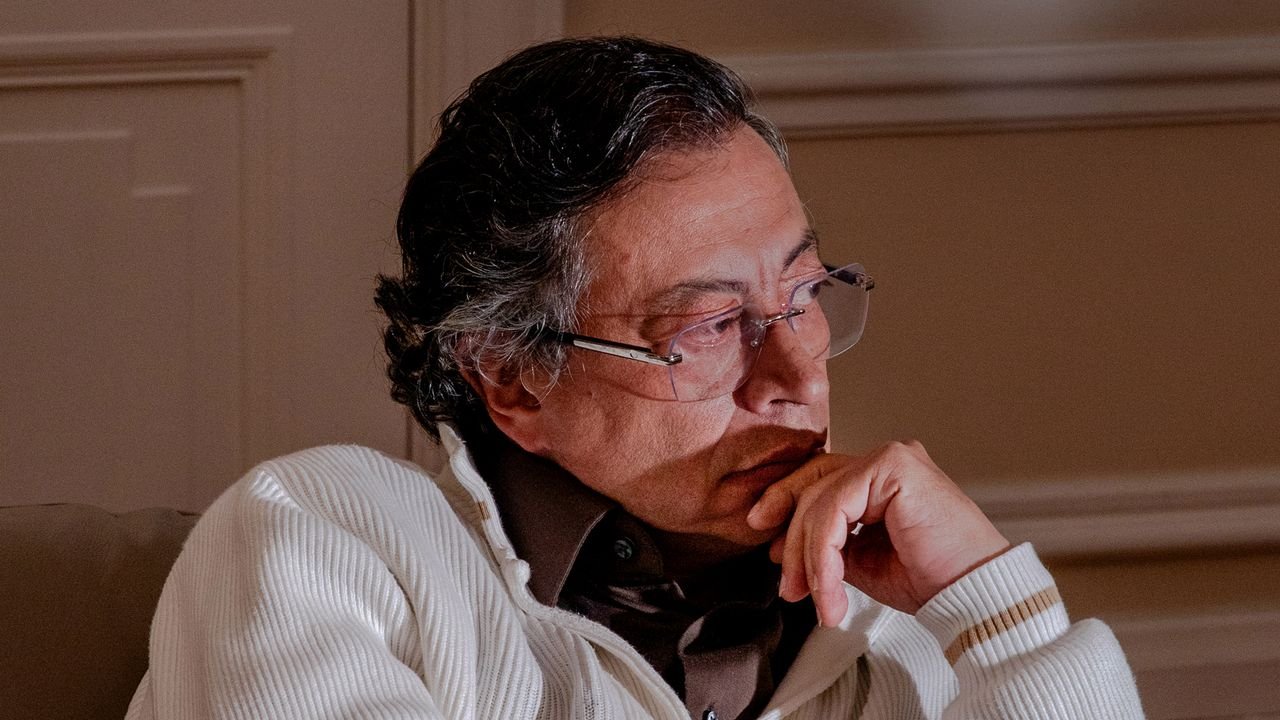
Before the recent call, Petro’s contact with Trump came largely in the form of trash talk online. “From the first day of Trump’s government, there was never any communication with us,” he told me. “If two Presidents don’t communicate, the governments fill that vacuum with another force.” At the start of Trump’s second term, the U.S. deported Colombian nationals in shackles on military planes, and Petro prohibited the aircraft from landing in Colombia. In a Twitter exchange that stretched on for most of a day, Trump ranted at Petro and threatened sharp tariffs on Colombian exports, while Petro likened himself to a rebellious, doomed hero of Gabriel García Márquez’s “One Hundred Years of Solitude.”
Petro finally assented, after several former Colombian Presidents offered to help smooth things over, and the relationship calmed down. But the episode prefigured Trump’s dealings with leaders of other nations, from Canada to Panama. “I thought all the Presidents were going to do the same,” Petro said, recalling his initial defiance. Instead, they mostly chose to appease the U.S.
The recent call came about at the urging of Senator Rand Paul, of Kentucky. The timing was not auspicious. The night before, Petro had gone on X to reject accusations that he was involved in narcotrafficking, writing, “The title that Trump assigns me as an outlaw of the drug trade is a reflection of his senile brain.” But Petro told me that Trump had struck a light tone when they spoke. “He didn’t want to get involved in substantive discussions,” he said. “He simply wanted to build communication.” When Petro insisted that the accusations of his involvement in the drug trade were false, Trump was solicitous: “He said, ‘You’re surrounded by lies, just like me.’ ”
Affinity will go only so far. In the forthcoming meeting in Washington, Trump is likely to insist that Colombia offer coöperation on immigration and natural resources, two areas in which he and Petro have strikingly different views. In Petro’s telling, right-wing politicians throughout the world have cynically used immigration as a wedge issue. “The fear of foreigners is the same as what existed in Germany regarding the Jews,” he said. “What it generates are far-right political proposals,” which “arise from fear and lies.”
An attendee looks on at the rally in Bogotá, on January 7th.
Trump is also likely to demand that Petro and Delcy Rodríguez take on the Ejército de Liberación Nacional, Colombia’s largest guerrilla group. The E.L.N. controls much of the border between the two countries, in addition to large portions of Venezuela’s interior—including the area where its valuable minerals are concentrated. The E.L.N. operated with Maduro’s approval, and is believed to have allies in the Venezuelan security forces. Trump’s intervention is unlikely to succeed unless the E.L.N. can be brought under control.
Petro told me that he wanted to offer Trump a deal. “I’m going to propose the alliance you want, but on the basis of clean energy,” he said. He recalled writing to Trump some time ago, proposing a “Pact of the Americas” to help solve environmental crises. Petro didn’t think that Trump read the letter, but he still hoped to make a persuasive pitch. “We would push the climate crisis further back,” he said. “It would be a service to humanity.” If that failed, he said, he would emphasize that he and Trump were aligned against narco gangs: “You don’t have a better warrior in Colombia against drug trafficking than me. Thirty-five per cent of the Senate ended up in jail thanks to me. I denounced the mafias that governed Colombia.”
It was not lost on Petro that Trump has withdrawn from every global initiative on climate change and conservation. “Trump’s vision is to seize oil, seize coal,” he said. He suggested that it was an inevitable effect of capitalist consumption. “The idea of private property has led them to think that oil and everything underground belongs to the landowner,” he said. “That doesn’t exist in Latin America. And when Trump says, ‘We took the oil,’ ‘They stole our oil,’ etc., those are phrases that are steeped in that culture.”
He suggested that the U.S. was dismantling the international system out of anxiety. “When the United States begins to fear losing global control to China, the desperation to control coal and oil reserves increases exponentially,” he told me. In Venezuela, where China is the largest buyer of oil, the competition between the two superpowers had become strikingly direct. If it wasn’t handled carefully, Petro said, “a world war will break out.”