
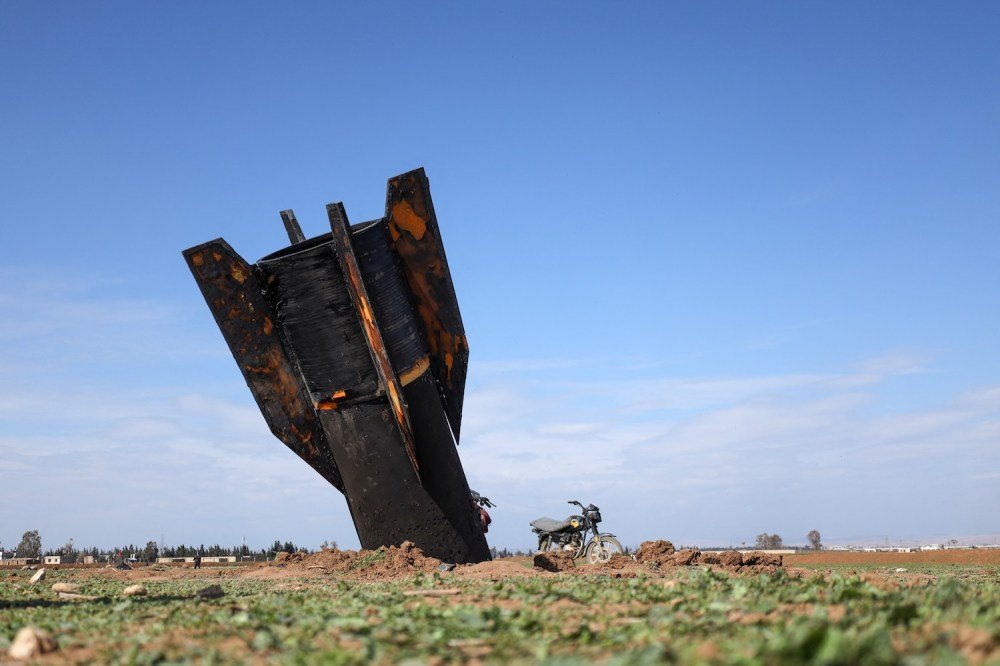
Just four years ago, Iran seemed to be consolidating and even expanding its position in the Middle East. Its proxies in Lebanon, Palestine, Syria, and Yemen had established themselves as organized military forces in their respective regions. Iran’s missile program appeared to be improving rapidly in both scale and technological sophistication. Meanwhile, Iran had increased uranium enrichment to 60 percent, bringing it within reach of weapons-grade levels should it decide to make that leap.
Today, the Islamic Republic is fighting for its survival. Israeli and U.S. warplanes are striking deep into its territory, dismantling the military that Iran has spent the past decade building. Most of its proxy forces—perhaps with the singular exception of the Houthis—are in shambles. Iran’s surface fleet has largely been sunk, its air force is effectively nonoperational, and its air defenses have proved to be incapable of stopping sustained attacks. The only force still capable of striking regional targets, its missile and drone arsenal, is under continuous bombardment as aircraft bomb the entrances to Iran’s so-called “missile cities.”
Just four years ago, Iran seemed to be consolidating and even expanding its position in the Middle East. Its proxies in Lebanon, Palestine, Syria, and Yemen had established themselves as organized military forces in their respective regions. Iran’s missile program appeared to be improving rapidly in both scale and technological sophistication. Meanwhile, Iran had increased uranium enrichment to 60 percent, bringing it within reach of weapons-grade levels should it decide to make that leap.
Today, the Islamic Republic is fighting for its survival. Israeli and U.S. warplanes are striking deep into its territory, dismantling the military that Iran has spent the past decade building. Most of its proxy forces—perhaps with the singular exception of the Houthis—are in shambles. Iran’s surface fleet has largely been sunk, its air force is effectively nonoperational, and its air defenses have proved to be incapable of stopping sustained attacks. The only force still capable of striking regional targets, its missile and drone arsenal, is under continuous bombardment as aircraft bomb the entrances to Iran’s so-called “missile cities.”
How did Iran’s position deteriorate so quickly? The reasons are numerous, but a key turning point was the realization by Israel and the United States some two years ago that Iran’s military capabilities, particularly its air defense and missile forces, are nowhere near as sophisticated as previously assessed. The failure of Iran’s missiles to deter the United States and Israel may ultimately lead Tehran toward alternative deterrence mechanisms, including nuclear weapons.
Before Iran’s first direct missile attacks on Israel in 2024, no one knew how effective Iranian missiles or Israeli and U.S. interceptors would be. There was some evidence suggesting that Iranian missiles could achieve precision effects at very short ranges in uncontested environments. In 2020, following the U.S. killing of Iranian Quds Force Commander Gen. Qassem Suleimani, Iran launched a small barrage primarily against Ain al-Asad Air Base in Iraq, then a major U.S. installation. No Americans were killed, though many were injured.
Iranian military leaders portrayed the strike as deliberately calibrated to avoid casualties while demonstrating precision capability. The commander of Iran’s missile forces, Gen. Amir Ali Hajizadeh (now deceased), claimed that in a real conflict, Iran could launch thousands of missiles, killing as many as 5,000 Americans within 48 hours.
But hitting Ain al-Asad, an undefended air base 175 miles from the border, was never a big challenge. The real test would come in 2024, when Iran attempted to strike Israel during True Promise I and II. In these operations, Iran fired hundreds of ballistic missiles toward a much more distant and heavily defended target. They traveled more than 1,000 miles, degrading their accuracy while also running the gauntlet of Israeli missile defenses.
The results for Iran were unimpressive. Despite attempts to attack the headquarters of the Israeli military and the reported headquarters of Israeli intelligence, Iran failed to destroy either due to a combination of inaccuracy and successful interception.
Perhaps the clearest evidence of the gap between Iranian rhetoric and reality was the performance of these missiles against Israeli military targets, especially airfields. In both True Promise I and II, Iran attempted to attack Nevatim Air Base in southern Israel. In True Promise II, it managed to land about 40 impacts on the air base, partly because Israel did not appear to heavily contest the attack with terminal interceptors.
Still, the damage was limited. The missiles scattered over a wide area, striking several buildings and one of many hardened aircraft shelters, but most missiles failed to hit significant targets. Much of the base remained intact and was quickly repaired. Then-Israeli Defense Minister Yoav Gallant described the attack as “aggressive but imprecise.”
The plethora of missile debris recovered in Israel also allowed the Israeli government and media to examine Iranian hardware in detail. A November 2024 investigation by Haaretz found that Iranian missiles were mainly made with poorly soldered, substandard parts, leading one missile analyst to ask if they were “toy missiles for kids.”
Israel’s response to these attacks, in contrast, demonstrated far greater capability. Israeli forces successfully destroyed Iran’s advanced radar for its Russian-made S-300 air defense system at a site deep inside Iranian territory. This operation foreshadowed what would follow in the 12-day war of June 2025 and the current conflict, where Iranian air defenses have failed to destroy a single crewed aircraft.
Had True Promise I and II demonstrated the ability to reliably penetrate Israeli air defenses and destroy specific targets en masse, Israel’s strategic calculus might have been different. If Iran had managed to destroy Israeli command-and-control facilities or proved its ability to destroy specific hardened aircraft shelters or other critical air base infrastructure at will—threatening Israel’s ability to conduct flight operations—then it is unlikely Israel would have been emboldened enough to start not one, but two separate wars with Iran.
But Iran failed to do either of these things. Instead, its missiles were revealed to be destructive yet clumsy weapons.
As a result, Iran’s ability to deter Israel from strikes on its territory has collapsed. Israel appears to have correctly concluded that a surprise attack, combined with layered missile defenses, could produce favorable military outcomes. While Iran continues to retaliate, it has so far failed to inflict a level of damage necessary to end the war, and strikes on Iranian territory continue.
It’s a situation that would have been unthinkable just a few years ago.
If the Iranian regime survives the coming weeks, it will face some difficult choices.
One option would be to continue investing heavily in its missile force. But this path could very well lead Iran back to where it finds itself now—vulnerable to continuous strikes designed to keep that arsenal as small as possible.
Iran does have other potential levers to pull. Its threat to target ships in the Strait of Hormuz has led to the de facto closure of the strait without all that much actual movement from Iran. But this threat has so far failed to deter military action, and Saudi Arabia’s construction of a pipeline leading to the Red Sea has allowed Saudi oil to bypass the blocked strait, blunting the closure’s effect.
Under these circumstances, doubling down on nuclear weapons may seem like a more attractive proposition to Tehran. This path would be extraordinarily difficult for both technical and political reasons. Iran would need not only to make a nuclear weapon in secret but also build enough of them that an adversary could never be truly confident that it had eliminated the entire arsenal.
Right now, Iran only has enough enriched uranium for about 10 weapons, which may not be enough against a determined attacker. None of this is necessarily out of reach, but it’s likely very difficult, considering the level of damage that Iranian nuclear facilities have taken over the past year.
In the past, Iran has only threatened to go down this path, seemingly deterred by the economic fallout from extreme sanctions imposed by the United States and Europe. In an effort to improve its economic standing, Iran cooperated for some time with the International Atomic Energy Agency (IAEA) and worked to strengthen its economic ties to Gulf countries.
All of that, however, is now out the window. Iran’s decision to break its IAEA safeguards agreement and terminate nuclear site monitoring, along with its drone and missile strikes targeting civilian areas in the Gulf, has triggered significant sanctions and likely permanently damaged its relations with neighboring countries. Continuing down the nuclear path will only exacerbate the economic challenges that Iran faces, potentially leading it to become an economically destitute pariah state in the vein of 1990s North Korea.
Yet, for the Islamic Republic, reestablishing deterrence has become a matter of survival. Given that it remains under intense bombardment, Iranian leadership may see extreme economic hardship as preferable to being left defenseless against the United States and Israel. After this war, Iran may emerge with a vastly different cost-benefit analysis than before, and it may conclude that far greater sacrifices are necessary to ensure its security.
In 1965, Pakistan’s then-Foreign Minister Zulfikar Ali Bhutto declared that his country would make a nuclear bomb even if it meant having to eat grass. The question now is whether Iran will reach the same conclusion.



