
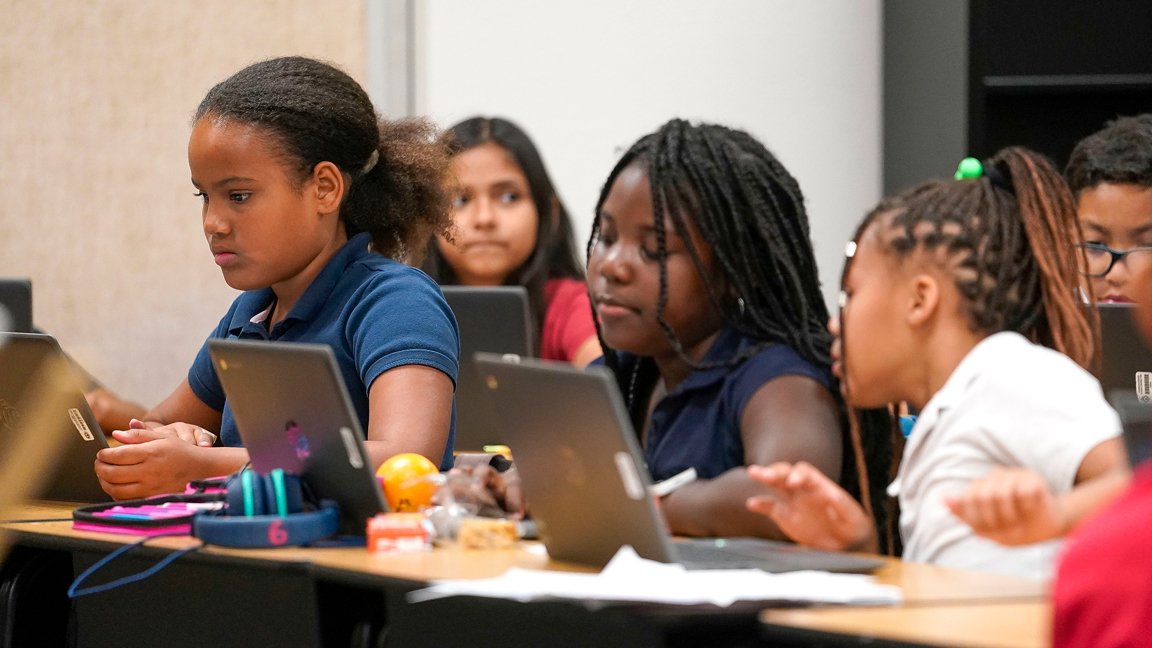
New Jersey’s public school students are on the brink of new curriculum standards designed to teach them how to spot misinformation, use artificial intelligence, protect online privacy and even build wealth.
Educators, in turn, will base some of these preschool and K-12 lessons on technology and “unplugged” activities, according to the latest New Jersey Student Learning Standards. Introduced last week, the standards are expected to be adopted at an upcoming state Board of Education meeting and will go into effect in about two years.

Department officials have proposed modernizing the statewide curriculum for preschool and subject areas for K-12 students, including career readiness, life literacies and key skills; science; computer science, innovation and society; world languages; and visual and performing arts.
“These are the standards that define the very beginning of a student’s educational journey and these proposed revisions are ones that have not come in front of this board in a long time,” Education Commissioner Lily Laux said of the proposed preschool curriculum updates, which were presented to the state school board last week.
In 2020, New Jersey became the first state to integrate climate change education across all nine subject areas. The updated standards would stress how human behavior is at the center of the phenomenon, for better and for worse.
“At this grade level students need to develop an understanding that people can make choices that reduce their impact on land, water, air and other living things,” said Lisa Haberl, executive director of teaching and learning services. “This positions them well in later grades to explore how climate change can affect those same systems.”
Statewide curriculum standards must be updated every five years, though the preschool version hasn’t changed since 2014. It comprises nine subjects, including English language arts, mathematics, social studies, and comprehensive health and physical education. The latter two are due for revision later this year.
Careers and finance
As part of the “career readiness, life literacies and key skills” curriculum, the revised standards include several approaches to pursuing college or joining the workforce, according to the proposal.
“The career-related standards now better emphasize practical skills such as labor market analysis, credential requirements, workplace safety and community participation,” the proposal stated.
The current financial literacy standards have three components — financial health, financial landscape and money management — that critics said lacked a useful, applicable approach. The new focus will be earning and spending, building wealth and learning financial protections.
“Earning and spending builds foundational skills for managing income and expenses, while building wealth develops understanding and actionable strategies for saving and investing overtime,” said Jorden Schiff, assistant education commissioner of teaching and learning services, during a presentation of the updates. “Lastly, financial protections focus on teaching students how to safeguard assets through insurance, fraud prevention and risk-management.”
Schiff added, “This revised progression more closely mirrors real-world financial decision-making.”
Information literacy
Students will learn how to analyze information sources for credibility.
“These standards reflect the critical importance of equipping our nation’s future leaders with the skills and knowledge they need to identify fact from fiction and accurately assess information,” Schiff said. “In a world where people are overwhelmed with information, students must be educated and empowered to critically evaluate the content they consume and make informed decisions.”
The proposed standards also address online awareness, so students understand how their activity is visible and has permanence, Haberl said at a recent state school board meeting.
A subject area called “computer science and design thinking” will become “computer science, innovation and society.” The proposed updates are “designed to help students build the skills they will need to thrive in an ever evolving tech-driven world” and for “students not just to use technology, but to shape and critically engage with it as active participants in a changing society,” Haberl said.
By the end of grade 12, students should be able to develop and refine computational solutions by designing, evaluating and translating algorithms, according to the proposed standards.
For an algorithms lesson, a teacher might have students create step-by-step directions to help a partner move across the classroom, If the “program” doesn’t work as intended, teachers could encourage students to test and revise their instructions.
Schiff said the standards were designed with “equitable access” in mind, because not all school districts will be able to provide AI tools to young learners. Kindergarten, first and second grades will be taught via “hands-on unplugged activities.”
For an algorithms lesson, for example, a teacher might have students create step-by-step directions to help a partner move across the classroom, Schiff said. If the “program” doesn’t work as intended, teachers could encourage students to test and revise their instructions.
“It ensures that all students, no matter their access to devices, can begin developing the logical thinking, problem solving and creativity that form the foundation for computer science and engineering in later grades,” Schiff said.
Preschool update
For English language arts, the emphasis will be on literacy and language to match the “science of reading” method that starts in kindergarten.
The 2014 standards for reading foundational skills in preschool stated that students should “follow words from left to right, top to bottom, page by page.” The revised standards state that students should “begin to recognize and understand basic concepts of print, such as direction of text, the difference between letters and words and how print carries meaning.”
Teachers could also pair fiction and nonfiction books to “help students explore ideas through engaging stories, real-world facts and vivid illustrations.”
The computer science component will recommend that teachers limit screen time to 30 or 60 minutes and to avoid granting screen time “as a reward for meeting curricular goals.”
Still, students should have opportunities to use technology as a foundation of learning literacy, according to the standards. One suggestion is for students to use a digital tool to ask about the weather, and then confirm the information with real-world observations.



