
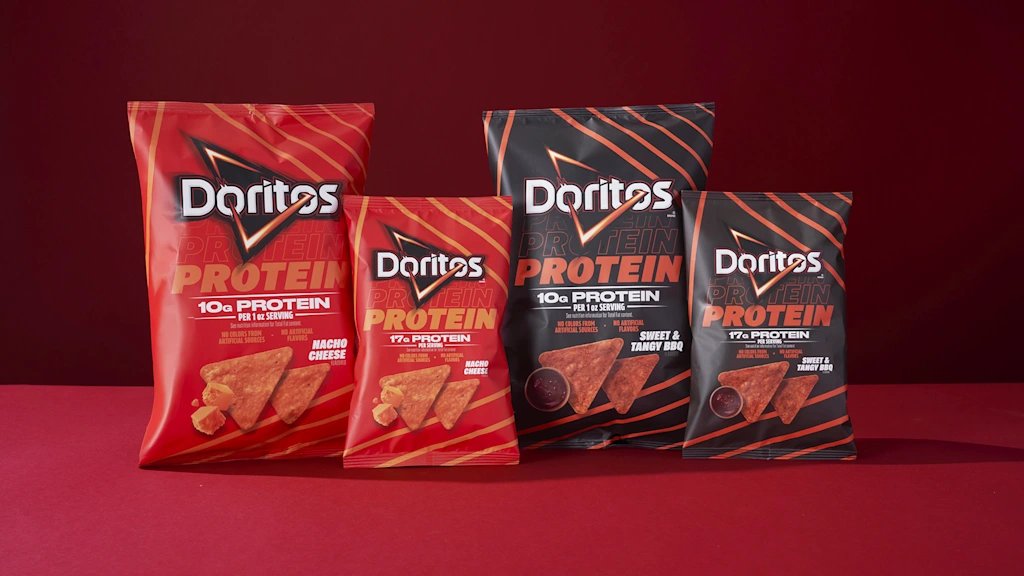
For the past several months, the food scientists at PepsiCo have been working overtime to dream up new products that meet young consumers’ health and wellness demands. First, there was a new Starbucks coffee protein drink. Then, there were dustless Cheetos. And now, the company’s latest innovation is Doritos Protein.
Doritos Protein launched in select retailers this month and come in two different flavors: classic Nacho Cheese and Sweet & Tangy BBQ. One 28 gram serving of these chips contains 10 grams of protein and 150 calories, compared to the meager two grams of protein in a 28 gram, 150 calorie serving of standard Doritos Nacho Cheese. And, unlike regular Doritos, Doritos Protein contain no artificial colors or flavors, relying instead on naturally derived ingredients.
Based on taste alone, though, you might not even be able to tell the difference between a standard Dorito and a protein Dorito. Jason Niermann, R&D senior director at PepsiCo Foods North American Snacking, says that was the goal.
“We tried dozens of protein snacks that were available in our market, and we did see a lot of trade-offs in products,” Niermann says. “They can be dry, they can be chalky, they can have off flavors. We knew that our consumers have a very high expectation on flavor and crunch. And, as a team, we really wanted to raise the bar on quality and hold ourselves to very high standards that we could be proud of.”
How PepsiCo is rethinking its iconic snacks
For PepsiCo, Doritos Protein fit into a growing portfolio of snacks and beverages designed to cater to an audience of wellness-obsessed consumers.
These innovations range from the new Pepsi Prebiotic Cola to SmartFood Fiber Pop, Quaker Protein oats, Sun Chips Fiber whole grain, and the aforementioned dye-free Cheetos. According to data collected by PepsiCo, 86% of Americans are actively looking to add more protein to their diets, while 70% want their salty snacks to contain protein—marking out a major opportunity for the company to protein-ify its iconic chips.
PepsiCo is also actively working to reduce its usage of artificial colors and flavors, in tandem with new initiatives from the Trump administration to phase out certain synthetic dyes. Right now, the company is testing natural alternatives to color its core products like Gatorade and Cheetos—a process that it expects to take several years. In the meantime, starting this year, all of the company’s new innovations in the U.S. will be made without artificial colors or flavors.
Niermann says designing Doritos Protein under these parameters presented a major challenge: recreating the look and taste of an original Dorito as closely as possible, while making several major tweaks to the recipe.
How Doritos got the protein treatment
Anyone who’s explored the existing protein bars, shakes, and snacks on the market knows that they have a laundry list of pitfalls. A chalky texture, artificial flavor, and bitter aftertaste are just a few of the issues that can arise when manufacturers try to pack a few extra grams into a protein-centric product. Balancing added protein with flavor is a challenge at the best of times—but working with a beloved snack like Doritos meant that Niermann’s team was under even more pressure to get the flavor spot-on.
The key to a successful protein Dorito, Niermann says, was finding the right kind of protein. His team tried plant-based proteins from ingredients like soybeans and chickpeas, as well as various different animal-based proteins. Ultimately, they landed on casein—the main protein present in milk and cheese—as the best-tasting option of the bunch.
“Some of the plant proteins can come with off flavors or notes that are just inherent in those raw materials,” Niermann says. “When you compare that with milk-based protein, we felt like it was a great compliment to delivering the bold texture of our product as well as flavor profiles like nacho cheese, which of course already has dairy in it.”
Once casein was selected as the protein product, PepsiCo’s food scientists needed to incorporate it into the actual dough used as the base of the Doritos. This was an intensive trial-and-error process that included repeatedly tweaking the ratios of other ingredients—like the Doritos’ core corn powder—to find the right combination.

“One of the specific challenges that came into account was the texture of the product and, how do you come up with a Doritos-worthy crunch when milk protein is the number one ingredient?” Niermann says. “And the secondary challenge was, also, how do you retain as many whole chips through the process so you don’t end up with a bunch of crumbs in the bottom of a bag?”
To address these challenges, Niermann’s team experimented with variables including the dough’s ingredients, the size of the chips, and the thickness of each individual Dorito. They seasoned the chips with natural ingredients, like cheddar cheese, buttermilk, and romano cheese, and colored them with add-ins including paprika extract and vegetable juice. Then, they called in a team of trained chefs, scientists, and engineers to sample the chip prototypes and evaluate them on a range of sensory qualities, like texture, taste, and smell.
Having sampled the Doritos Protein myself, I can attest that they’re probably the best-tasting protein snack I’ve ever encountered. If you presented me with the protein version and the original, I’d be hard-pressed to tell the difference (aside from just a slightly odd aftertaste). One important caveat is the macronutrient profile: Doritos Protein have a lower protein-to-calorie ratio compared to a competitor like Quest, which sells nacho cheese protein chips that contain 18 grams of protein in a 32 gram, 150 calorie portion.
Doritos Protein might not be the most “optimized” protein snack—but if you’re craving Doritos, you’re probably after optimization in the first place.



