
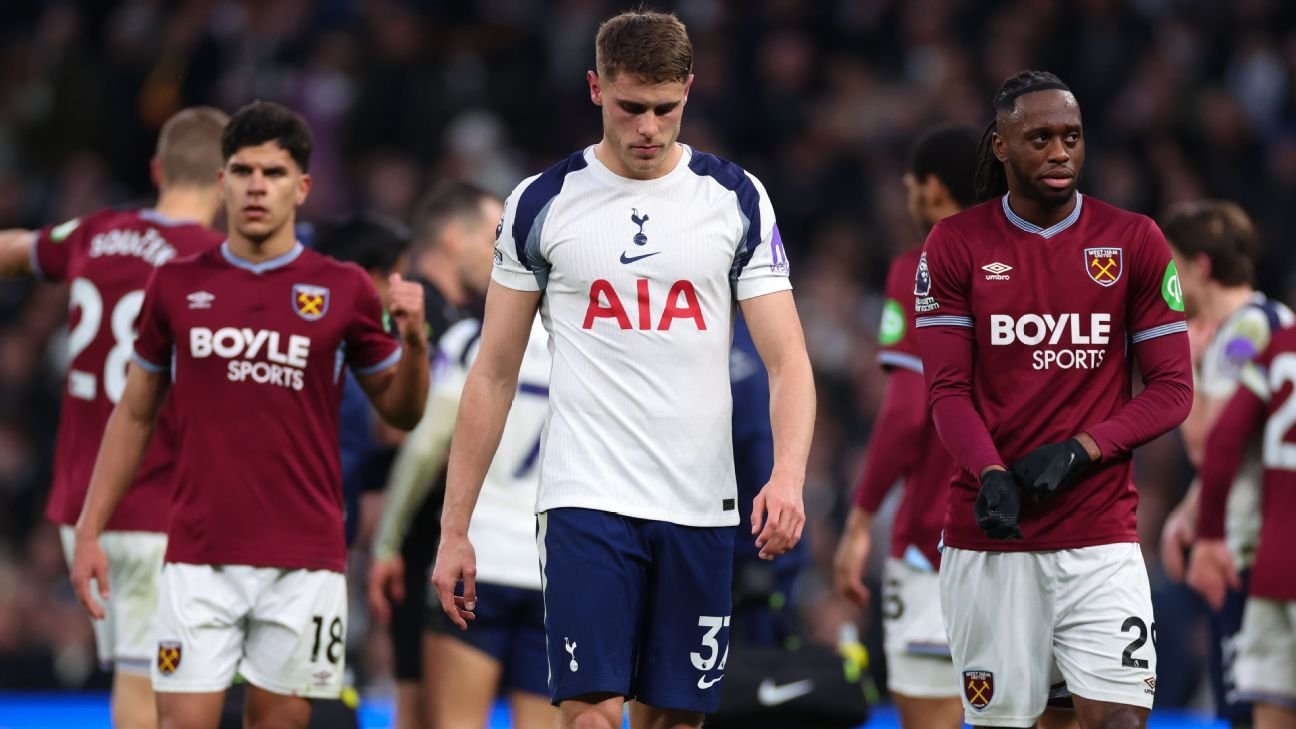
When you are fighting a battle against relegation, you know the end is close once you hit the 30-game mark and, if you’re not in good form, the pressure becomes greater and greater.
I know what it feels like: I was relegated twice from the Premier League as a player with Queens Park Rangers in 2013 and 2015 and was also part of the team that escaped relegation in 2012, so I have experienced at first hand just what it’s like to fight for survival in the final months of a season.
Players will carry the hope, but as time passes and results aren’t there, that hope fades, and the harsh realities of the sport appear. Soon, you get to a place where you don’t know whether you’ve already had your last win of the season. Maybe one of the teams in the relegation scrap won’t win another game this season. You just have to hope that team isn’t you.
If we accept that Wolves and Burnley are now in a hopeless situation at the bottom of the Premier League, there are four teams — West Ham United, Tottenham Hotspur, Nottingham Forest and Leeds United — who are locked in a fight to avoid the third and final relegation spot, and they each have seven games to make sure somebody else is relegated.
They will all have hope right now because there are still enough points to be won, but they will also be checking the fixture lists of their rivals, whether they play before or after their own team, and it’s unavoidable to try to predict how games will turn out and the impact those results will have on your team.
This weekend is a prime example of how it can all get into the minds of players at the bottom end of the table. West Ham, who are third-bottom right now, play Wolves at home knowing that a win will take them above Spurs before Roberto De Zerbi’s reign as manager begins away to Sunderland on Sunday.
The implications of Friday’s game are huge because of the ripple effect that comes with whatever the outcome might be. If West Ham win, then Spurs are suddenly in a relegation position, and they haven’t won a league game since December. They will have to go to Sunderland, who have a strong home record, knowing that they simply have to win if they are to climb out of the relegation zone.
But if West Ham don’t beat bottom-place Wolves, all of a sudden, there is less pressure on Spurs. That sense of relief is only fleeting, though, because the Spurs players will then realise the significance of a win at Sunderland and that brings a different kind of pressure — the type of pressure that comes with opportunity, not necessity.
2:05
Burley: De Zerbi needs to focus on fight, not football at Spurs
Craig Burley and Steve Nicol react to Roberto De Zerbi’s appointment at Tottenham.
It’s a tough place to be. Sometimes you get cut adrift, and if a win only means that you continue treading water, the pressure for some can become too much. I reckon that none of the Spurs players will watch West Ham’s game on Friday, but if they start to get messages from friends to say that West Ham are losing or the scores are still level at 80 minutes, then you can bet they will turn the TV on to watch because you want to feel a boost to your morale and belief that you can survive.
That situation is a lot like you would imagine: There will be a sense of nervousness and some players saying they can’t turn it on. Someone else will try to command a sense of control and say the game on TV doesn’t matter, that it’s “in our own hands anyway.” But of course it matters. Any player who says, “I don’t look at the league table. I just try and focus on what we’re doing,” I think in some ways that’s disappointing because I want someone to feel the emotion of being where you are at this moment in time.
All of the clubs in the relegation battle are looking for some kind of spark that will turn into positive momentum that takes them away from trouble. Yet, none of the four teams fighting to avoid relegation are enjoying any kind of momentum right now.
Spurs still haven’t won a league game in 2026 — an incredible stat — and Leeds are without a win in six league games. Forest’s win at Spurs in their last game was their first win in eight, while West Ham, for all the talk of their revival under manager Nuno Espirito Santo, have won just once in six league games and are still in the bottom three.
When we stayed up at QPR in 2012, our spark came from the January signing of former Liverpool striker Djibril Cisse. He was an obsessive goalscorer, and he netted six times in eight league games for us, including an 89th-minute winner against Stoke in the penultimate game that took us out of the bottom three going into the final weekend of the season and our infamous game at Manchester City.
We beat Liverpool, Arsenal and Spurs at home during the final 10 games of the season, and it meant that we stayed up, a point clear of the bottom three.
We didn’t enjoy the same run the following year, though. We finished bottom, and it was clear by late February that we were in a situation that we couldn’t get out of, and we failed to win any of our last nine games.
That’s when the hope disappears: You get to a point where there has been a separation from the rest of the teams you’re supposed to be fighting against, and even a win doesn’t make a difference. Our season was summed up by a game at Reading in April when we both had to win to keep our survival hopes alive. We drew 0-0, and both of us were relegated.
West Ham, Spurs, Forest and Leeds are not doomed just yet. They are now in a mini-league in which three of them will be successful. It’s a matter of perspective — the odds of being relegated are actually quite small.
Things can change so quickly at this stage of the season. If Forest and Leeds win this weekend and West Ham and Spurs both fail to do so, the separation starts to be visible, and it then boils down to two teams in real trouble.
The people who feel it the most are the players: the nervousness, the pressure and, most of all, the hope.
Nedum Onuoha was speaking to ESPN senior writer Mark Ogden



